The changing landscape of palliative care: #ANZSPM16 conference Sept 2016 Perth

Getting excited about heading to the Australian New Zealand Society for Palliative Medicine conference in September in Perth. With Melbourne’s frigid weather, the thought of a flight to sunny warm Perth in Spring has to be attractive. But more than that, the topic of how palliative care is changing in the 21st century is fascinating.

Continue reading

A death in the family

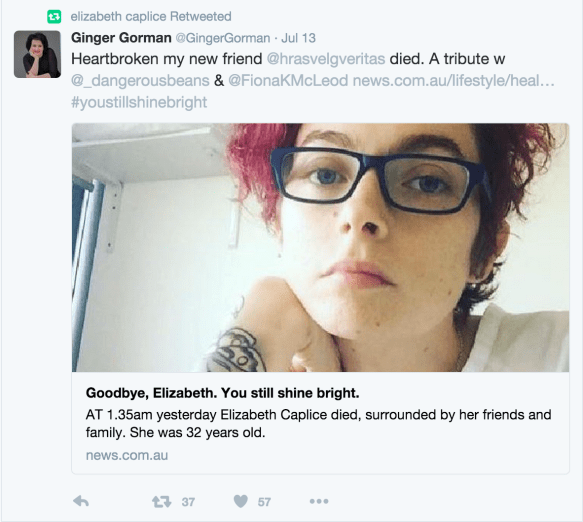
It was with great sadness that we learnt that Palliverse contributor Elizabeth Caplice had died.

Screen Shot 2016-07-14 at 22.12.09

Screen Shot 2016-07-14 at 22.12.28

Click here to read Ginger Gorman’s report.

Thank you Elizabeth for your contributions to Palliverse, and for your advocacy for Palliative Care.

Thank you for trying to make the world a better place.

We’d like to extend our deepest condolences to Alex and your loved ones.

Rest in peace Elizabeth.

James Jap on behalf of the Palliverse community.

Victorian end of life and palliative care framework

The Victorian government has released the long awaited end of life and palliative care framework. The framework aims to deliver care where and when people require it and ensure people from all walks of life can determine what happens to them at the end of their life. It recognises that palliative care services alone cannot meet the growing demand that our society will require for care in the final stage of life.

Continue reading

Annie’s Story

Palliverse is excited to welcome a  Guest Contributor – Molly Williams – who shares with us “Annie’s Story” ahead of our #PALLANZ tweetchat on paedriatic palliative care (#pedpc) this Thursday 30th June at 7pm AEST.

Molly Williams

Pictured: Dr Molly Williams

Molly is a paediatric oncologist now in the last 6 months of training in paediatric palliative care. She has a particular interest in supportive care in cancer – the idea of creating a culture of concurrent curative and palliative cancer management & giving kids the best chance of cure while not sacrificing their quality of life fills her with enthusiasm & glee! She has a personal fascination with positive psychology and creative anachronisms, and makes her own beer, cheese and tonic water!

Hope you can join us at #PALLANZ  on Thursday to chat about many more stories like Annie’s. If you would like to share your story with our community, email us at palliverse@gmail.com

@AnnaLCollins


Annie’s Story, As Told By Her Doctor

By Mollie Williams

This is a story about working in paediatric palliative care. It is all about Annie, which is not her real name actually but it is a perfectly true story apart from that. Continue reading

Upcoming #PEDPC #PallANZ Tweetchat

Palliative Care Needs of Children & Adolescents

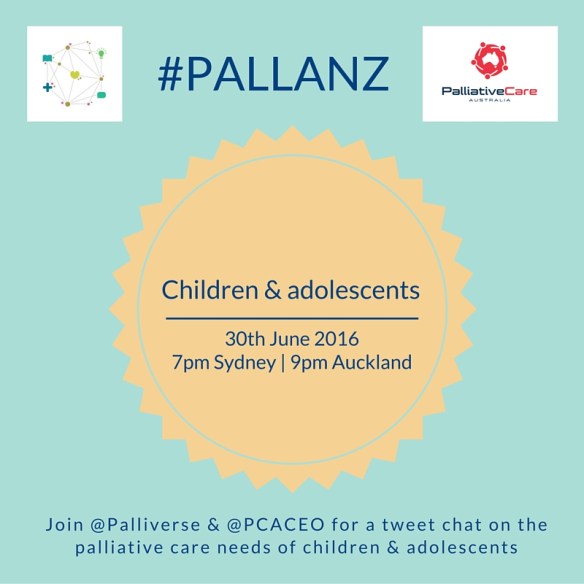
This month, we are excited to explore how palliative care can help to support young people in our community living with serious illness! Our upcoming #PALLANZ tweetchat to be held at 7pm (AEST) on Thursday 30th June will discuss topics related to the palliative care needs of children and adolescents and their families. We will also be featuring some guest blogs from new Palliverse Contributors working with young people in Paediatric Palliative Care (#pedpc).

During our #PALLANZ tweetchat, we hope to bring together those interested to talk about how a kid’s #pedpc service can help young people with serious illness to live well; when a young person might meet the #pedpc team; and where they might like to receive care. We’ll also imagine we have a magic wand able to do anything we want to improve the available supports and share these ideas and other helpful resources!

PallANZ 201606

Continue reading

Planning care for people with dementia

CjRDzR9UUAQ9woR.jpg-large

Two new resources are now available to help with planning care for people with dementia. Palliverse talked to driving force Prof Meera Agar about the ‘whys’, ‘hows’ and ‘whats’.

Q: Why develop care planning resources just for dementia?

A: People with dementia face unique challenges and decisions related to their care and health care needs as their illness progresses; and supporting their choices is made more complex as they become less able to communicate their needs and articulate decisions about what they want from care. While good intentioned, many health professionals in aged care and other settings may not understand the course of dementia, and there may not always be good communication, involving the person with dementia whenever possible and their families,  and also between the different health professional involved in the persons care.

Q: So how do the new resources help?

A: The two new resources are a website offering practical support for family case conferencing and a report providing guidance on critical recommendations to improve advance care planning. Continue reading

Palace of Care – Parallel Lives

image

Cape Reinga the northern-most tip of New Zealand, where the spirits of Maori depart on their final journeys. Photo by Gadfium.

The first time I met the young ladies I had been cross-covering at the hospital, and was taken to see each of them as they both had severe pain and discomfort. They came from completely different backgrounds, had lived completely different lives but somehow ended up on the same journey.

About a week or so later they had both been admitted into our inpatient unit for pain control. Adjustments were made and they became more comfortable, but a few days later pain had returned again, as well as other problems. We had to aim at constantly moving targets, and so it would be over the next three months of their individual roller-coaster rides.

The similarities were startling; the same diagnosis, the same poor response to treatment, and in the end the same prognosis. What was completely different was their individual experiences of the same outcome. Continue reading

Palace of Care/I think therefore I am? – #getjnrbak – Nervous anticipation

Yesterday we were left with a number of questions.

Was Poppa going to be able to hold on?

Was Junior going to be okay during the flight?

What tie should I wear tomorrow?

A nervous night was spent with as many fingers crossed as possible, finger cramps set in disturbing sleep – and that was just me.

The answers to the questions above are contained in the photo below:

Continue reading

*Updated* 13/05/16 – Palace of Care/I think therefore I am?: #pallanz Mercy mission #getjnrbak


Hi everyone,

Situation:  

Poppa is my patient. Grandson “Junior” in Sydney unable to fly back to Auckland because of eye injury. Tearful conversation via internet this morning. Two men heartbroken at the thought that they will never be able to hug each other again.

Background:

Poppa very unwell and worsening rapidly, admitted this morning for hospice care.

Family have tried Cruise lines, Courier companies, travel agents to no avail so far.

Assessment:

Re-uniting Poppa with Junior would provide the greatest comfort.

Recommendation:

Spread the word through all available palliative care networks to see if we can #getjnrbak!

It might have to be via sea because of Junior’s eye injury.

Thanks in advance for your help.

Let’s see if we can provide another example of a real world translation from our Palliative Care virtual community of practice.

Cheers,

James


UPDATE 11/05/16 1700 NZT:

Junior’s medical details were obtained with his permission.

Sean Coleman from Air Ambulance NZ has been very helpful, again – Shipping companies contacted – minimum of 4 day trip by ship.

Freighter Travel company contacted.

Suggestions:  Make-a-Wish foundation could be approached?

Anyone know any super-rich people with a spare super-yacht?


UPDATE 12/05/16 1100 NZT:

Cruise ship company contacted.

No commercial flight options available. Low cabin pressure private jet would cost at least $30000+ one way.

The search continues, people have been leaving suggestions in the comments section, thanks.


UPDATE 12/05/16 1700 NZT:

I made contact with P&O Cruises and they did not have anything available this year.

Junior’s family are also exploring freighter ship options apparently there is a Brisbane to Auckland ship sailing next week. Hamish from Freighter Travel also told me about the same possibility, he was very helpful.

Poppa remains very unwell.

Fingers crossed.


UPDATE 13/05/16 1400 NZT:

No news on the travel front, but Poppa woke up and was comfortable today!

Fingers double crossed that its the start of a trend.

Glen’s Story: “I am the principal carer for my wife, Carole.”

Hi Palliverse folk.

In line with our #PALLANZ Tweetchat, this month Palliverse takes a special focus on Carers. As part of this, we are pleased to welcome a new contributor to Palliverse, Glen Davis. Glen lives in regional Victoria. He is husband, advocate, and principal carer for his wife, Carole, now in the final stage of dementia. He also is father to 3 children, and has 5 grandkids.

I was fortunate to connect with Glen when he contacted us to contribute his thoughts to tomorrow’s Tweetchat. For me, Glen’s story powerfully resonates many feelings and realities experienced by carers in our community. He shares with us several resources he’s  discovered that have been personally influential. Although Glen believes the palliative care community understands carers better than most medical disciplines, his story highlights the many gaps that exist in the way our carers are supported.

Hope you can learn from Glen’s story and join us tomorrow at #PALLANZ for a candid discussion of how we provide “Care for the Carers”.

Anna (@AnnaLCollins


BECOMING A CARER

Pictured: Glen with his wife Carole, 2007

Pictured: Glen with his wife Carole, 2007

Who do you care for and how did you come to be a carer?

I am the principal carer for my wife, Carole. I retired from my work earlier than planned because Carole was needing more help at home. Her symptoms then were anxiety, discontent and some trouble finding her words. Spending more time with her, I soon learned there were some tasks she could no longer do. She had been a crack typist and that had gone. Her sister and brother-in-law (a nurse and a doctor) noticed symptoms they likened to Alzheimer’s disease, so we started investigating intensively. It took over a year before, in 2011, we reached a diagnosis of fronto temporal dementia. That is a degenerative disease in which cognition, speech and eventually mobility decline progressively as a result of shrinking of the brain. It is a fatal disease with no cure.

Continue reading