I think therefore I am? – Hearts and Minds

Photo by Jon Tyson on Unsplash

To do palliative care and hospice well your heart does need to be in it. People can easily tell if you are not really there. It doesn’t have to be as obvious as someone who won’t sit down, or who constantly checks the time on their watch. Do you have somewhere more important to be at the moment, than in my room? Something more important that needs to be done than listening to me?

If someone’s heart isn’t really in it people can tell right away. The lack of attention that is paid to simple things. So we do want people to be engaged to actually care for people. It does need to be done professionally, with kindness and respect. People need to have firm boundaries that they do not cross. It’s about protecting yourself and also the person that you are working with. You can be friendly but cannot be their friend. You can be caring but it must be in a professional manner. We are guests in their lives, and we do not want to disrupt pre-existing relationships.

We are involved possibly in the final chapter of someone’s book of life. It is not about us, but about them. They are the stars of their own show, of their own movie, of their own stories. We are only extras, or play a tiny bit part. We may have only a few lines to say, and we will try to say them well. The direction of the story needs to be guided by the person going through it all. We would not be in the same room as them if they were not sick, if they did not need the care that we can provide. We must never forget that, that they are not here because of us, but that we are all here because of them. The patient needs to be at the centre of everything that we do, not their family members or friends but the actual person themselves.

Continue reading

Palace of Care – See the difference Mum?

Photo by Amir Esrafili on Unsplash

The other doctor was Asian too, but he had such sad eyes.

I said to him, don’t look at me with your sad eyes.

See mum, he just told me really bad news, but he did it in a gentle fashion.

That’s the difference compared to the hospital doctors.

He sat down, talked to me, we had some laughs.

He prepared me for the bad news and then delivered it, and didn’t run away.

Sat right in front of me, asked me if I had any questions.

The others sort of threw the bad news at me, and then ran out of the room as if they’ve just thrown in a grenade.

Danger, danger, gotta get out before it explodes.

Hot potato, pass it on, quickly or you’ll burn your hands.

I can handle the bad news, I’ve had plenty of it. Where’s the respect, you just tell me the worst thing in the world, and then you run off as if you are the one who is hurting?

Continue reading

Guest Post – Naomi’s Notes – Precious

Part 1

Photo by charlesdeluvio on Unsplash

At school two little six year olds had an argument.  They were both very upset when I called them over to talk to me.

I asked the first one what the problem was.

Pointing at the other girl with a quivering finger she said, amongst sobs, “she called me a F F F FAT BANANA. Why are you laughing?”

“Well,” I said, “are you a banana?”

“No.”

“Are you fat?”

“No.”

“Is it true?”

“No?”

Softly I said to her, “so darling if it were true it would be serious, but it’s not true so it’s funny isn’t it?”

I asked the other girl, “why did you say that?”

“I wanted her to be my friend but she didn’t want to,  so I called her a FAT BANANA…  Naomi,  I really love bananas.”

I smiled and said to her, “darling if you want someone to be your friend, that’s not the way to do it. First you  have to  help them if they need help, be kind to them and laugh at their jokes.   Then they will want to be your friend because they can see that you are a kind and caring  person.” 

Continue reading

PIANO Lessons – First meeting

Photo by Josh Appel on Unsplash

Years ago I received a cold-call email from a teacher at one of the local primary schools. Naomi Lees had read my bio on the Hospice New Zealand Conference website. This was a conference at which I was a keynote speaker. Naomi said that from my bio it sounded like we had common interests and she invited me along to her primary school’s networking meeting.

I had always loved the idea of compassionate communities and thought it would be a good opportunity to connect with one of the local communities we serve. I was keen to meet Naomi, her school principal and other community members, at the PIANO (Papakura Information and Networking Opportunity) meeting. A cool name and I wondered what kind of music we would produce together.

Continue reading

Palace of Care – How did you first meet each other?

Photo by Leonardo Sanches on Unsplash

Taking the social history is an important part of our assessments in palliative care, as we need to know the people that we are dealing with in order to be able to help them to the best of our abilities.

One of my favourite questions to ask couples is, how did you first meet each other?

The replies are always interesting and take people back to exciting times. Transporting them to when they first fell in love.

Examples of answers include:

“I was working in the islands and she was the beautiful girl on the bicycle who caught my eye. I just had to find out who she was. We’ve now been married for 52 years and have four children, 15 grandchildren and four great-grandchildren.”

Continue reading

I think therefore I am? – Mindful Room Reading

Photo by Tyrell James on Unsplash

I’ve been practising Mindfulness meditation for the past seven years and I feel that it helps me to tune into my patients’ situations better. I still do my usual alcohol hand rub routine prior to entering each room, to bring myself into focus, to be present in the room.

I need to take in the whole atmosphere of the room, who else is in there, how are they interacting with each other. What is the emotional temperature of the space. It might be an inpatient room, an outpatient clinic, a hospital room, or at a patient’s home that I find myself.

A quick survey of the environment prior to beginning the assessment proper is useful. You look for extra equipment in the room. A commode chair can indicate difficulty with mobilising. Monkey bars or bed levers may confirm restricted independence. Is there equipment in the room, like oxygen tubing, oxygen concentrators, nebuliser or suction systems. Are there any hand held devices such as inhalers of sprays that the patient could give to themselves? Any walking aids? A sensor mat would indicate confusion and possible delirium. Not safe to transfer independently. Urinary catheter bags and tubes, and other drainage devices.

With observation alone you can find a lot of information, even before speaking to them. All of the above is assessed within the first 30 seconds of meeting someone. You also check out their visitors at the same time.

Continue reading

I think therefore I am? – In-between

Photo by Rohan Reddy on Unsplash

Palliative Care lies in between the usual medical culture of active treatment and the culture of death and dying. Was that what attracted me to Palliative Care, having lived as an in-betweener for most of my life? Growing up between two cultures; Chinese at home and mostly Eurocentric outside of home. This continued for me in University being part of the local Chinese Group but also being part of the newer Asian immigrant group. A bridge is needed between the two groups as the two different cultures can be different in many ways, and may think that they have little in common.

Standard healthcare is directed at saving life, curing disease, fixing things which are broken. Death is looked upon as the great enemy, something to be fought against, railed against until the dying of the light. People have to go to battle against their diseases, go to war, but when it comes to your own bodies the collateral damage may be too much too handle.

Continue reading

Palace of Care – Parallel Lives

image

Cape Reinga the northern-most tip of New Zealand, where the spirits of Maori depart on their final journeys. Photo by Gadfium.

The first time I met the young ladies I had been cross-covering at the hospital, and was taken to see each of them as they both had severe pain and discomfort. They came from completely different backgrounds, had lived completely different lives but somehow ended up on the same journey.

About a week or so later they had both been admitted into our inpatient unit for pain control. Adjustments were made and they became more comfortable, but a few days later pain had returned again, as well as other problems. We had to aim at constantly moving targets, and so it would be over the next three months of their individual roller-coaster rides.

The similarities were startling; the same diagnosis, the same poor response to treatment, and in the end the same prognosis. What was completely different was their individual experiences of the same outcome. Continue reading

*Updated* 18/05/16 – Palace of Care/I think therefore I am? -#getjnrbak – Extra, extra read all about it! #pallanz

Hi everyone,

Apologies for the late update, I’ve been clinically busy while working the weekend.

We – Palliverse and the family of “Poppa” and “Junior” are still trying to find a way to make their reunion happen.

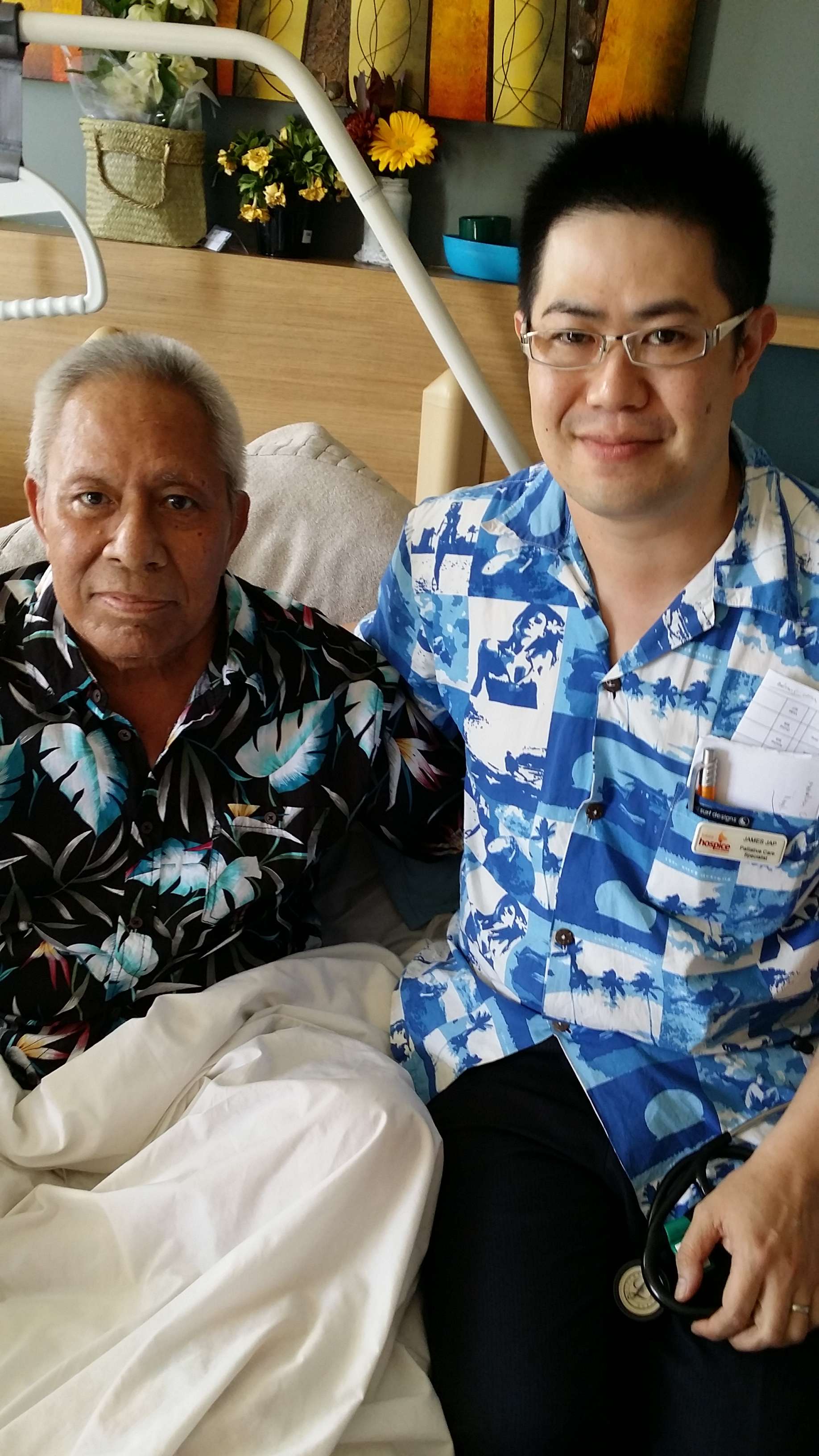
With the family’s permission here is a photo from yesterday morning’s ward round:

Shirts

“Aloha” from Saturday morning from two guys who are fashion-forward? Poppa is trying to hold on for Junior.

The link to Poppa and Junior’s Story was shared through the social media by myself, the Palliverse community and the family.

I was pleasantly surprised that the link to the post appeared as a headline on Friday 13th May’s edition of the #hpmglobal paper.li – Thank you very much Jim Cleary!

I was informed by the family that one of NZ’s national papers had contact them and they were interviewed last night.

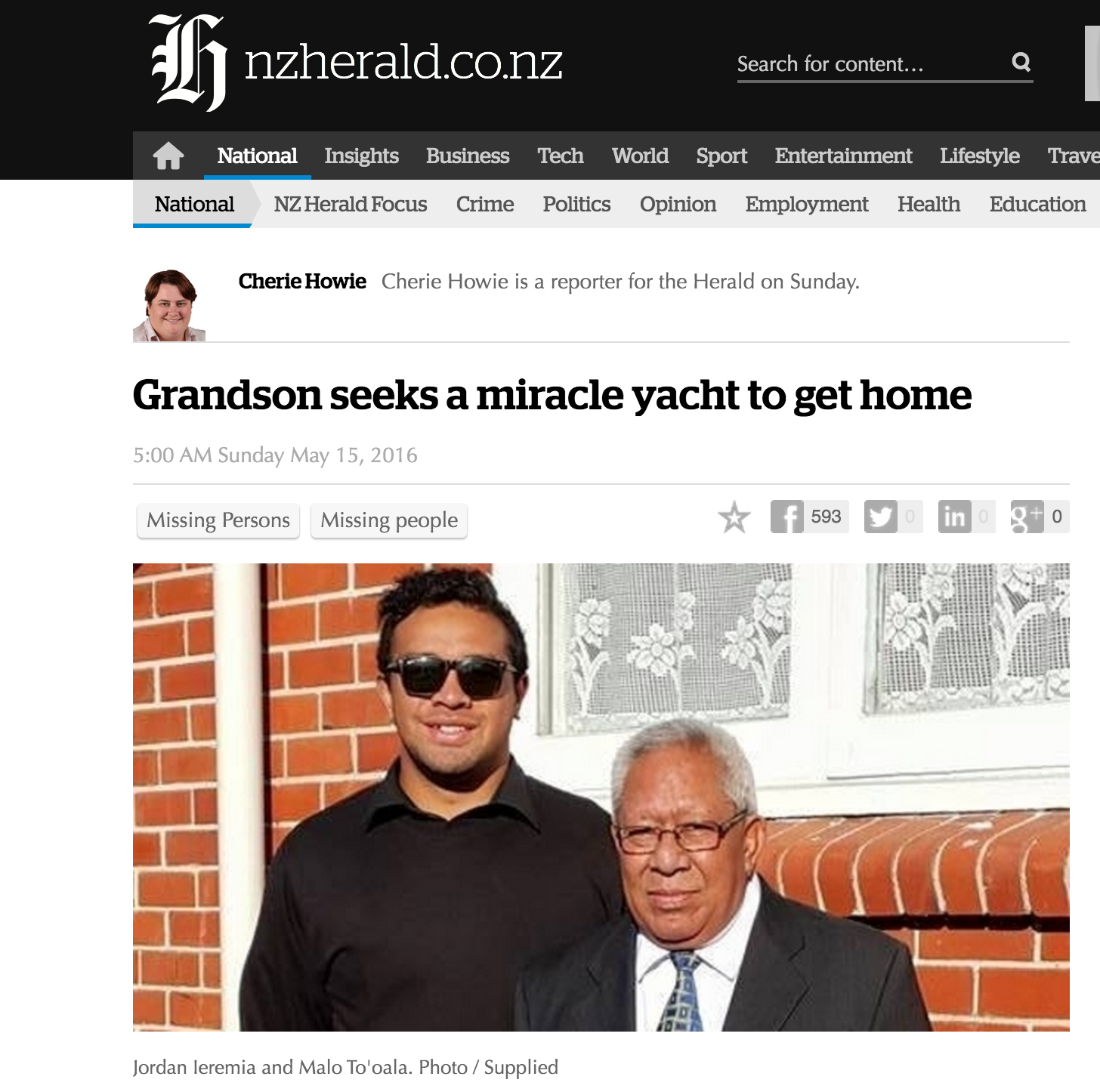
This resulted in the following story appearing this morning:

Screen Shot 2016-05-15 at 22.20.18

Snapshot of from the New Zealand Herald website – Click here to read the full story.

I’m checking out a few more traditional media leads in order to spread the word further.

I’m also trying to contact sailing clubs as suggested by others’ helpful comments.

Fingers are still crossed.


Update 18/05/16 1700 NZT:

Poppa is still holding on, but is getting mighty fatigued.

Junior is on the mend which is good to hear.

Since the NZ Herald on Sunday story we have received a number of helpful emails.

Apparently another NZ newspaper has shown interest in running our story.

I’ve emailed a number of NZ radio shows, an Australian newspaper, and whatever else that myself and other people can think of. I’ve started writing a letter to Santa Claus, the tooth fairy and others in the Pantheon.

Received by Palliverse today was an email from one of the major shipping companies with a desire to “try to make it happen.” I have passed on the details to the family to make direct contact.

This is the most promising lead so far.

Fingers crossed to the power of 10! Say your prayers folks.