
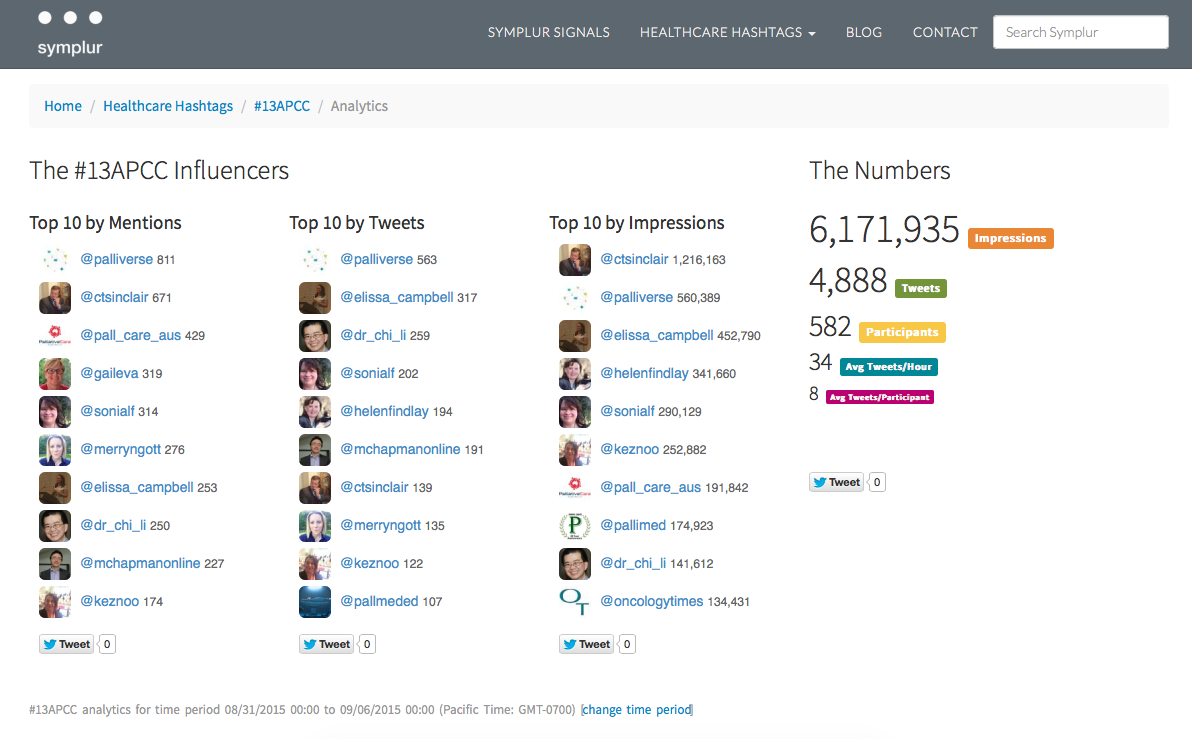
Social media activity during the 13th Australian Palliative Care Conference

13APCC conference analytics

With a theme of ‘Fit for the Future’, the 13th Australian Palliative Care Conference utilised a coordinated and multifaceted social media strategy to enhance the delegates’ experience and reach new audiences globally. This was achieved through the concerted efforts of team Palliverse (@Palliverse) and other key individuals, including Christian Sinclair (@ctsinclair).  Continue reading

Renal supportive care weekend

St George model

[Prof Mark Brown discussing the renal supportive care model at St George Hospital]

21-23rd August, 2015 | St George Hospital, Sydney

It was the fifth annual symposium but the first master class. A truly multi-disciplinary audience comprising nephrology, palliative care, geriatrics, trainees, specialists, nurses, social workers, dieticians, et al met on a warm and wet weekend at the St George Hospital in Sydney. All shared a commitment to making life better for individuals with advanced kidney disease. Continue reading

A real death: what can you expect during a loved one’s final hours? via @ConversationEDU

A real death: what can you expect during a loved one’s final hours?

Charles Corke, Deakin University and Peter Martin, Barwon Health

It’s hard to predict events in the final days and hours of a person’s life. Some deaths are wonderful – a gentle decline preceding a gracious demise. Certainly these are the sorts of deaths we see in films or on television, where the dying patient bids farewell to gathered family and friends before softly closing his eyes.

These gentle departures happen in real life too – many people simply die in their sleep, and many families and friends share the privilege of witnessing the calm and serene departure of a loved one. Of course, grief follows, but those left behind are able to take solace in the knowledge and memory of a peaceful passing.

Unfortunately for every “good” death, there are many which are much more stormy and drawn out. These deaths can leave families traumatised for many years or simply make the grief that much harder.

Out of sight Continue reading

Harassment in healthcare – What can palliative care learn from the RACS?

As many of you would know the Royal Australasian College of Surgeons has recently released its expert advisory group Draft Report into discrimination, bullying and harassment in surgery.  The results of the report are confronting even if they are unfortunately not altogether surprising.

Continue reading

‪#‎ACPEL2015‬ Day 2 Highlights: from Elissa

Greetings from Munich (Grusse aus Munchen)

The morning session was an opportunity to share advance care planning (ACP) success stories from different countries – Singapore (Living Matters), UK (Gold Standard Framework) and the US (Honoring Choices Wisconsin, Kaiser Permanente). Helen Mason from NZ also presented the findings of her Harkness Fellowship, identifying key components of health systems for successful ACP.

To me, the recurring themes were:
– the need for grassroots, community engagement
– identifying and using clinical and community champions of ACP
– the need for a coordinated whole systems approach
– not limiting ACP to end of life – focus on living well, not just dying, and
– employing continuous quality improvement.

Continue reading

Advance care planning may “fit” palliative care but is bigger than any clinical specialty

IMG_1640

The International Society of Advance Care Planning and End of Life Care (ACPEL) Conference began today, with addresses from leading practitioners and researchers from across the world. Set in Munich, Germany, the opening panel discussion examined factors contributing to successful advance care planning implementation, and discussed how implementation might progress in European countries.

Continue reading

Advance care planning improves end of life care and patient and family satisfaction

In the spirit of the #ACPEL2015 conference coming up soon, I was reminded of this randomised controlled trial done in Australia about the impact of advance care planning.

309 legally competent medical inpatients aged 80 or more were randomised to “normal care” or “normal care plus advance care planning” and followed for six months or until death. The main outcome measure was whether wishes were known and respected in the patients who had died.

Of the 56 patients who died by six months, end of life wishes were much more likely to be known and followed in the intervention group (25/29, 86%) compared with the control group (8/27, 30%; P<0.001). In the intervention group, family members of patients who died had significantly less stress (intervention 5, control 15; P<0.001), anxiety (intervention 0, control 3; P=0.02), and depression (intervention 0, control 5; P=0.002) than those of the control patients. Patient and family satisfaction was higher in the intervention group.

The authors concluded that “Advance care planning improves end of life care and patient and family satisfaction and reduces stress, anxiety, and depression in surviving relatives.”

Birthday announcements: Palliverse is turning 1!

If like me, you can’t believe that it is nearly September then let me hit you with another bit of news.  Palliverse is having its first birthday!

Birthday Cake by Will Clayton / CC BY

Birthday Cake by Will Clayton / CC BY

And we have decided to give ourselves a bit of a present – a new look.

Continue reading

Call for abstracts: 14th National Conference of Emerging Researchers in Ageing

‘Bringing research to life’: 7-8 December 2015, National Ageing Research Institute, Melbourne.

The National Ageing Research Institute is pleased to host the 14th National Emerging Researchers in Ageing Conference in 2015. This is the only national conference in Australia focusing exclusively on the work of higher degree research students undertaking research in ageing across a range of disciplines. The conference presents a unique opportunity for higher degree research students to come together to share their research.

The conference organisers invite the submission of abstracts for oral and poster presentations from PhD, Masters and Professional Doctoral students and other emerging researchers engaged in ageing related research from any discipline.

The call for abstracts is now open and will close on 31 August. A copy of the submission guidelines and abstract template are available on the conference website.

Get Twitter-ready for the 13th Australian Palliative Care Conference #13APCC

Attending the 13th Australian Palliative Care Conference in two weeks? If you don’t have one already, now’s a great time to create a Twitter account and check out these handy tips about using Twitter at health conferences.

If you’re not attending the conference, then you can follow the #13APCC hashtag to see what conference attendees (including @palliverse) are sharing. You do not need a Twitter account to follow the hashtag, just follow this link for up to date conference tweets.

We will also be updating the Palliverse Facebook page during the conference.

Will you or your organisation be posting to social media from the #13APCC? If so, please share your details below so we can follow you!

Elissa (find me on Twitter @Elissa_Campbell)