interview – Giovanni Galvis, palliative and oncology fellow from Sweden

Hi Giovanni!

Tell us about yourself . What are you doing in Australia?

Hello, my name is Giovanni Galvis. I was born in Caracas-Venezuela. I studied Medicine in Bogota-Colombia. After my graduation I decided to go to Europe. I have always been fascinated with the history and architecture and of course the good level in research and clinical medicine there. I spent some time in Germany but in 2007 I moved to Sweden where I did research in the beginning and then started my specialty in Clinical Oncology.  I am doing a placement at Peter MacCallum Cancer Centre attending the department of Pain and Palliative Care, the breast clinic and the melanoma clinic.

What is your impression of palliative care and cancer care in Australia? Is it different from that in Sweden? How? Continue reading

The Hairy End: or, the bad shit.

download

Palliverse contributor Elizabeth Caplice shares this candid post with us. Thank you, Elizabeth.

elizabeth's avatarsky between branches

i’m sorry for all the people in my life i haven’t had a chance to already talk to this about in person, and this is sort of why i’ve been quieter on social media.

but my treatment, and treatment aims have started to move into the next phase of stage IV cancer, and we’re at a point where we can start talking a timeline.  i am now, without question, terminally ill – which means, my  life expectancy is under 12 months.  for the first time, i asked my oncologist straight out for numbers, because he said that a point would come where he could start estimating. that point is now.  his ‘worst case’ estimate (all treatment failing now) is 3 months, and his ‘best case’ estimate (all treatment working for as long as would be expected) is 12 months. the reality will lie somewhere between those two figures.
it’s my…

View original post 878 more words

Human Rooms in Palliative Care: Creating multi-sensory healing spaces

A human room is a space where a vulnerable person or persons can reconnect with self. This process usually occurs after the participant engages with taking control of the environment by selecting sensory elements that appeal to them…”

Continue reading

I think therefore I am? – Its a small world after all.


7026077961

Photo by Sid Mosdell, taken on March 28, 2012

Over the years I have been privileged to share some meals with a visiting Lama from the Tibetan Buddhist Faith. Rinpoche is based in Scottsdale, Arizona, USA but regularly visits New Zealand. Dinners with Rinpoche are always very interesting and he has many stories to tell. Given my own professional interests, the topic of death and dying often comes up. During one of those conversations Rinpoche shared a related story about one of his late American friends.

Continue reading

guest interview – Soula Ganiatsas, Palliative Care Research Network Victoria

Tell us about your job.

I am the program manager for the Palliative Care Research Network Victoria (PCRNV).

What does PCRNV do?

We try to gain funding to conduct clinical and community intervention research. The PCRNV also  provides an opportunity to network and collaborate with other palliative care researchers through PCRNV forums and workshops.

We also help with access to a variety of PCRNV funding schemes including; PhD scholarship, small project and travel grants. There can be support with developing your research idea into a potential project and grant proposals via the PCRNV Concept Development Workshops and also mentoring.

But, it’s not right to do research on people who are dying, is it? 

Continue reading

A Christmas wish…

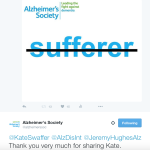
A Christmas wish from Kate Swaffer

Kate Swaffer (she/her) Kaurna Country's avatar

Screen Shot 2015-12-11 at 9.59.54 am

Yes, I am suffering…
but only some of the time
not every moment of every day

And, importantly…
not always from dementia
more often from the language of dementia

The symptoms of dementia
do not consume me
one hundred percent of the time

Only some moments
of some days
and definitely not all days

So why then must others
with and without dementia
exacerbate the suffering and stigma

by labelling me
a sufferer
ALL of the time?

Please do not label me a sufferer
This is my one and only
Christmas wish

View original post

First Person: The therapeutic value of touch

photo by Jonas Vincent via unsplash.comThe first time one of my medical professionals touched me for comfort rather than during a physical exam, it was during my liver biopsy.  I was extremely frightened of the procedure, due to how painful I’d been warned the procedure was, and I was, and still am, slightly uncomfortable with needles (though daily Clexane shots sure sorts that out fast).  The medical team at the imaging clinic I attended had gotten in a second nurse, just to hold my hand during the procedure.  It was her 60th birthday, and she had been called in, literally, just to hold my hand.  I was incredibly moved by this, and incredibly comforted to have someone gently talk me through what was going on – to warn me to look away when the giant liver biopsy needle was brought out, helping me count holding my breath as the needle drew up the cancerous cells, and gently walking me to the recovery room after the procedure finished. It was one of the kindest things I have experienced with my medical professionals – and I have experienced more kindness than I can even recognise. Continue reading

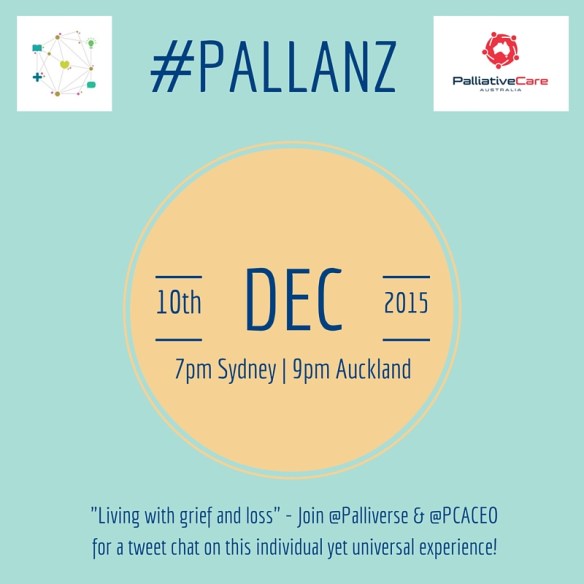
#PallANZ tweet chat

PallANZ 201512

Grief and loss is something we will all face at different times throughout our lives. Whether it is the death of our pets, our friends, our children, siblings or parents; the experience and expression of grief in response to these losses can be a very personal and individual thing. Grief can also arise in anticipation of loss. For those living with life-limiting illness, living with the loss of social role and professional identity can be especially challenging.

Thoughts about old, new and future losses can be particularly common during the festive season. For some of us, it may represent an anniversary of the death of a loved one, and bring with it painful memories of loss. Some might be facing their first Christmas ‘alone’, while others may be grappling with the possibility of celebrating their ‘last Christmas’.

While living with grief and loss is a personal experience, we don’t have to endure it on our own. As a community, there are many ways that we can support each other. Join us to talk openly about living with grief and loss.

TOPIC                    Living with grief and loss

DATE / TIME       10th December, 2015 @ 1900 AEDT

MODERATOR     @Elissa_Campbell

T1 Have you experienced grief and loss? How would you describe it? And what did you need from those around you?

T2 How do children live with grief and loss? How are they different from adults?

T3 What kinds of support are there for people living with grief and loss in your community?

T4 As a community and as individuals, how can we better support those living with grief and loss during the festive season?

How does it feel to be young and dying?

ElizabethCAplice

Palliverse welcomes a new contributor today. Elizabeth Caplice is an archivist on hiatus. She has Stage IV colorectal cancer, and writes about cancer, and how it intersects with life, particularly in younger adults. Elizabeth has shared a recent photo, to show that “stage IV cancer looks far broader than just some elderly hands with a cannula in them.” (Try doing a Google image search for “palliative care”.)

We recommend Elizabeth’s excellent blog  Sky Between Branches and her Twitter feed. As always please leave responses in the “Comments” box below.


Today, I saw my oncologist, and got dealt more bad news.  Stage IV cancer life is mostly bad news, and you come to expect it.  The cancer has spread, again, after only two weeks off chemotherapy – which I needed to take due to my blood count consistently dropping to dangerous levels.  He gently told me that if it was in my bones now, it wouldn’t be shocking, because I was diagnosed with Stage IV rectal cancer a year and a half ago.  I have done remarkably well.  Continue reading

Community members wanted

446px-Uncle_Sam_(pointing_finger)

We want you! (By James Montgomery Flagg via Wikipedia)

We are looking for community members to join our team at Palliverse.

If you are interested in palliative care and would like to contribute to our work here at Palliverse, we would love to hear from you! We are seeking individuals who do not directly work in palliative care, and are keen to invite current, past and future consumers (e.g. patients, carers, family or friend) to come on board. Personal experience with palliative care is welcome but not essential. Prior participation in community advocacy or representation is not required – but sharing our goals and values is a must!  Continue reading