“Failure to maintain”: do hospitals cause suffering in older people?

Today Palliverse talks to Assistant Professor Kasia Bail (@Kasia_Bail) from the University of Canberra. Kasia is a nurse, a researcher, a kung fu instructor and a drummer in a metal band. She came to our attention via social media when we noticed her crowdfunding campaign for the next stage of her research into nursing care of complex, hospitalised older people. Here at Palliverse we are fans of crowdfunding, although we’re yet to use it for research purposes!

Kasia’s research aims to improve sustainable acute care health delivery for an ageing population, while her clinical experience includes general medical and acute palliative care. In her PhD, Kasia developed an approach to measure nurse-sensitive outcomes, which is currently being used to evaluate a Government-funded implementation of a cognitive identifier. Kasia has a passion for identifying and researching the structures and processes which impede or enable quality patient care, and sharing her learning and inquiry with nursing students, industry and professional groups. Here, Palliverse asks her about her latest research project and dipping her toe into the world of social media.

kasiabail

Dr Kasia Bail (image via Dr Bail)

Your research has led to a new concept in the care of older people with complex medical problems, “Failure to Maintain”. What does this mean? Continue reading

#4APCRC: 4th Australian Palliative Care Research Colloquium

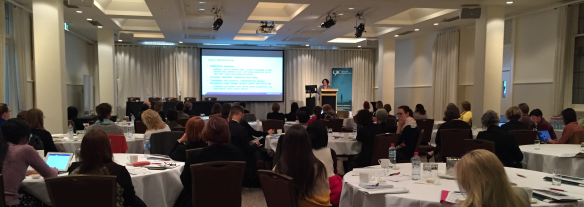
audience

Members of team Palliverse had the pleasure of attending the 4th Australian Palliative Care Research Colloquium between October 27-28th, which was once again held in the comfortable surroundings of the Rendezvous Hotel in Melbourne, Victoria.  Continue reading

#ANZSPM16 tweet chat: the (hidden) cost of caring

anzspm16-cost-of-caring

A game changer at the recent Australian and New Zealand Society of Palliative medicine 2016 Conference (#ANZSPM16) was Dr Merryn Gott’s plenary presentation on the hidden costs of caring. Little is known about the financial impact of caring for people at the end of life.

She detailed some powerful anecdotes, including the story of two sisters whose mother lay dying in a hospital. The cost of parking was prohibitive and the daughters took it in turns to sit in the car watching out for the parking inspector. When their mother died, only one of the daughters was there; the other was in the car. Continue reading

#ANZSPM16 Wrap up

This slideshow requires JavaScript.

Days two and three of the Australian and New Zealand Society of Palliative Medicine (ANZSPM) 2016 Conference: The Changing Landscape of Palliative Care was just as brilliant as the first. The plenary sessions featured:

  • Merryn Gott (@MerrynGott) spoke about the ‘last taboo’ in our community: the invisible and sometimes unexpected costs of providing care at the end of life, which are often not explored in clinical and almost never measured in policymaking and research. She also discussed  the impact of culture, ethnicity and gender on who is bearing these financial and non-financial costs. To find our more, read her open access @PalliativeMedJ article here.
  • Meera Agar (@meera_agar) discussed the growing evidence base around delirium care in the palliative care setting. Management of this complex, distressing, life-threatening, but often reversible syndrome is challenging. Non-pharmacological strategies and a system-wide approach to organizing and delivering care are crucial, as research into various drug treatments continue to demonstrate a lack of clear benefit and the potential for harm. Meera recommends iDelirium for more information about this important area of palliative care.
  • Pippa Hawley reflected on the lack of evidence around the use of medicinal cannabis – despite the immense interest from (and considerable experience of) our communities. How should clinicians respond while the scientific and legal issues are sorted out? Ask questions, keep an open mind & work with our patients!
  • Douglas McGregor explored the interface between heart failure and palliative care. He referenced Sarah Goodlin’s open access article, Merryn Gott’s study while discussing prognostic uncertainty and clinician paralysis; and observed that most guidelines still see palliative care as relevant only at the very end of life, rather than a key component of chronic disease management. Amy Gadaud’s (@agadoudreview was flagged as a good place to start when considering issues around early integration.
  • Sam Bloore stimulated and inspired delegates with his fascinating talk about dying well in a culture of bitcoin and botox. How can palliative care adapt, survive and thrive in this changing cultural landscape characterized by information overload, mindless distraction and incoherence? We must remain a “subversive” counterculture and continue to strive towards caring deeply and meaningfully!

In addition to these amazing plenaries, fully (and at times even over-)subscribed workshops on the overlap between palliative care and addiction medicine / chronic pain, aged care, literature and the arts were held, alongside numerous excellent oral and poster presentations from specialists and trainees. The enthusiastic and well-informed audience present during all of the sessions was another highlight for me (and I’m sure all of the other speakers and delegates)!

It’s been a wonderful few days in Perth. A big thank you to the Conference organizing committee, chaired by Derek Eng (@dr_engd), for inviting team @Palliverse to be part of this great event. Thanks also to all of you for engaging with #ANZSPM16 on social media. Keep an eye out for our upcoming tweet chats, during which we will continue the conversation about the changing landscape of palliative care!


Michael’s story: Delirium – “the fear on his face was palpable”

Delirium is a common, distressing complication of life-limiting illness, yet poorly understood, often misdiagnosed and poorly managed. The Australian Commission on Safety and Quality in Health Care (ACSQHC) recently launched its Delirium Clinical Care Standard. I was fortunate to attend the official launch event on 15th July 2016 – the stand-out of which was the powerful story of Michael, as told by his wife Joan Jackman, who was Community Representative on the Delirium Clinical Care Standard Working Group.

She has kindly allowed me to reproduce her speech here and I hope it will spark discussion about delirium, what we can learn from Michael and Joan’s experience, and how we can do better.


WayneRobinsonBoranup.jpg

Michael loved the Australian bush. Photo: Wayne Robinson

Michael’s story:

‘Every medical condition is about a person with an individual history, friends and family, and a personal story. The person in the centre of this story is my husband Michael – a healthy, fit, intelligent man – who had been a fitness trainer in the British Air Force before becoming a British-trained Remedial Gymnast in Rehabilitation, for people with a disability. He was an elite sportsman, with a love of life, and also for his family.

Around the age of fifty-nine or sixty, Michael began to experience changes, utmost being that he became increasingly disengaged –with us, and with life! Something was wrong! We sought help.  After three misdiagnoses and six years, Michael was finally diagnosed with a Younger Onset Dementia. He was by then, 66 years old.   Continue reading

Compassionate Communities: An International Perspective…

In the lead up to this week’s #PallANZ Tweet Chat with @PCACEO
and @Palliverse, we are very fortunate to feature the contribution
of Dr Heather Richardson, Joint Chief Executive,
St Christopher’s Hospice London
, sharing with us from her
experience, insights into building compassionate communities—
an international perspective from which we all can learn and benefit…

StC_general_heather_richardson

Dr Heather Richardson

Prior to her current role as Joint Chief Executive at St Christopher’s,
Dr Richardson held posts of National Clinical Lead for Help the Hospices,
and Strategy Advisor at St Joseph’s Hospice. She has a wealth of experience as a general, mental health, and palliative care nurse; and holds a Master’s degree in Health Management as well as a PhD.

In 2015, Dr Richardson was appointed an Honorary Professor of the International Observatory on End of Life Care at Lancaster University, and her work is featured in Compassionate Communities: Case Studies from Britain and Europe, edited by Klaus Wegleitner, Katharina Heimerl, and Allan Kellehear.


Dr Richardson is in Australia presenting a Keynote Address at the 2016 Palliative Care Victoria Conference (if you haven’t already – you should register now!), and she very kindly gave time from her busy schedule to speak with us about our #PallANZ discussion this week on Compassionate Communities:


So, what is a compassionate community – and how is it relevant to hospice and palliative care?

This is a great question and one that a number of us have been pondering in the UK. There is a growing belief amongst hospices and others that compassionate communities could help improve the experience of dying and loss in the UK. This change is a key aspiration on the part of hospices and other palliative care services.

Compassionate communities have a similar aim and it is this mutual ambition that makes compassionate communities relevant to hospice and palliative care. Most importantly hospices are increasingly realizing that even with the best will in the world they will never achieve the reach, their vision that death and bereavement is seen as part of life, and the improvements in care required without drawing on the energies, relationships and connections in communities.


What challenges then, must we overcome to promote compassionate communities?

These challenges are significant but there is real appetite on the part of many in the UK to overcome them. Research being undertaken by Sallnow in East London, currently unreported, confirms that individuals and communities who see themselves as the first members of a local compassionate community, highly value the contribution being made by their local hospice to support their efforts. This suggests that hospices do have a role to play, but there is no doubt that they will have to change the way they work if they are to be effective in promoting and supporting compassionate communities.

In particular they will need to review their approach to risk management, which can serve to constrain the potential contribution of volunteers. They will also need to consider carefully how individuals working as part of a compassionate community are described and positioned. To whom do they belong and have accountability? Are they similar or different to traditional hospice volunteers and is that term transferable? Thinking differently about training will also be necessary. Moving from a place where training focused on “doing things the hospice way” to helping people recognise and harness their own capacity and that of the community to which they belong is a significant shift.


In what ways can we build meaningful and effective partnerships between palliative care professionals and the broader community?

These partnerships will be vital if significant improvement in the experience of people who are dying or bereaved is to be achieved.

Hospices are in a privileged position in this respect. Many were conceived by the communities that they serve and enjoy prolonged and vital partnerships around fundraising and volunteers. If they can make the shift in mind-set from a professionally driven service to a community enabled network of mutual support around death, dying and loss they will be able to build on these relationships to the benefit of local people.

Hospices and other palliative care services are also well integrated into health and social care systems. With an open mind and a generous spirit, they could become part of a rich web of partnerships that draw together their staff and volunteers, statutory providers of health and social care, commissioners, policy makers, community development organisations and most importantly community leaders, members and groups. Their work together will be key to transforming care which for many is currently unsatisfactory and of an unacceptably poor quality.


SO, dear readers, given that the UK is an international leader in building
compassionate communities, what can WE all LEARN from the UK experience?

Join us on Wednesday 27th July to share your thoughts during the #PallANZ Tweet Chat on Compassionate Communities.

@Palliverse and @PCACEO are extremely grateful for the generosity of Dr Heather Richardson in sharing her invaluable insights with us. You can see Heather present the Keynote Address at the Palliative Care Victoria Conference on Thursday 28th July; Bayview Eden Hotel, Melbourne Australia. Register now!

 

A death in the family

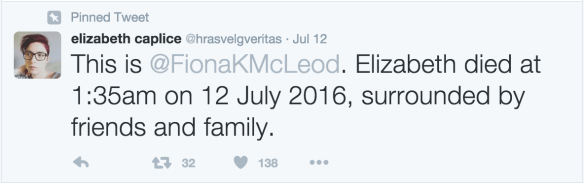
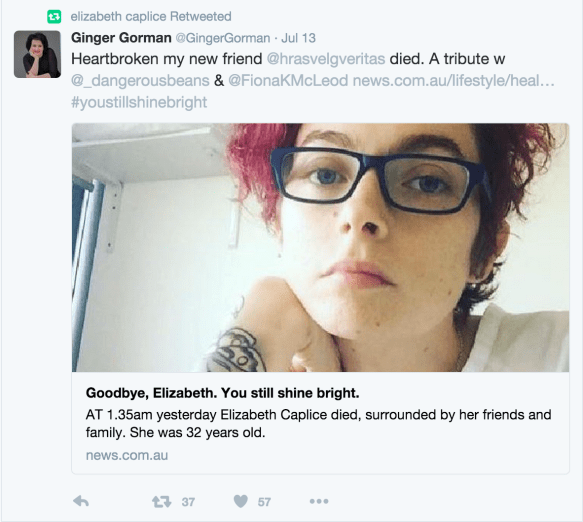
It was with great sadness that we learnt that Palliverse contributor Elizabeth Caplice had died.

Screen Shot 2016-07-14 at 22.12.09

Screen Shot 2016-07-14 at 22.12.28

Click here to read Ginger Gorman’s report.

Thank you Elizabeth for your contributions to Palliverse, and for your advocacy for Palliative Care.

Thank you for trying to make the world a better place.

We’d like to extend our deepest condolences to Alex and your loved ones.

Rest in peace Elizabeth.

James Jap on behalf of the Palliverse community.

Control & Decision Making

elizabeth

Taken from my hospital room on a good day

I’ve been in hospital for the last three weeks, and have just returned back home (finally!).  It has been both a very difficult physical experience dealing with pain management and a wound, but also a mental journey for me.


A lot of what I read about palliative care, and my own experiences as well, have been about control; the control that palliation gives you over the time you, as an individual, have left, rather than the often more passive involvement of care when engaging in active treatment.  Throughout my treatment, I’ve been eager – possibly to my own mental and emotional detriment – to remain highly active with what has been going on.  I make guesses as to what might be causing pain or discomfort or other symptoms, explaining to my doctor what it must mean as he compassionately and respectfully listens to my ideas that I’ve gotten from my half-hearted reading of an abstract from a medical journal.  Continue reading

An unexpected journey into aged & palliative care

albany wind farm

Albany wind farm

This post is a year overdue. If I were to have written this in April 2015, the title would have been “The tale of two deaths” where I would have reflected upon the peaceful, managed and expected passing of a 93-year-old aged care patient contrasted with the tragic accidental death of a 19-year-old patient whom I’d seen only a week earlier.

But what I’ve learnt is that tragic accidents are random, unexpected and do not happen often. More importantly I have been involved in the end-of life care of several patients since then, that have taught me a great deal about palliative care medicine, the value of open and frank conversations with family and some of the myths surrounding the management of death.

This is also a story of my maturity through being stretched and learning that the part of medicine that I ran away from the most has ended up becoming my greatest passion and future, aged and palliative care.

Continue reading

*Updated* 18/05/16 – Palace of Care/I think therefore I am? -#getjnrbak – Extra, extra read all about it! #pallanz

Hi everyone,

Apologies for the late update, I’ve been clinically busy while working the weekend.

We – Palliverse and the family of “Poppa” and “Junior” are still trying to find a way to make their reunion happen.

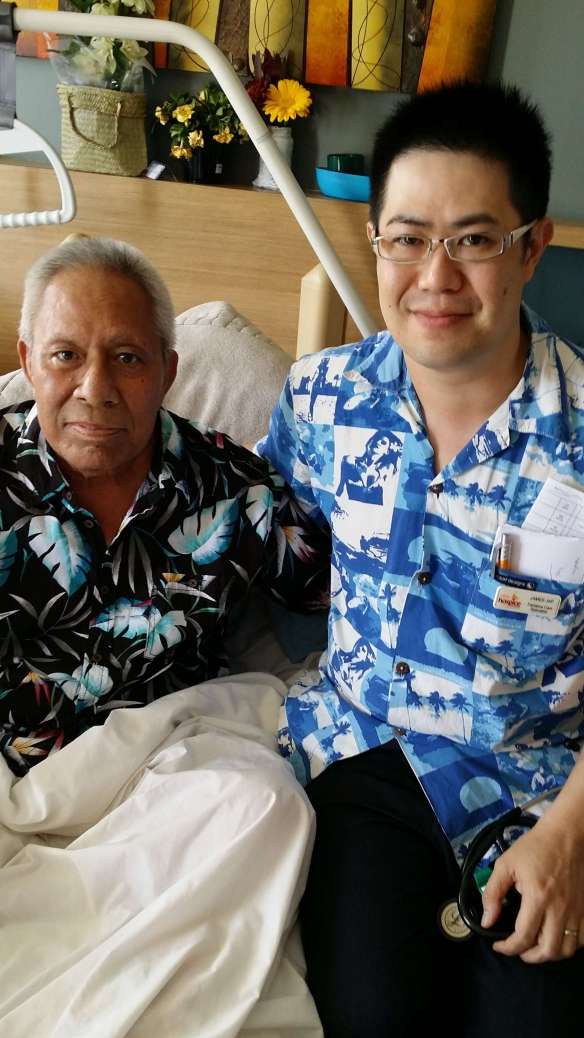
With the family’s permission here is a photo from yesterday morning’s ward round:

Shirts

“Aloha” from Saturday morning from two guys who are fashion-forward? Poppa is trying to hold on for Junior.

The link to Poppa and Junior’s Story was shared through the social media by myself, the Palliverse community and the family.

I was pleasantly surprised that the link to the post appeared as a headline on Friday 13th May’s edition of the #hpmglobal paper.li – Thank you very much Jim Cleary!

I was informed by the family that one of NZ’s national papers had contact them and they were interviewed last night.

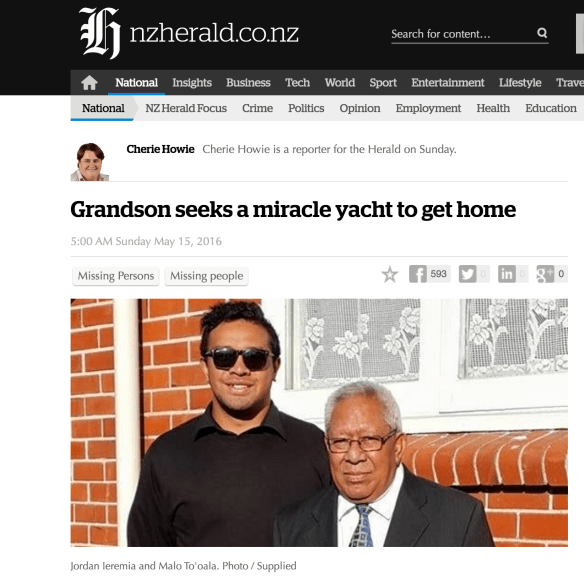
This resulted in the following story appearing this morning:

Screen Shot 2016-05-15 at 22.20.18

Snapshot of from the New Zealand Herald website – Click here to read the full story.

I’m checking out a few more traditional media leads in order to spread the word further.

I’m also trying to contact sailing clubs as suggested by others’ helpful comments.

Fingers are still crossed.


Update 18/05/16 1700 NZT:

Poppa is still holding on, but is getting mighty fatigued.

Junior is on the mend which is good to hear.

Since the NZ Herald on Sunday story we have received a number of helpful emails.

Apparently another NZ newspaper has shown interest in running our story.

I’ve emailed a number of NZ radio shows, an Australian newspaper, and whatever else that myself and other people can think of. I’ve started writing a letter to Santa Claus, the tooth fairy and others in the Pantheon.

Received by Palliverse today was an email from one of the major shipping companies with a desire to “try to make it happen.” I have passed on the details to the family to make direct contact.

This is the most promising lead so far.

Fingers crossed to the power of 10! Say your prayers folks.