
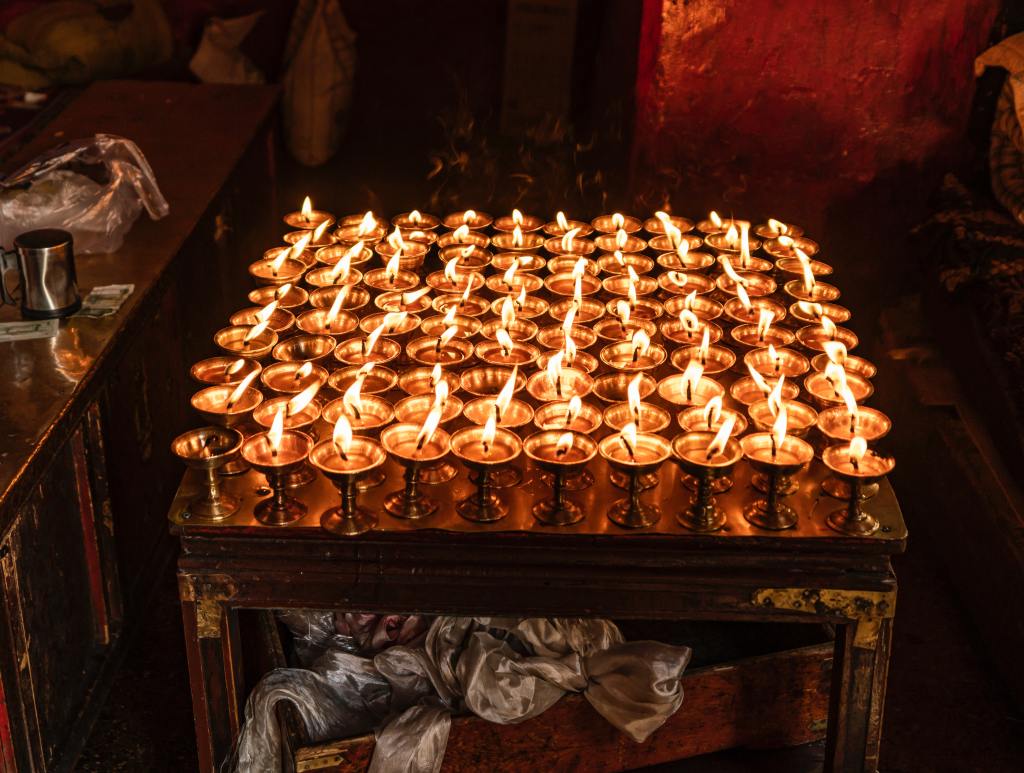
Guest Post – Naomi’s Notes – Doing Your Best

Photo by Thomas Lipke on Unsplash

It was three weeks before Christmas and she asked me to visit her in Wellington, preferably before Christmas. I was leaving for India the following week and no cheap flights meant it was not possible. I phoned her and told her I would visit when I returned from India.  

Whilst in India, my Teacher got an email saying she had been admitted into hospice.   I was unsure that I would get back in time. However, my Teacher was confident that it would be okay. At least I was in one of the holiest places and attending a prayer festival.  I sponsored some group prayers for her as well as doing my personal prayers for her.

I met the Tibetan family that my friend sponsored. They were very grateful for her kindness and generosity and very sad that my friend was terminally ill.   They requested me to take a beautiful woollen shawl back to New Zealand for her. 

Within a few days of arriving home, I flew to Wellington to see her.  She was out of hospice and back in her own home, being well cared for by one of her sons and her sister.  Upon arrival, I was greeted by a much thinner version of my friend who was still quite mobile due to the loving care of her son and sister.  I stayed two days with her.

Continue reading

Guest Post – Naomi’s Notes – Saying Goodbye

Photo by Philippe Leone on Unsplash

She was a solicitor used to dealing with other people’s problems and separating the emotion from the facts.  But today she looked tired, worn out, and close to tears.

“Noticed your not your usual self what’s the matter”? I asked.

“I’m caring for my dying mother at home and have been doing it for the last two months. I need to get home as quick as I can”.  

“Do you have anyone helping you”? I inquired

“Sometimes my sister helps but she has three kids. Mostly it’s just me and mum, I had to move in with her temporarily to take care of her because she couldn’t manage on her own. I’m not sure if I can manage.   I sleep in the armchair next to the bed”.  

“Would it help if I sat with her while you do your work at home”?

A smile fleetingly replaced the stress on her face.  ‘Here’s the address she said and my number if you get lost”.

“Ask your mum if I can come and see her, phone me if she says yes, no problem if she says no”.

Later that evening she phoned confirming it was okay.

Continue reading

Palace of Care – Like father, like son.

Photo by laze.life on Unsplash

The little old Chinese man, looked so pale, he didn’t know what to do with himself. His short-term memory had been impaired for some years but had worsened in recent months as he deteriorated.

We both used our second language to communicate with each other, Mandarin. Both speaking with thick accents, but able to understand each other. His supportive daughter had come over from China to look after her parents. They had lived in New Zealand for over twenty years.

He had always been terrible at reporting his discomfort. His daughter talked about when he had appendicitis and had not told anyone until he almost died of an intra-abdominal infection after his appendix had burst. His stock answer would be to say, “I am fine,” but his body language was a give away for his wife and daughter. He didn’t let anyone know that he had painful shingles until he was found writhing in bed, crying because of pain, telling his family that the pain was so bad that he wanted to die.

Continue reading

Guest Post – Naomi’s Notes – Time

Photo by R.D. Smith on Unsplash

He was 84. He had been sick for a long time with his liver and recently had his gallbladder removed.  He was tired and grumpy as he struggled to make sense of the illness.   He was tired of taking medicine and being unwell. It was a far cry from the strong funny man that used to make his family laugh.

As a father when he made up his mind to do something he would always follow through.  Like the time he decided to take a night class in pruning fruit trees.   He would come home from class and prune all the fruit trees which were quite substantial.  The trees all had a slight lean to them and his family was not convinced he passed that class but the trees bore great fruit.  

He decided he wanted to become a welder so he enrolled in a night class and completed the course.  His family thought it was an extension of his pruning class because he did some welding maintenance around the fruit trees.  When he wasn’t watching, his children used his welding hat to play Darth Vader in Star Wars but he used to laugh when he thought they couldn’t see him. 

It was early morning when the phone rang and she knew immediately something was wrong.

Continue reading

Palace of Care – Saying No – Part 3

Photo by Christina Deravedisian on Unsplash

He was admitted because of uncontrolled nausea and vomiting. We thought it might be a malignant bowel obstruction but his bowel sounds were normal. He would vomit at least three times a day. Strangely the vomiting didn’t seem to bother him, in fact at times he and his wife seemed happy after he vomited. We weren’t sure of what was causing his nausea and vomiting, his blood tests showed evidence of dehydration, but there was nothing obviously reversible going on to explain his symptoms. He looked unwell and after a few days on our ward he appeared more gaunt. Our attempts at controlling his symptoms were not working, we hadn’t solved the mystery yet, until we noticed the half-filled blue glass bottle on his table. “Keep out of direct sunlight.”

Continue reading

Guest Post – Naomi’s Notes – Mamma Mia

Photo by Dominik Lange on Unsplash

It was getting harder to manage working full time during the day and caring for my mother.  The routine was I would wash her in the morning and give her breakfast and her medication then leave her a drink in a thermos cup with something for morning tea.  

My sister would call in to see her before she went to work at 10 am. My other brothers and sisters were supposed to phone her during the day when I was at work.   I would come home for lunch, give her lunch I prepared the night before, give her medication and a drink and leave something for afternoon tea before heading back to work.  I finished at 5pm but sometimes couldn’t get away till 5.30pm as I worked at the District Court and sometimes the Court sat late.

The routine worked for a while but as she started to decline I noticed little things.   I would come home for lunch and her morning tea hadn’t been touched.  When I asked her why she hadn’t eaten the orange I left her, she was embarrassed and replied, “I tried and tried but I couldn’t peel it” and she couldn’t unscrew the lid of the drink.  I felt terrible that she wasn’t able to access it.  It coincided with her telling me she was lonely when I went to work, it was a long day for her.   I looked at her beautiful face and I knew she was not one to complain but this was important to her.    Something had to change. 

Continue reading

Palace of Care – Saying No – Part 1

Photo by Debby Urken on Unsplash

In his professional life he was used to taking charge, of taking control and at times this bled into his personal life as well. His wife’s mother was unwell with widely spread cancer, she had been admitted into the hospice for symptom control of pain, breathlessness, and nausea. He had always been close to her right from their first meeting, he was probably closer to her than he was to his own parents, and even called her Mum. She had always been there for her children and their partners, and he really wanted to be there for her. He wanted to make sure that she was treated right, and he had a small inkling that his manner might come across as intimidating, but that was useful in police work. He just wanted to make sure that Mum was being well looked after, it was what she deserved.

She was a Pasifika lady in her early 60s, with end-stage cancer to her liver, lungs, and many bones. She was the frailest patient in our inpatient unit and I was worried that she might be dying. She was well cared for by her family who were always with her. Her husband of similar age, two daughters and a son-in-law, who I found out was a police officer. He had already caused a bit of a disturbance in the unit as he had spoken in an aggressive manner to some of our nurses, and was impatient. The family were all tired, worried about our patient, and stress levels were high. The family members all seemed to defer to the policeman who had taken on the role of family spokesman. The patient was fatigued but had not slept much in the past days because of uncontrolled pain. The first time I saw her I thought to myself that I wouldn’t be surprised if she crashes quickly.

Continue reading

Guest Post – Naomi’s Notes – Mama

Photo by dominik hofbauer on Unsplash

Today was shower day. In preparation, I lit the fire and made the room nice and warm,  laid out her clothes so they would be nice and cosy to get into, just like my mother had done countless times over the years for all her children.

After showering, I raced her down the hallway in her wheelchair into the warm room and proceeded to dress her and blow dry her hair.  She was unable to transfer other than to put her arms around my waist and hold onto me as I put her into her favourite chair.

“Well,  now you have to pay me,” I announced.

She looked at me suspiciously until  I said the cost of the shower was two kisses.

She smiled and gave me five kisses and said,  “Oh I have overpaid you.”

“Don’t worry,” I replied, “I have change.”  I kissed her cheek three times;  She laughed just like she used to laugh and then I made her a hot cup of tea.  After the tea she fell asleep in her chair.  She looked exhausted from the effort of showering and slept for an hour.

When people came to visit she would try and sit up and talk with them but after a while she was just so exhausted.  Her kidney function was getting worse.

Continue reading

Palace of Care – The Art of Prognostication

Photo by Arthur Ogleznev on Unsplash

End-stage COPD (chronic obstructive pulmonary disease) due to lung damage from smoking had been his problem for the past decade. Lung tissue destroyed by toxic exposure leading to severe shortness of breath. He needed oxygen at all times, and could only at best mobilise short distances. Life had become a struggle, and just when he thought things couldn’t worsen, they did.

He was in really bad shape when he came in on Friday, he was only semi-conscious and could not respond to my questions. His wife and son, who were his main caregivers at home, looked exhausted. He looked terrible, blue lips and tongue, breathing rapidly, short, shallow breaths, with only a small amount of chest movement. I had not seen him so unwell before, which really concerned me.

Using all my clinical skills and experience, I really thought that he was dying, that he would die within the next hours. That he might last only days, and might never fully wake up again. I gently conveyed this news to the family. That I thought this might be the end of his life. They took it well, he had been unwell a long time, and had been close to death many times in the past.

I prepared his medication chart for end of life care. I wanted to cover the five common symptoms that occur at the end of life; pain, breathlessness, nausea, agitation/confusion, respiratory secretions. Anticipatory prescribing for a dying person is done, in order to cover the things that occur commonly during their last hours to days of life. Aiming for comfort more than anything else, we started him on syringe driver medications. This would mean a continuous infusion of symptom control medications to keep him calm and comfortable for whatever time was left. I left that Friday afternoon truly thinking that I would not see my patient alive when I returned after the weekend.

Continue reading

Palace of Care – Limited time, big changes

Photo by Skyler Gerald on Unsplash

We had been expecting to admit our patient for a number of days. In the past week she had been troubled by bad pain in her back. We knew that the cancer had spread there already. It hurt her to walk, and she had peed her pants on the way to the toilet. She could not make it in time because the pain of walking held her up.

On admission some medications were changed and by the next morning, they had worked really well. She had slept well for the first time all week, her pain was well controlled, and she was happy to be away from home. Home was full of family, and it was hectic, three generations of family living in the same household, with up to 20 people around her at any time. It was easy to get lost in her own home. She appreciated the opportunity to rest.

Everything we told her was written in her notebook, she wrote down the conversations we had, the medication changes we had made. The notebook was where she made her plans, for everything. She knew that she was unwell, and had already taken it upon herself to plan her funeral. She had always done things differently in her life, and that was not going to change after death. She was planning to break from her usual cultural traditions, and was planning an European style funeral. She would not be going to the traditional place of mourning of her people. She was going to do things in her own way. We talked about Frank Sinatra’s song “My Way.” She jotted it down as something that she wanted to play at her funeral.

Continue reading