
2015 in the Palliverse – conferences

cropped-cropped-img_4157.jpg

As we adjust to the New Year (hello 2016), Palliverse is looking back at some of our posts over the past year. Being palliative care nerds, Team Palliverse have been lucky to attend numerous Australian, New Zealand and international conferences over the past year. Click the links below to attend vicariously or relive some of them:


Stay tuned in 2016 for more conference updates – Team Palliverse are already begging for leave and furiously submitting abstracts. And if you are attending a conference that would be of interest to Palliverse readers, and would like to share a summary, please contact us!

To be alerted about new Palliverse posts, follow us on Facebook, Twitter or LinkedIn or hit the “Follow” button in the right-hand column to subscribe to email alerts.

 

NICE guidelines for end of life care

The National Institute for Health and Care Excellence (NICE) provides national guidance and advice to improve health and social care in the UK.

In response to the Neuberger report and the demise of the Liverpool Care Pathway, new evidence based guidelines have been developed.

This guideline includes recommendations on:

In my state, Victoria Australia, the VEC (Victorian End of life Coordinating Program) is undertaking similar work, and plans to release a Victorian end of life care plan soon.

In Australia, we have not had the negative stories and experiences seen in the UK; because the LCP was implemented in a better way? The stories coming out of the Neuberger report were shocking: I cannot imagine any patient being denied a drink when requested “because she is on the LCP”. However the LCP has also been withdrawn locally in response to the negative findings delivered in the UK.

I will be participating in a pilot of the new end of life care plans which will replace the LCP locally. I am looking forward to seeing the final version.

Thoughts, dear reader, about the terminal care of the LCP?


Review article concerning hospital end of life care in NEJM

Not the traditional festive season article perhaps, but this review article by Dr Blinderman and the late Dr Billings provides a good summary in a very reputable and widely read journal concerning end of life care in hospitals in the United States.

Is end of life care in hospital in the US different?

The article reports that 29% of deaths take place in hospitals in America, a bit lower than I would have expected. In Australia, 54% die in hospital but this includes inpatient palliative care deaths which are excluded from the US figure of 29%.

According to AIHW, 42% of the Australians who died in hospital had some involvement from palliative care  (42% of 54% in hospital deaths is 23%) About a third of patients who died as an admitted patient in hospital (a third of 54% is about 15%) died in inpatient palliative care. That still leaves us behind the US, with around 36% dying in a non palliative inpatient Australian hospital bed compared to 29% in the USA.

Interestingly the NEJM article does not refer to subcutaneous medications which are the mainstay of terminal care medication administration in Australia, New Zealand and the UK. Do US practitioners use less SC medication?

Personally I don’t find that cough and nausea are so troubling at the end of life, and we would promote meticulous mouth care for dry mouth ahead of pharmacological management.

The article also advises us to avoid benzodiazepines for delirium including at the end of life, which I found surprising.

Dear reader, do you have any thoughts? What is end of life care like in hospitals in your neck of the woods?


2015 in the Palliverse – palliative care reading

cropped-cropped-img_4157.jpg

Are you looking for some reading over the summer holidays (or winter if you’re that way inclined)? Over the next fortnight, we’ll be looking back at some of our posts over the past year. We’ve been to conferences, reflected on clinical and research experiences, shared palliative care educational resources (#FOAMPal) and hosted guest contributors.

A good place to start for palliative care reading is our “Elsewhere in the Palliverse” posts, curated lists of palliative care articles, blog posts, educational resources and the occasional video from Australia, New Zealand, and beyond. This year we’ve shared fifteen “Elsewhere in the Palliverse” posts. We’ve had special editions for events like World Hospice and Palliative Care Day, Dying to Know Day, and Halloween.

To be alerted about new Palliverse posts, follow us on Facebook, Twitter or LinkedIn or hit the “Follow” button in the right-hand column to subscribe to email alerts.


A Christmas wish…

A Christmas wish from Kate Swaffer

Kate Swaffer (she/her) Kaurna Country's avatar

Screen Shot 2015-12-11 at 9.59.54 am

Yes, I am suffering…
but only some of the time
not every moment of every day

And, importantly…
not always from dementia
more often from the language of dementia

The symptoms of dementia
do not consume me
one hundred percent of the time

Only some moments
of some days
and definitely not all days

So why then must others
with and without dementia
exacerbate the suffering and stigma

by labelling me
a sufferer
ALL of the time?

Please do not label me a sufferer
This is my one and only
Christmas wish

View original post

European association for palliative care early researcher award

Know a hot young palliative care researcher? Or perhaps you ARE a hot young palliative care researcher?

You might be interested to investigate this award for early palliative care researchers. There are other awards for post docs and for clinical research

http://www.eapcnet.eu/research2016/

You will have to get your proverbial skates on as applications close 13th December. The EAPC research congress is in Dublin in June 2016.


The right words matter when talking about pain

Michael Vagg, Barwon Health

It is no coincidence that we describe the “pain” of loneliness or the “agony” of rejected romantic feelings. Paper cuts can be “excruciatingly painful”, but so can watching the social mishaps of Basil Fawlty or David Brent. Personal criticism can be “stinging”.

The book The Patient’s Brain outlines the evidence that later evolutionary traits such as social cognition and language appear to have grafted themselves onto the ancient brain functions that alerted us to external threats or bodily damage.

Words are neurological events. They are meaning-laden puffs of air that our brain transforms into knowledge, opinions, emotions or danger signals.

Shakespeare, perhaps the greatest wordsmith of all time, frequently used bodily sensations including sensitivity to pain as metaphors. If you’ve ever complained about the “bitter cold”, called an ugly sight an “eyesore” or felt it “sharper than a serpent’s tooth … to have a thankless child” you might know what I mean.

Words affect pain

Continue reading

#IDPD2015 – International Day of People with Disabilities – towards supporting inclusion and participation

Today, Thursday December 3rd, is the International Day of People with Disabilities.

In 2008, the United Nations adopted a Convention on the Rights of Persons with Disabilities (UN CRPD). In considering this Convention, and our approach to disability, what might this mean for the delivery of palliative care?

Continue reading

First Person: The therapeutic value of touch

photo by Jonas Vincent via unsplash.comThe first time one of my medical professionals touched me for comfort rather than during a physical exam, it was during my liver biopsy.  I was extremely frightened of the procedure, due to how painful I’d been warned the procedure was, and I was, and still am, slightly uncomfortable with needles (though daily Clexane shots sure sorts that out fast).  The medical team at the imaging clinic I attended had gotten in a second nurse, just to hold my hand during the procedure.  It was her 60th birthday, and she had been called in, literally, just to hold my hand.  I was incredibly moved by this, and incredibly comforted to have someone gently talk me through what was going on – to warn me to look away when the giant liver biopsy needle was brought out, helping me count holding my breath as the needle drew up the cancerous cells, and gently walking me to the recovery room after the procedure finished. It was one of the kindest things I have experienced with my medical professionals – and I have experienced more kindness than I can even recognise. Continue reading

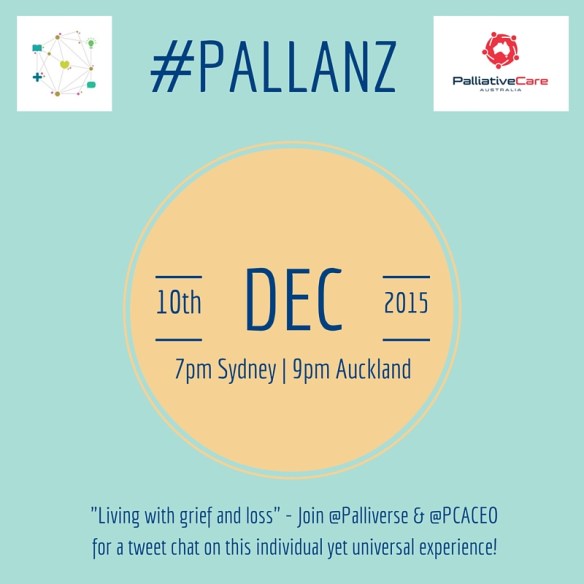
#PallANZ tweet chat

PallANZ 201512

Grief and loss is something we will all face at different times throughout our lives. Whether it is the death of our pets, our friends, our children, siblings or parents; the experience and expression of grief in response to these losses can be a very personal and individual thing. Grief can also arise in anticipation of loss. For those living with life-limiting illness, living with the loss of social role and professional identity can be especially challenging.

Thoughts about old, new and future losses can be particularly common during the festive season. For some of us, it may represent an anniversary of the death of a loved one, and bring with it painful memories of loss. Some might be facing their first Christmas ‘alone’, while others may be grappling with the possibility of celebrating their ‘last Christmas’.

While living with grief and loss is a personal experience, we don’t have to endure it on our own. As a community, there are many ways that we can support each other. Join us to talk openly about living with grief and loss.

TOPIC                    Living with grief and loss

DATE / TIME       10th December, 2015 @ 1900 AEDT

MODERATOR     @Elissa_Campbell

T1 Have you experienced grief and loss? How would you describe it? And what did you need from those around you?

T2 How do children live with grief and loss? How are they different from adults?

T3 What kinds of support are there for people living with grief and loss in your community?

T4 As a community and as individuals, how can we better support those living with grief and loss during the festive season?