Palace of Care – Friday morning hospice ward round cryptic crossword

Photo by Ross Sneddon on Unsplash

ACROSS
1: Impromptu quartet sang – One of the members in great need of a barbershop.
2: Wedding planners hard at work.
3: You took the words right out of my mouth – Rock cake, Crap.

DOWN
4: Worst fears confirmed with some relief evident
5: A torrent of emotional pain released as a primal scream.
6: My heart will go on?

1: Have you heard the one about the patient, her daughter, and her two doctors?

How did you meet your husband?

A lot of people have asked me that, they always want to know that. It was nothing to do with me, God made it happen. After we married we travelled to many of the Pacific Islands, as missionaries, we took our kids with us. He started off being a teacher, then he became a minister. I helped him with both. It was hard work but a good life.

You must have helped many people.

Yes, we enjoyed it very much. I really miss him, he’s been gone four years. I will be with him again, that’s the only thing I want now. To be with my husband again, back home.

You’ve been really unwell lately, but you have improved again. What makes you so strong?

You want to sing a song?

I’m not sure that’s a good idea, I don’t want to distress you with my voice. I once took singing lessons some years ago. My wife says I should find my teacher, and ask for a refund.

Go on, just one song.

Umm, I’ll do it if you sing with me. What do you want to sing?

Hmmm, you choose.

Let me think…Amazing Grace.

Amazing Grace, how sweet the sound
That saved a wretch like me
I once was lost, but now am found
Was blind but now I see

Sunbeam smile from the patient which lit up the room.

Daughter smiled and was able to truly relax for the first time in weeks.

Behind her mask the young doctor smiled in surprise at the simple beauty of the moment.

The masked older doctor smiled as he was reminded of why he works in hospice.

Thank you again Glen for sharing your wisdom

Dear Palliverse Community

Five years ago, I started a Palliverse discussion with a contribution about my role as a carer for my wife, Carole with dementia. Carole died in 2019 when her cognitive abilities were no longer sufficient to maintain the routine function of vital organs.  So Carole literally died of dementia which is not very common.  Many patients die of injuries or comorbidity factors.  We did the whole journey together.
I resolved to write booklets to help other carers in the various stages of dementia.  To have this done and published while memories were fresh, I gave myself a year (and used almost all of it). I published eleven brief booklets on Amazon in 2020.

Page 
1.     Dementia Caregiver Survival 
2.     Tips For Newbie Dementia Carers 15 
3.     Tips For Communicating 28 
4.     Diagnosing Dementia 38 
5.     Take Genetic Testing? 61 
6.     “I’m FINE!” Coping with Anosognosia 68 
7.     Managing The Rage Stage 73 
8.     Selecting a Dementia Residence 89 
9.     Managing Dementia Placement 97 
10.  Coping with End of Life 107 
11.  Picking Up The Pieces 121 
12.  Manejando la etapa de la ira. Libro 7 de la serie 134 
13.  Bien gérer les accès de colère  Volet 7 147 
14.  Dementia Carer-  Tips from a Mentor (the compilation of 1-13)   This book 

I was born without my share of the Mother Teresa gene, but I learned a lot along the way and became a mentor on an international carer support forum.  The booklets have been well received by carers, and professors of nursing wanted a compilation for use in education. The compilation is now used in nursing degree courses in USA, Canada and UK. In 2021, the compilation has become a teaching resource in Australian tertiary studies.

I should pass on to practitioners some observations I recently made to another carer, a Kiwi to whom I am a mentor.
“The thing I continue to find remarkable is the reception of the booklets by leading practitioners.  These booklets were written simply for fellow carers.  They are brief because carers have little time.
“The compilation was a hasty afterthought when the booklets first caught the eye of a nursing professor. It made no attempt at continuity or de-duplication or any kind of rewrite… just a stack of booklets under a title !”

Your enthusiasm is very flattering to me.  The simplicity of expression in my booklets was intended originally to reach fellow carers.  It results in reviews like ‘raw’ and ‘frank’ and I guess it makes these resources stand apart from professional and academic literature on these subjects.You generously noted they are practical and experienced.  Those are the attributes that appeal to other carers and that is where these booklets are truly innovative.  Some ideas here have not found expression elsewhere in any form at all.So I am most grateful for your endorsement to some colleagues and I hope to continue to contribute.
If you can forgive the literary shortcomings and the blunt presentation, I believe you will find more practical help and support in these booklets than elsewhere.  I offer this resource (Word file attached) for use by Palliverse community members and for referral to carers of persons with dementia. The link follows to the publications from Amazon.


Regards,Glen

https://www.amazon.com/author/davisglen

Cancer patients can’t believe everything they read

The stream of information about cancer treatments and cures can be overwhelming. When the Guardian describe new miracle cures. It’s hard to know what to believe. This article is an example of how biased interpretations of scientific papers can be misleading for patients and families.

Let’s find out if this new cancer treatment can wipe out tumours in terminally ill head and neck cancer patients as claimed.

A cancer patient on the trial, Barry Ambrose, 77 is interviewed. The cancer in his throat was no longer detectable after his immunotherapy. He is delighted.

I looked for a link to the original randomized controlled trial. Eventually I managed to find the paper in the medical literature. But surely, I had found the wrong paper? This paper had a different conclusion, that there was “no improvement in survival” with the new immunotherapy treatment. How can this be?

The Checkmate 651 trial asks : if you have a high-risk cancer of the head and neck, is immunotherapy or standard chemotherapy a better first treatment?

947 patients were randomly put into two treatment groups – half had immunotherapy and the other half chemotherapy.

The people having the new immunotherapy treatment did not live longer than the people having the old chemotherapy treatment. The study did show a couple of differences in treatment group outcomes. The immunotherapy sub-group lived for a median of 17.6 months compared with 14.6 months in the chemotherapy group, but this three-month difference might have happened by chance according to the statistical analysis. More people were alive at 2 years after immunotherapy in a subgroup (26% compared with 16%). The immunotherapy treatment, if it worked, worked for longer at 33 months compared with 7 months.

The main author of the study Dr Argiris is here speaking about its results.

The study is at risk of bias because it’s paid for by the drug company that benefits if it is successful. It did not show that immunotherapy is superior to chemotherapy, despite the Guardian headline. It did show that immunotherapy has fewer side effects than immunotherapy – but we already knew that from other studies. In a subgroup of patients, those having immunotherapy died a median of 3 months later but this result was not strong enough to meet the criteria for being statistically significant, meaning it could be a chance result. For those who did respond to immunotherapy, though, it was a longer time before their cancer came back.

It is so important for patients with cancer to have a good understanding of potential treatments – both their risks and benefits. This enables the person to make good decisions about their medical treatments.

Can this “new cancer treatment … wipe out tumours in terminally ill head and neck cancer patients”? Sorry, not enough evidence to claim that. The treatment has fewer side effects and if you respond to the treatment the beneficial effect lasts longer.

If you find information about a new treatment, discuss it with your oncologist and see what they think. Unfortunately, we can’t believe everything we read about new miraculous treatments.

Hello, my name is…..

I go to see John* on the ward. He’s been admitted for pain management. He tells me that the plan is for some chemotherapy next week. Who was it who said that? I ask. He shook his head. “I dunno, there are so many…. I have no idea who most of them are. “

It can be so hard to work out who is who in the health care setting.

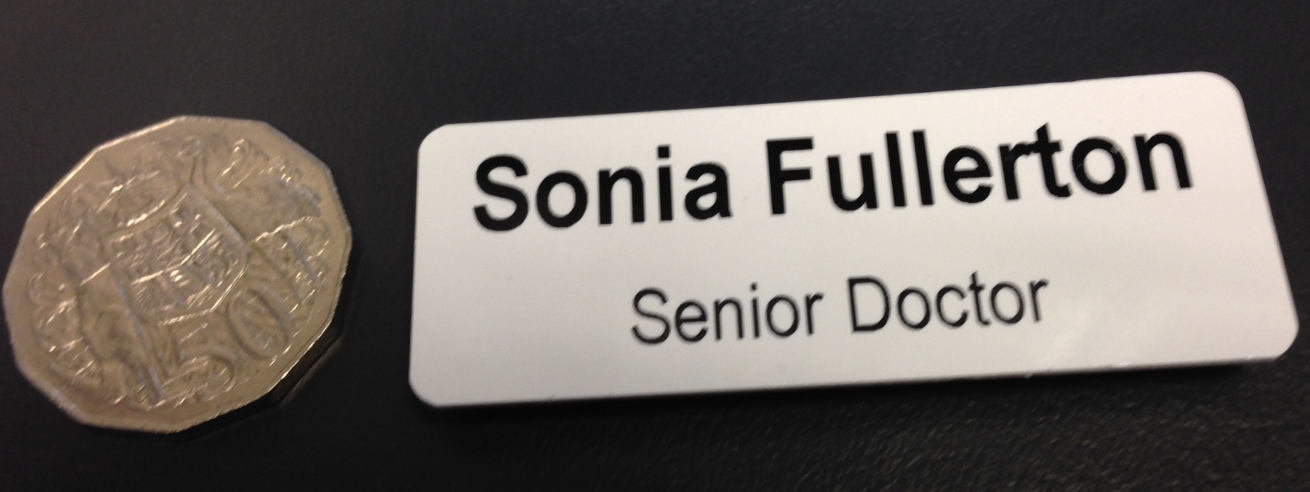
Dr Kate Grainger was a senior doctor in the NHS in the UK when she was diagnosed with cancer. She was shocked that people looking after her and even doing procedures on her did not introduce themselves. Before her death, she started a worldwide campaign called #hellomynameis. Its aim is to encourage healthcare staff to introduce themselves to patients. This improves patient satisfaction, participation in care, and also patient safety.

One thing that can help is to understand how the hierarchy works in the hospital setting. Yes, it’s a hierarchy! The consultant, or senior doctor, is the leader of the medical team. An inpatient in a hospital bed might see them every few days.

The doctors who come around each day to see all their patients are the registrar, the mid-level doctor who makes the day to day medical decisions. They are likely to be in a training program to become a specialist.

The most junior member of the medical team is a resident, who can also be called an intern or junior medical officer. They don’t make as many management decisions themselves, but carry out the requests of the registrar and consultant.

Alongside the many excellent bedside nurses caring for you, you may also be seen by allied health professionals. These could include a physiotherapist, an occupational therapist, a social worker, a pharmacist, a spiritual care worker, and more.

Make sure you know who the team members are who are looking after you. I hope everyone greets you with a friendly, “Hello, my name is….”

Have you had an experience in the hospital setting where it was hard to work out who was who?

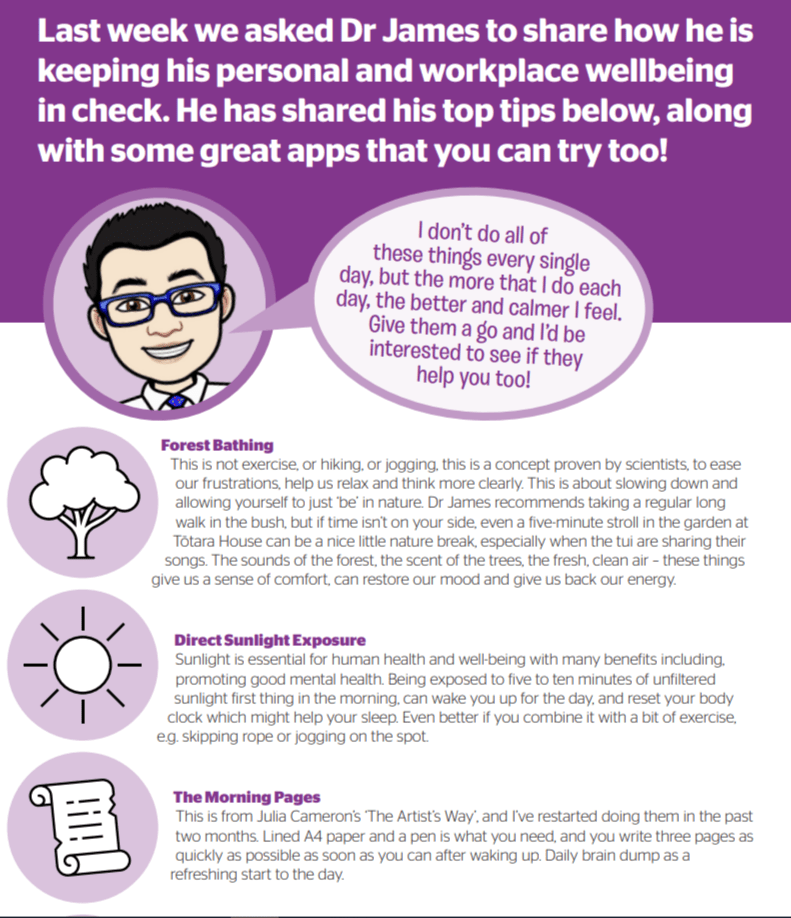
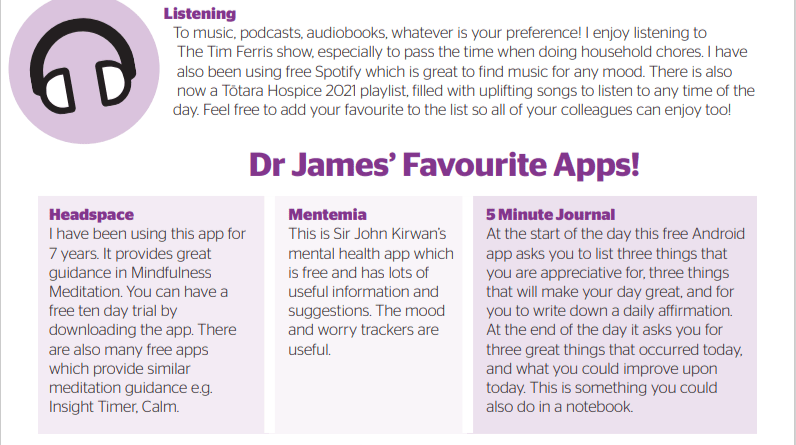
Palace of Care – Wellbeing Tips

Hi everyone,

I shared some wellbeing tips with my workmates and they produced a pdf file that you can download.

Palliative Care Australia awards 2021

Opportunity for Australian members: $2,000 National Palliative Care Award – Nominate now!
Dear Australian readers,

Do you have an hour or so this week to take the time to recognise someone who has made an important contribution to palliative care? Award winners are eligible to receive $2,000 (for individual awards) or $4000 (for team awards) to go toward professional development.

This year there are four new awards with the aim to recognise a broader range of people, including the work in Aboriginal and Torres Strait Islander communities, generalist areas, community-based care, and Paediatric palliative care.

https://palliativecare.org.au/awards 

The form will roughly take 20 minutes to complete. The person nominating will need to gain approval from the nominee and document whether this person has received an award in the past.
There is a 5000 character written piece that needs to address the criteria of the particular award which can be found here – 

There are now 11 award categories
Individual Awards
Emerging Leader
Emerging Researcher
Excellence in palliative care-rural and remote
Excellence in palliative care in an aged care setting
Outstanding achievement by a volunteer
Excellence in palliative care-Paediatric Palliative Care
Excellence in palliative care-Community Based Care
Excellence in Generalist Palliative Care
Excellence in Aboriginal and Torres Strait Islander palliative care
Organisation/ Team Awards
Outstanding Teamwork Award
Innovation in Palliative Care

Please help PCA and ANZSPM celebrate our heroes.

Research Position Advertised

Research Fellow, Palliative and Supportive Care

HammondCare is looking for a post-doctoral researcher, who has a passion for research which can improve palliative and supportive care.  Working within the Centre for Learning & Research in Palliative Care, the Research Fellow provides high level support for the research effort in palliative & supportive care across the organisation. 

This role offers a post-doctoral researcher an excellent opportunity to develop their research skills, experience and track record within the themes of palliative and supportive care.

  • Position based at Pallister House, Greenwich Hospital.
  • Part time (0.6 FTE), flexible working arrangements. Three years fixed term position.
  • Provide high level support for research in palliative and supportive care

Closing Date: 1st August 2021

For further information about the role and the information pack can be found at  https://www.hammond.com.au/careers/current-vacancies/RF-NSW

For enquiries please contact Prof Josephine Clayton, Director, Centre for Learning & Research in Palliative Care, HammondCare on jclayton@hammond.com.au 

Hot topic

Hot topic webinar by the Centre for Palliative Care

Management of NIV in MND & elective withdrawal of ventilation

 4:00PM – 5:00PM Wednesday 30th June 2021

https://www.centreforpallcare.org/events/75/hot-topic-webinar-management-of-non-invasive-assisted-ventilation-in-motor-neurone-disease-and-elective-withdrawal-of-ventilation

Motor Neurone Disease (MND) is a fatal neurodegenerative disease affecting some 2000 Australians. Average life expectancy from symptom onset is around 30 months. 

Patients show different clinical phenotypes and rates of progression. Death usually results from ventilatory failure secondary to progressive respiratory muscle weakness and can be complicated by aspiration and respiratory infection. Offering respiratory support through non-invasive assisted ventilation (NIV) is considered best practice and can improve quality of life, symptoms and survival in selected patients. Patients usually begin using NIV overnight to improve sleep and daytime wellbeing. Over time, most will use it increasingly across the day, with some becoming NIV dependent. 

Some patients who are dependent on NIV may ask that it be stopped. This is their right. It is not assisted suicide or assisted dying, it is withdrawal of medical treatment. Withdrawal of ventilation needs to be thought through and carefully discussed and planned to ensure that the patient is comfortable throughout the process and both staff and family/carers are supported. 

This presentation gives the opportunity to hear from and ask questions of specialists in Neurology, Respiratory Medicine and Palliative Medicine about the management of NIV in MND and elective withdrawal of ventilation.

Register

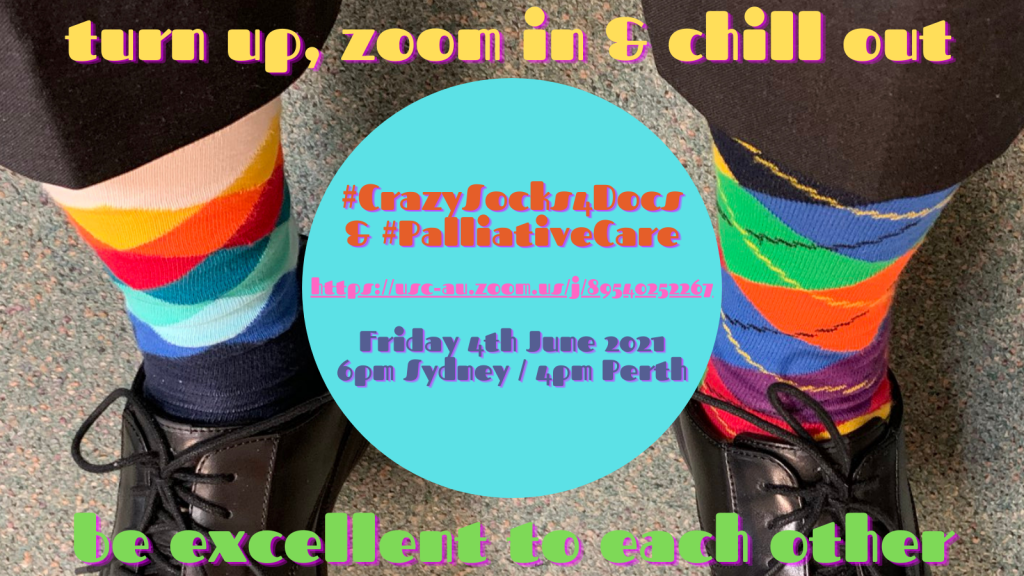
#CrazySocks4Docs – #PalliativeCare Edition

Join Team Palliverse for #CrazySocks4Docs day on Friday 4th June 2021!

We will be wearing your craziest socks & hosting a zoom chat to shine a light on the mental health of palliative care doctors, nurses, allied health professionals, researchers, educators, managers & leaders. COVID-19 has made it harder for all of us trying to do our bit for palliative care – those working on the frontline, behind the scenes & on the home front. So to misquote Timothy Leary for our pandemic generation – let’s all “turn up, zoom in & chill out”!

  • Grab a well-deserved drink / generous amounts of chocolate / cuddly animal or doona & settle into a comfy chair / snug beanbag / cozy bed around 8pm NZST (New Zealand) 6pm AEST (Sydney / Melbourne / Brisbane / Canberra) / 5:30pm ACST (Adelaide) / 4pm AWST (Perth) on Friday 4th June 2021
  • Pick up your laptop / tablet / phone & punch in / click on / head to: https://usc-au.zoom.us/j/89540252267
  • Be excellent to each other while catching up with old friends, making new ones & chatting about anything, everything & all things palliative care & self care!

Dying2learn? Conversations with the Australian community around death and dying. Wed 31 March 16:00 AEST

The team at Palliative Nexus is presenting a webinar about death and dying which will be of interest to the #pallanz community. It’s on a laptop near you on Wednesday the 31st of March at 16:00 AEST

Professor Jennifer Tieman will outline her work on the Dying2Learn MOOC (Massive Online Open Course). It won an Innovation in Palliative Care award in 2017.

Prof Tiemen is the Palliative and Supportive Services and Matthew Flinders Fellow, College of Nursing and Health Sciences at Flinders University.

She will discuss the research arising from this excellent MOOC including community perspectives on death and dying.

Please register here: http://go.unimelb.edu.au/5mpi