Elsewhere in the Palliverse – Weekend Reads

photo by David Mao itsdavoI have a few palliative care links to share this week. If you’re not satisfied, we also share links on our Facebook page and Twitter account (you don’t need your own Twitter account to see what we’re posting), and you can check out our Elsewhere in the Palliverse archives.

At the End of Life Studies blog, Dr Naomi Richards examines the question, “Is the voluntary refusal of food and fluid an alternative to assisted dying“?

Talking About Dying Won’t Kill You, says Palliative Care Australia, writes comedian Jean Kittson (Sydney Morning Herald)

And a palliative care nurse told me that day after day she visited a person dying at home and day after day she walked into a house full of scented candles and rainforest music, until one day she said “Is anyone else sick of these scented candles?” and the family said “Yes”.  “And is anyone else sick of this rainforest music?” And the family said “Yes”. So the nurse said “Well, let’s open some windows, and what music does your mum like? OK, let’s put on some Stones.”

Continue reading

Mad cow disease does not exist!

There was an annoyingly inaccurate article concerning CJD  in national newspapers last week.

CJD is a degenerative neurological  disorder which occurs at a frequency of about one in a million per year. In Australia, 90% are sporadic and 10% of cases are genetic. There has never been a case of variant CJD (contracted by eating contaminated meat) in Australia.

As it’s so rare, often doctors have never seen a case before. It can be quite traumatic for patients and families to go through the process of diagnosis.

Articles such as that which appeared last week contribute to the stigma experienced by families. Linked is a well informed article by Mandy Newton, whose father and sister died of CJD and who herself caries the gene and will go on to die of CJD.

As a hardworking palliative care specialist I have cared for around 10 patients with CJD (which is a lot apparently!) My colleagues and I are presenting a talk at the PCA conference in September about 14 patients and their presenting features and course.

Have you had experience with patients dying from CJD and their families?

http://www.smh.com.au/comment/mad-cow-disease-doesnt-exist-but-creutzfeldtjakob-disease-is-all-too-real-20150713-giawgv.html

Elsewhere in the Palliverse – Weekend Reads

photo by David Mao itsdavo

Welcome to this weekend’s reads. People seem to enjoy the cute animal stories, so I’ve included one (near the end, if you want to read it first).

The latest paediatric palliative care video (below) from Little Stars is about treating chronic pain in children. It’s nice to see how the interdisciplinary team interacts with, and respects, the girl in the video.

An article that is all over my social media feeds this week: Knowing How Doctors Die Can Change End of Life Discussions. It also brought back to mind this article on How Doctors Die. (NPR)

“I felt like I was beating up people at the end of their life…I would be doing the CPR with tears coming down sometimes, and saying, ‘I’m sorry, I’m sorry, goodbye.’ Because I knew that it very likely not going to be successful. It just seemed a terrible way to end someone’s life.” Continue reading

Shifting the focus of care from disease to people – heartfelt article about dying in acute hospitals

This article is going a bit viral on social media. Does it mirror your experiences? It certain does mine, having worked for a long time in consultation services in acute hospitals. There have been a number of comments and letters to the Age supporting the message of the article, written by a senior doctor about the death of his father. http://www.theage.com.au/comment/hospitals-must-shift-focus-of-endoflife-care-from-disease-to-people-20150707-gi6joz

MyPal Podcasts

cover170x170

Do you like technology? Innovation? Palliative care? Research? Why, these things are what @palliverse is all about – and why you/we are here in the first place!

Guess what? These things are exactly what the #MyPal podcasts from @amaranwosu are all about as well. How about that!

Check it out here and also on iTunes. Be amazed. Happy listening!

Reflections on Research – the pointy end of the funnel

At the halfway point of the year, and the 5-month point of my 12-month Fellowship, I thought it a good time to stop and reflect. (I have tried writing one of these posts at the 3-month and 4-month marks but became stuck. I hope this is not a metaphor for my Fellowship.)

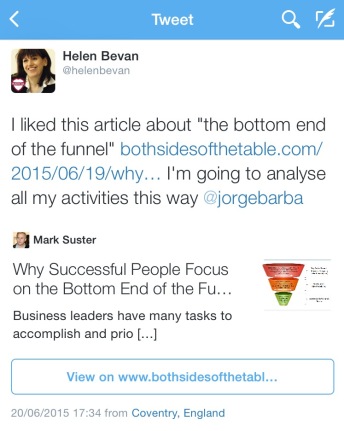
HelenBevantweet

After following the above tweet by Helen Bevan, to an article by “entrepreneur turned venture capitalist” Mark Suster, I discovered the “funnel framework” – a marketing model that seems a good fit of my Fellowship experiences so far.

Palliative Care Australia National Awards 2015

Here’s a great idea!

Palliative Care Australia has established a series of awards for outstanding teams and individuals working in palliative care in Australia. Entry is free and will close at the end of July. Winners will be announced at the PCA conference in September 2015 in sunny Melbourne.

“The National Awards are aimed at recognising innovation, teamwork and emerging talent in the palliative care sector. The awards recognise the efforts of those who support and care for people who are dying through public recognition of organisations and individuals who provide support and care to those people.”

There are two team and two individual awards: for an emerging leader, emerging researcher, innovation in palliative care, and outstanding teamwork in palliative care.

More details are here

Who will you nominate?

Sonia

Elsewhere in the Palliverse – Weekend Reads

photo by David Mao itsdavo

This week’s reading list features stories from around the globe.

Telehealth helps to facilitate home-based palliative care in Taiwan, in one of a series of EAPC blogposts about palliative care in SE Asia (Cloud-based platform for palliative care at home)

Tailored care for older patients with cancer in Latin America: an imminent challenge (British Geriatrics Society blog)

“Although it is unrealistic to believe that someday every older adult with cancer will be treated by a geriatric oncologist, we should make every effort to offer geriatric training to all healthcare professionals and to create bridges between geriatrics and other medical specialties.”

Health advocate and heart attack survivor Carolyn Thomas on the physiological and emotional response to the fear of dying during a heart attack. Continue reading

Elsewhere in the Palliverse – Weekend Reads

photo by David Mao itsdavo

I hope you enjoy this week’s reads, which include topics like wills, funerals, dementia, research ethics and the experience of a hospice nurse who becomes carer for her mother. I hope there’s no typos – I’m rushing off to a communication skills workshop but wanted to post this before I leave.

As always, please leave your thoughts in the comments box below.

Continue reading

Malignant Psoas Syndrome

Malignant psoas syndrome is said to be extremely rare, but I keep seeing it. Admittedly, working in the pain and palliative care service in a specialist cancer centre, if anyone was going to see it, you would think it would be my team.

I have had three patients with MPS this year and because each time it’s something that the clinical staff are not familiar with, I thought I would share a  short summary with the Palliverse.

The original description of MPS in 1990 (1) described patients with:

  1. Metastatic cancer involving the psoas major muscle either intrinsically (direct intramuscular metastasis), or extrinsically from metastatic retroperitoneal lymph- adenopathy infiltrating into the muscle.
  2. Painful flexion of the ipsilateral hip with positive psoas stretch test (‘‘reverse’’ straight leg raise) related to psoas muscle spasm or irritation.
  3. Clinical evidence of proximal (L1–L4) lumbar plexopathy with spontaneous, burning and lancinating pain associated with hyperalgesia (allodynia and hyperesthesia).
  4. Absence of osseous lumbar vertebral metastases and/or concomitant lumbar polyradiculopathy due to other causes (e.g., malignant neuraxial dissemination, chemotherapy-associated or radiation-induced neurotoxicity).

In 2010, Stevens et al wrote a helpful review (2) of MPS with a case review, mechanisms and theories. Five years ago, according to the paper, there had only been 28 cases reported in the English speaking literature.

I will leave interested readers to explore the papers themselves, but it describes polymodal pharmacotherapy (aka throw everything at it), plus some novel strategies like local anaesthetic block of psoas sheath.

What has encouraged me to put fingers to keyboards tonight though is the referral of yet another patient with psoas syndrome, plus this Japanese case series by Takase et al (3). It describes three patients with MPS who had excellent results with methadone (15-30 mg/day). Their average pain scores were reduced by an astounding 7 points with greatly improved function.

I am pretty keen to try adjuvant methadone for my new referral.

Have you seen any malignant psoas syndrome cases before?Were they recognised and treated as such? How did it go? Particularly keen to hear whether anyone has tried methadone. 

Sonia

References:

1. Stevens MJ, Gonet YM: Malignant psoas syndrome: Recognition of an oncologic entity. Australas Radiol 1990; 34:150–154.

2. Mark John Stevens, Charlotte Atkinson, and Andrew M. Broadbent. Journal of Palliative Medicine. February 2010, 13(2): 211-216. doi:10.1089/jpm.2009.0193.

3. Takase Naoto, Ikegaki Junichi, Nishimura Harumi, Yuasa Sayoko, Ito Yumiko, and Kizawa Yoshiyuki. Journal of Palliative Medicine. July 2015, 18(7): 645-652. doi:10.1089/jpm.2014.0387.