Like many of you I was glued to Q&A last night. The topic was “Facing Death”
and the discussion pivoted around the panel’s view around the right or otherwise of Australians to have access to euthanasia.
Needless to say the twittersphere was running hot, but clear to a number of commentators was that many were poorly informed about the topics at hand. From my perspective one of the most concerning issues was a lack of understanding about what palliative care is and assumptions that it is on some level the same as euthanasia.
Tonight in Australia (Thursday, 5 November, 830pm), SBS Insight tackles the topic of cardiopulmonary resuscitation and whether it’s always the right thing to do. (There are some familiar faces in the preview video!)
The discussions on Insight are usually excellent. I’m hoping for some thoughtful conversation about advance care planning, and hearing from people with life-limiting illnesses and their loved ones.
Palliverse will be participating in the Twitter chat surrounding the show (#insightSBS).
They had spoken their marriage vows decades ago, but things didn’t work out as planned. They split up many years ago – for whatever reason? I never found out, it was just too inappropriate to ever ask.
The ex-wife became progressively more unwell over the past months. The ex-husband arrived from many thousands of miles to help out, leaving his second family behind.
Things rapidly worsened, and she started to lose her functional abilities. She knew that the end of her life was coming and she made preparations for her own funeral. Her anxiety worsened as her body and it’s senses started to fail her. She became increasingly confused and uncomfortable. The family tried their very best to keep her at home, but they became physically and emotionally exhausted, and could not cope as her condition worsened.
She was admitted to our in-patient unit and knew that she would die there. Now that death was soon approaching, it made her fear grow to intolerable levels. He promised his ex-wife that he would be at her side until the very end, his calm and steady voice brought peace to her. The days passed and her condition deteriorated, sleep became a brief and unfamiliar acquaintance to him. He was physically drained, emotionally wrought but yet he was dedicated to maintaining his vigil.
I’m not sure what he said to her that last night, but I know that he emptied out his heart. He told me with tears in his eyes that after he had said what he needed to her, that she had taken her last breath, and then her life was over.
I’m not sure what had happened to them in the past, to break them apart, but when she needed him the most, he had been there.
Q&A. Love it or loath it, or maybe a bit of both. But there is no denying that it strikes a chord with a sizable portion of the Australian population who would perhaps rather not be watching A Current Affair, Today Tonight or their new lovechild: The Verdict. Continue reading →
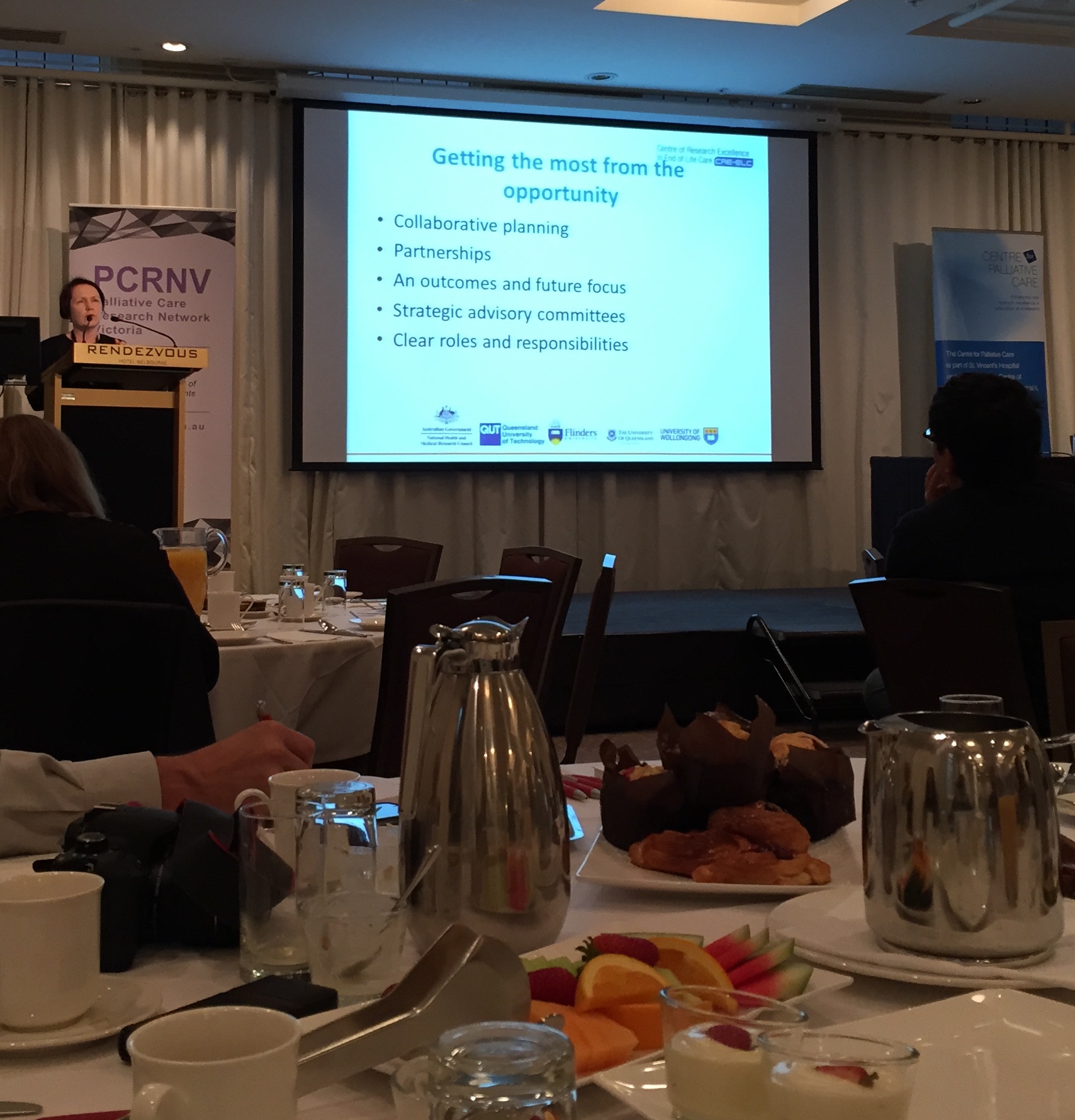
Prof Patsy Yates sharing her reflections on setting up a NHMRC Centre of Research Excellence in End of Life Care at the PCRNV Breakfast Forum
For the third year in a row, the Australian Palliative Care Research Colloquium was held at the Rendezvous Grand Hotel in Melbourne on October 22-23. The meeting was once again preceded by a breakfast forum hosted by Palliative Care Research Network Victoria (PCRNV), which served as a tempting entrée to the two-day main course of fantastic presentations and workshops exploring a diverse range of topics pertaining to palliative care research. Conversations about research continued over tea and meal breaks, next to quality poster presentations, and during the convivial conference dinner on the banks of the Yarra. Continue reading →
“It’s about starting a conversation…[Doctors need to] throw in a phrase like how you going, how’s the old boy, is he getting up, is he getting the job done?”
“…I find men want to talk about it, but someone has to start the conversation with them.”
Pulitzer prize-winner Tina Rosenberg visits La Crosse, Wisconsin, home of the Respecting Choices program, where 96% of adults reportedly participate in advance care planning discussions. (Talking Early About How Life Should End, New York Times).
And we are back! After our very successful inaugural tweet chat last month, let’s rock again with our next effort, and Let’s talk about death, baby together with Palliative Care Australia.
A tweet chat is a virtual meeting on twitter. This chat has the hashtag #pallANZ. Remember to use this hashtag in all your tweets, otherwise people will miss your comment. If you are not familiar with tweet chats, check out our Twitter 101 and 102 articles on this site.
It’s hard to talk about dying, or as we sometimes say (only half joking), the D word.
Here are some great references on the subject recently:
Victorians are being urged to have their say about the services they want to support them at the end of their and their loved ones’ lives.
Many people with a life-limiting illness die in hospital, when they would have preferred to die at home. Figures show that up to 70 per cent of Australians would prefer to die at home, but only 14 per cent actually do so.
A new Discussion Paper – Greater Say for Victorians: Improving End of Life Care – has been released, and consultation will be undertaken in coming months with health professionals, carers, families and members of the community to develop a new state-wide end of life care framework.
The 2015 theme Spiritual Care Together offers those of us working in the area of palliative care an opportunity to take the time to pause; to reflect, and consider the ways in which we all can, and do, contribute to spiritual care for the dying and their families.


 When a man loves a woman


 palliverse.com