Hi, my name is Naomi Lees, I work at Edmund Hillary School in Papakura. I met Dr James Jap a few years ago when he came to a meeting at school. I have really enjoyed Palliverse posts. When James asked recently who would help I said I would and did nothing about it for six weeks except for the occasional pang of guilt for not doing what I said I would do.
I looked after my parents in the last two years before they died. These posts will contain some of what I learned.
So here is the first of my contributions:
Looking for Kindness
When I was at school I was out on duty in the playground making sure the kids were safe in the playground. Then two little girls came up to me and one of the girls was new to the school and she was 5. The new girl was crying loudly. So I gave her a cuddle and asked her what was wrong and she said to me.
“Oooh I’ve lost my friend.”
“Don’t worry,” I said, “I’ll help you to find her.”
“What is her name?”
More tears then she said, “I don’t know.”
Then I said, “what does she look like?”
More tears then she said ………”She looks KIND.”
Bianca the other little girl who is 8, looked at me and we both smiled then I said very gently to her that Bianca knew all the kind girls so if she held Bianca’s hand and walked with her I am sure they would find her friend. Off they went in search of Kindness!
This discussion with Stacey Panozzo, Joanne Britto, Christine Hofmeyer and Avi Paluch reflect on opportunities for consumer and community involvement (CCI) in palliative care and share a new program of work that seeks to explore, develop and implement a program to enhance CCI in palliative care in Australia.
The purpose of the Palliative Care Research Network (PCRN) is to foster the evolution of collaborative scholarly inquiry in #palliativecare in Australia. The PCRN is leading a program of research that focuses on consumer engagement, which seeks to enhance consumer and community involvement in palliative care. Learn more about the PCRN here: https://pcrnv.com.au/
He was well respected and had many visitors. He had sponsored most of his family to come over to New Zealand. He had enabled his brothers and parents to come over in order for them to have a better life. He was the reason that the children’s generation grew up speaking English and Chinese. He ran his businesses successfully with the help of his siblings.
It was unfortunate that he became unwell with cancer, but he was well-supported by his family. He had always been there for them so when he was unwell they were there for him. He was able to purchase the best care that money could buy, and his Private Oncologist tried everything that was available, but it did not work.
He went back to China in order to access other treatments but they did not work either and meant that he had to spend time away form his family which he did not like. Family was the most important thing to him in the world. That was the whole reason that he had worked so hard in order to make things better for his family, so that they could enjoy their time together.
He started to deteriorate more quickly and he was admitted for symptom control but ended up requiring end of life care. There was always a family member present. When he started having trouble swallowing, the family asked about tube feeding. We knew that back in China if you could afford to pay for it you could access almost any treatment you wanted. It was explained that we did not think that artificial feeding and hydration would be beneficial. He became sleepier and less clear in his thinking. Eventually he became comatose.
His family continued their vigil, even though he was unresponsive. They asked how long he had left, and we couldn’t give them a adequate answer. They rightfully pointed out to us that he had not had anything to eat or drink food about two weeks. How could he keep on staying alive? I had trouble explaining it with all of my medical training, our science could not explain what was going on.
Dr Barbara Hayes and Prof Joe Ibrahim have combined forces to make this elegant simple Youtube resource to explain not for resuscitation orders, cardiopulmonary resuscitation, and advance care planning for patients and families.
It works through the differing perspectives of medical teams and patients and their families to explain why sometimes CPR can do more harm than good.
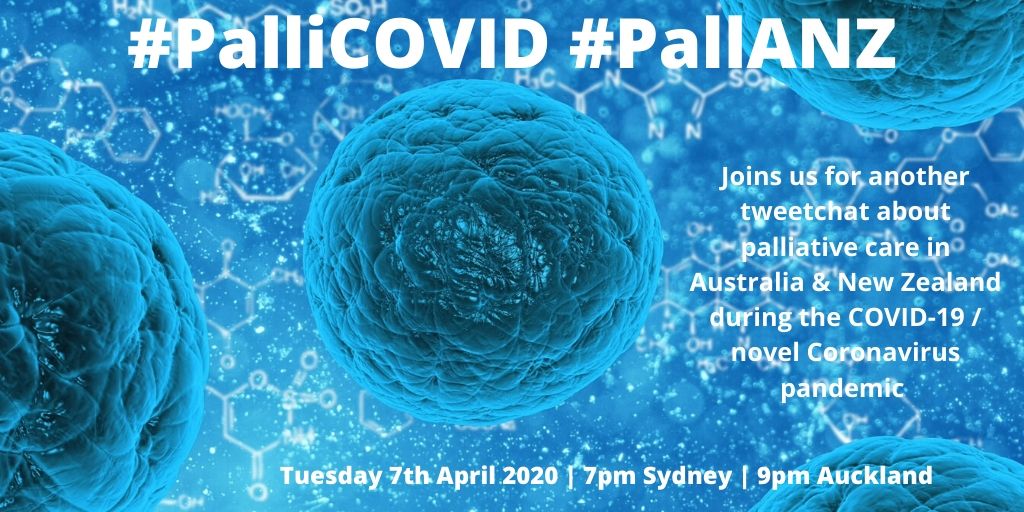
Please join us for another tweetchat on Tuesday 07/04/2020 to discuss palliative care in Australia and New Zealand during the COVID-19 / novel Coronavirus pandemic. Find out from special guests Prof Meera Agar @meera_agar (Board Chair of Palliative Care Australia @Pall_Care_Aus) and A/Prof Leeroy William @drleeroyw (President of the Australian and New Zealand Society of Palliative Medicine @ANZSPM) what has been happening in this space since our last tweetchat – and share your experiences and resources with other palliative care practitioners from across our region!
To join in on the discussion, sign up for or sign into your Twitter account
To find out more about how to participate, check out our guidelines here and here
What?
Topic 1: Social distancing rules (e.g. restricting visitors & limiting funeral gatherings) have changed the way we care for the dying & grieve for the dead. How can we help patients & families to live well, die well, grieve well AND flatten the curve?
Topic 2: Telehealth and working-from-home poses unique challenges to a touchy-feely, team-based specialty like palliative care. Please share a story about how you’ve adapted (or not!) to these evolving work practices.
Topic 3: Meera & Leeroy – can you please give us an update on the work of the Australian COVID-19 Palliative Care Working Group? Does anyone else have any updates / policies / resources that they would like to share?
We hope you can join us for another great discussion!
Palliverse has heard about two PhD scholarships in the area of improving psychosocial support and education for people with cancer and their carers, at Curtin University in Perth, WA. Scholarships are available to health professionals (particularly nurses and radiation therapists). For more details see the Curtin University website.
Delirium is a favourite topic of ours at Palliverse – it is experienced by many people with palliative care needs, including at the end of life, and is often distressing to the person, their loved ones and health professionals providing care. Despite this, it remains poorly recognised, underdiagnosed and poorly treated – not least because the evidence base is still growing.
They have suggested some Actions to Take on #WDD2017. I’ve listed them below & with some thoughts on how to take action.
Commit to using the term ‘delirium’
If you hear someone using terms like “agitated”, “restless”, “aggressive” or “pleasantly confused”, think – could this be delirium? I use the term delirium, document it and make sure it’s communicated in the medical record and letters. Recognising and diagnosing delirium allows us to educate patients and their loved ones, as well as providing the best delirium care possible.
Screen your patients for delirium
People at risk of delirium, who should be screened, include those with serious illness, those aged over 65 years and those with underlying cognitive impairment. This includes many of the people cared for by palliative care services! The diagnosis of delirium may be missed, delayed or misdiagnosed without screening, as signs may be subtle (especially in hypoactive delirium). There are multiple simple bedside screening tests for delirium, and although not all these have been validated in the specialist palliative care setting, they are still useful. The 4AT is a freely available screening tool that can be administered by any health professional and does not require training.
Listen to patient and family stories about the experience of delirium
What may seem “pleasantly confused” to staff members can be very distressing for the delirious person and their families. Being agitated, aggressive or “just not themselves” can be distressing for patients and families to witness – it is important to acknowledge these emotions and provide education about delirium. (See “Michael’s Story: the fear on his face was palpable” for a wife’s experience of her husband’s undiagnosed delirium.)
Engage your leadership in a discussion of delirium
If the above isn’t enough to convince your leadership to take note, delirium also increases the risk of health care complications like falls, pressure injuries, prolonged length of stay, and mortality. For those in Australia, World Delirium Day is a great time to introduce your leadership to the recently released Delirium Clinical Care Standard (which we’ve covered here before).
Educate health professionals about delirium
Delirium does not “belong” to just one group of health professionals or one specialty. It’s common, especially in palliative care, and important for us all to know about it. Some of my favourite educational resources are freely available at the Scottish Delirium Association, plus this 5-minute video from UK-based Delirium Champion Dr MS Krishnan. (I’ve shared this before but it’s worth sharing again!)
As a final bid to raise awareness, you can participate in a #WDD2017 Thunderclap via your Facebook, Twitter or Tumblr account, to alert your friends and followers to the importance of delirium.
Merryn Gott (@MerrynGott) spoke about the ‘last taboo’ in our community: the invisible and sometimes unexpected costs of providing care at the end of life, which are often not explored in clinical and almost never measured in policymaking and research. She also discussed the impact of culture, ethnicity and gender on who is bearing these financial and non-financial costs. To find our more, read her open access @PalliativeMedJ article here.
Meera Agar (@meera_agar) discussed the growing evidence base around delirium care in the palliative care setting. Management of this complex, distressing, life-threatening, but often reversible syndrome is challenging. Non-pharmacological strategies and a system-wide approach to organizing and delivering care are crucial, as research into various drug treatments continue to demonstrate a lack of clear benefit and the potential for harm. Meera recommends iDelirium for more information about this important area of palliative care.
Pippa Hawley reflected on the lack of evidence around the use of medicinal cannabis – despite the immense interest from (and considerable experience of) our communities. How should clinicians respond while the scientific and legal issues are sorted out? Ask questions, keep an open mind & work with our patients!
Douglas McGregor explored the interface between heart failure and palliative care. He referenced Sarah Goodlin’s open access article, Merryn Gott’s study while discussing prognostic uncertainty and clinician paralysis; and observed that most guidelines still see palliative care as relevant only at the very end of life, rather than a key component of chronic disease management. Amy Gadaud’s (@agadoud) review was flagged as a good place to start when considering issues around early integration.
Sam Bloore stimulated and inspired delegates with his fascinating talk about dying well in a culture of bitcoin and botox. How can palliative care adapt, survive and thrive in this changing cultural landscape characterized by information overload, mindless distraction and incoherence? We must remain a “subversive” counterculture and continue to strive towards caring deeply and meaningfully!
In addition to these amazing plenaries, fully (and at times even over-)subscribed workshops on the overlap between palliative care and addiction medicine / chronic pain, aged care, literature and the arts were held, alongside numerous excellent oral and poster presentations from specialists and trainees. The enthusiastic and well-informed audience present during all of the sessions was another highlight for me (and I’m sure all of the other speakers and delegates)!
It’s been a wonderful few days in Perth. A big thank you to the Conference organizing committee, chaired by Derek Eng (@dr_engd), for inviting team @Palliverse to be part of this great event. Thanks also to all of you for engaging with #ANZSPM16 on social media. Keep an eye out for our upcoming tweet chats, during which we will continue the conversation about the changing landscape of palliative care!
Ed: Have you been thinking about whether an advance care plan is something you should get around to doing? Perhaps you’re unsure about why it matters? Here, drawing on his caring experience and expertise as a registered Justice of the Peace, Palliverse Contributor Glen Davis muses about the relevance of advance care plans for us all.
If you live in Victoria and would like to know more about advance care plans, The McCabe Centre for Law and Cancer is hosting a community Q&A panel on advance care planning for patients living with serious illnesses at the Wheeler Centre in Melbourne tomorrow – Thursday 19 May from 6:00 pm – 7:30 pm. You can still register for this public forum aimed at providing patients, carers and community members a better understanding of how advance care planning can support better decision-making at the end-of-life.
@AnnaLCollins
We have the option to make plans that guide or direct the decisions made about our health care in the event we are unable in future to make those decisions for ourselves.
Notice this is an option and not an obligation. You do not have to make a plan and it is an offence for somebody to force you to.
First, a few terms. “Advance Care Planning” is the process of consultation, research and decision about what health care decisions are important to you. “Advance Care Directive” is the document recording your decisions.




 palliverse.com