EQUATOR is a good place to start if you’re struggling with writing up your research protocol or results. The EQUATOR Network (Enhancing the QUAlity and Transparency Of health Research) provides guidelines for reporting different types of health research. The EQUATOR Network is an international initiative that aims to “achieve accurate, complete, and transparent reporting of all health research studies” and includes researchers, journal editors, peer reviewers, and other relevant bodies. Continue reading
Author Archives: Elissa
Elsewhere in the Palliverse – Weekend Reads
Welcome to this weekend’s reads. People seem to enjoy the cute animal stories, so I’ve included one (near the end, if you want to read it first).
The latest paediatric palliative care video (below) from Little Stars is about treating chronic pain in children. It’s nice to see how the interdisciplinary team interacts with, and respects, the girl in the video.
An article that is all over my social media feeds this week: Knowing How Doctors Die Can Change End of Life Discussions. It also brought back to mind this article on How Doctors Die. (NPR)
“I felt like I was beating up people at the end of their life…I would be doing the CPR with tears coming down sometimes, and saying, ‘I’m sorry, I’m sorry, goodbye.’ Because I knew that it very likely not going to be successful. It just seemed a terrible way to end someone’s life.” Continue reading
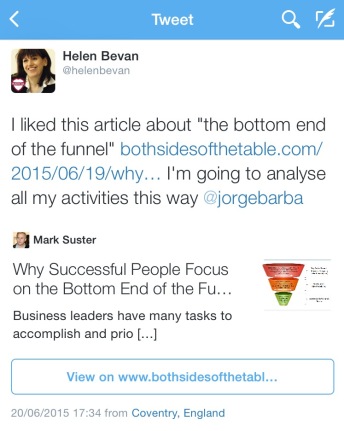
Reflections on Research – the pointy end of the funnel
Elsewhere in the Palliverse – Weekend Reads
This week’s reading list features stories from around the globe.
Telehealth helps to facilitate home-based palliative care in Taiwan, in one of a series of EAPC blogposts about palliative care in SE Asia (Cloud-based platform for palliative care at home)
Tailored care for older patients with cancer in Latin America: an imminent challenge (British Geriatrics Society blog)
“Although it is unrealistic to believe that someday every older adult with cancer will be treated by a geriatric oncologist, we should make every effort to offer geriatric training to all healthcare professionals and to create bridges between geriatrics and other medical specialties.”
Health advocate and heart attack survivor Carolyn Thomas on the physiological and emotional response to the fear of dying during a heart attack. Continue reading
Elsewhere in the Palliverse – Weekend Reads
I hope you enjoy this week’s reads, which include topics like wills, funerals, dementia, research ethics and the experience of a hospice nurse who becomes carer for her mother. I hope there’s no typos – I’m rushing off to a communication skills workshop but wanted to post this before I leave.
As always, please leave your thoughts in the comments box below.
- When Doctors Don’t Talk To Doctors. This happens far too often. (New York Times)
- Palliative care nurse Sarah Russell reflects on her experience as carer for her mother. (eHospice)
- Two recent pieces by Australian oncologist and writer Ranjana Srivastava: Happiness and the art of care and conversation on the cancer ward (The Conversation) and Dr Google is here to stay – and here to help (The Guardian). The latter made me think of patient advocate Jen Morris’ advice to doctors – if you tell a patient not to Google their condition, they’re likely to take that as a challenge.
End-of-life care: no, we don’t all want ‘whatever it takes’ to prolong life
This article originally appeared in The Conversation
Charles Corke, Deakin University
We all die eventually, of course, but these days it’s very hard for doctors and loved ones to let patients and relatives die without first doing “whatever it takes” to try to keep them alive. That is, unless they’ve left clear instructions to the contrary.
The overwhelming priority for doctors is to save life. In the last few decades, technologies have progressed so far and fast that doctors are able to embark on treatments that until recently did not exist, or were too risky to consider.
The extra years of good health are wonderful. But everything comes at a price. While we and our loved ones can often be kept alive, this may involve burdensome treatment and awful outcomes.
But while the default position of medicine is to prolong life, staying alive isn’t everyone’s number-one priority, as my soon-to-be published survey results reveal. Continue reading
Elsewhere in the Palliverse – Weekend Reads
Here’s the latest collection of reads for your weekend, with palliative care news from around the world, research and social media advice, and a palliative pet care story. As always, please enjoy and share your thoughts in the comments below.
Today is World Refugee Day, at a time when world refugee numbers are at their highest since WWII. A new Palliative Care in Complex Humanitarian Emergencies (PALCHE) network has launched to help address the unmet palliative care needs of the world’s >60 million refugees. Read about it (and find out how to get involved) at ehospice.
Happy 10th Birthday, Pallimed! Continue reading
3 Tips for Using Social Media to Read Articles More Efficiently
I’ve been asked how I have time to find and read so many palliative care articles, both in academic journals and the lay press (the type of thing that ends up in Elsewhere in the Palliverse posts). Is my nose constantly pressed up to a screen? Definitely not. Below I will share a few tips on how to read more efficiently using free social media tools and apps. Continue reading
Elsewhere in the Palliverse – Weekend Reads
I hope you enjoy this selection of articles (and some links to photos and videos) about palliative care, research and related topics. If you make it to the bottom, I’m interested to know what you think of the last link. Please share your thoughts, and any recommendations, in the comments section.
- “Why is so difficult to prognositicate?” asks neurologist Jules Montague, examining cases of poor prognostication throughout history. (Why doctors get it wrong, The Guardian UK)
- Team Palliverse still have a place in our heart for textbooks, and we love it even more when their editors write blog posts. To mark the release of the fifth edition of the Oxford Textbook of Palliative Medicine, the OUP blog is publishing a 3-part series titled “Facing the challenges of palliative care”. Part 1 (Continuity) and Part 2 (Development) are available now. (Oxford University Press)
Elsewhere in the Palliverse – Weekend Reads
I have so many links to share with you. Here are a few of them:
Australian critical care doctor and blogger Andy W writes about death and taxes and asks, “…why is it that we seem to spend so much time talking about the taxes, and not nearly enough about death?” Thought-provoking stuff. “The Things That Are Certain“, The Flying PhD
“Death isn’t failure. But avoiding these conversations is.” UK Palliative Care Physician Katherine Sleeman shares her story in this beautiful piece, “While medicine gets better, dying gets worse: Doctors are so good at saving lives that we forget about death.” (The Independent UK) Continue reading