Get Twitter-ready for the 13th Australian Palliative Care Conference #13APCC

Attending the 13th Australian Palliative Care Conference in two weeks? If you don’t have one already, now’s a great time to create a Twitter account and check out these handy tips about using Twitter at health conferences.

If you’re not attending the conference, then you can follow the #13APCC hashtag to see what conference attendees (including @palliverse) are sharing. You do not need a Twitter account to follow the hashtag, just follow this link for up to date conference tweets.

We will also be updating the Palliverse Facebook page during the conference.

Will you or your organisation be posting to social media from the #13APCC? If so, please share your details below so we can follow you!

Elissa (find me on Twitter @Elissa_Campbell)

Elsewhere in the Palliverse – Weekend Reads

photo by David Mao itsdavoI have a few palliative care links to share this week. If you’re not satisfied, we also share links on our Facebook page and Twitter account (you don’t need your own Twitter account to see what we’re posting), and you can check out our Elsewhere in the Palliverse archives.

At the End of Life Studies blog, Dr Naomi Richards examines the question, “Is the voluntary refusal of food and fluid an alternative to assisted dying“?

Talking About Dying Won’t Kill You, says Palliative Care Australia, writes comedian Jean Kittson (Sydney Morning Herald)

And a palliative care nurse told me that day after day she visited a person dying at home and day after day she walked into a house full of scented candles and rainforest music, until one day she said “Is anyone else sick of these scented candles?” and the family said “Yes”.  “And is anyone else sick of this rainforest music?” And the family said “Yes”. So the nurse said “Well, let’s open some windows, and what music does your mum like? OK, let’s put on some Stones.”

Continue reading

Elsewhere in the Palliverse – Weekend Reads

photo by David Mao itsdavoHere’s the latest collection of reads for your weekend, with palliative care news from around the world, research and social media advice, and a palliative pet care story. As always, please enjoy and share your thoughts in the comments below.

Today is World Refugee Day, at a time when world refugee numbers are at their highest since WWII. A new Palliative Care in Complex Humanitarian Emergencies (PALCHE) network has launched to help address the unmet palliative care needs of the world’s >60 million refugees. Read about it (and find out how to get involved) at ehospice.

Happy 10th Birthday, Pallimed! Continue reading

3 Tips for Using Social Media to Read Articles More Efficiently

3 Tips for Using Social Media to ReadI’ve been asked how I have time to find and read so many palliative care articles, both in academic journals and the lay press (the type of thing that ends up in Elsewhere in the Palliverse posts). Is my nose constantly pressed up to a screen? Definitely not. Below I will share a few tips on how to read more efficiently using free social media tools and apps. Continue reading

Elsewhere in the Palliverse – Weekend Reads

photo by David Mao itsdavo

I hope you enjoy this selection of articles (and some links to photos and videos) about palliative care, research and related topics. If you make it to the bottom, I’m interested to know what you think of the last link. Please share your thoughts, and any recommendations, in the comments section.

  • “Why is so difficult to prognositicate?” asks neurologist Jules Montague, examining cases of poor prognostication throughout history. (Why doctors get it wrong, The Guardian UK)
  • Team Palliverse still have a place in our heart for textbooks, and we love it even more when their editors write blog posts. To mark the release of the fifth edition of the Oxford Textbook of Palliative Medicine, the OUP blog is publishing a 3-part series titled “Facing the challenges of palliative care”. Part 1 (Continuity) and Part 2 (Development) are available now. (Oxford University Press)

Continue reading

#thickenedliquidchallenge with @DrMukeshH: Do thickened fluids benefit people with swallowing problems?

The team at GeriPal started the Thickened Liquid Challenge to raise awareness of the use of thickened liquids (or thickened fluids, as I know them) for people with swallowing difficulties. Thickened fluids are frequently prescribed to people with swallowing difficulties, but the evidence for their long-term benefit is unconvincing, as GeriPal’s Dr Eric Widera explains. In addition, they are unpleasant (as you will see from the videos!) and may result in reduced fluid intake and dehydration. You can read more about it (and watch many videos of the challenge) at GeriPal. Continue reading

Special guest post – Dr Chris Sanderson on #lettertome

Dear readers,

We are honoured to bring you a guest post, in fact two, and indeed we hope more, from the fabulous Dr Chris Sanderson, palliative care physician.  I have to say that I was so inspired by this idea, by putting patients at the centre of our communication, where they should be, that I totally stole this idea for my own Change Day pledge.

Below is part one of her description of her pledge for Change Day, #lettertome.

#lettertome : A twitter campaign to improve how we share information with patients.

Social media is such a wonderful space for spreading ideas – and sometimes the simplest ideas may convey a world of significance. Recently on twitter, there was a conversation between various doctors and patient advocates about how we speak to and about our patients, and the subject of doctors’ letters was raised. Thus was born a new hashtag, a pledge for Change Day Australia, and potentially a new way of doing things.

Continue reading

A resource to assist with Clinical Audit

Screen Shot 2014-12-30 at 10.03.32 pm

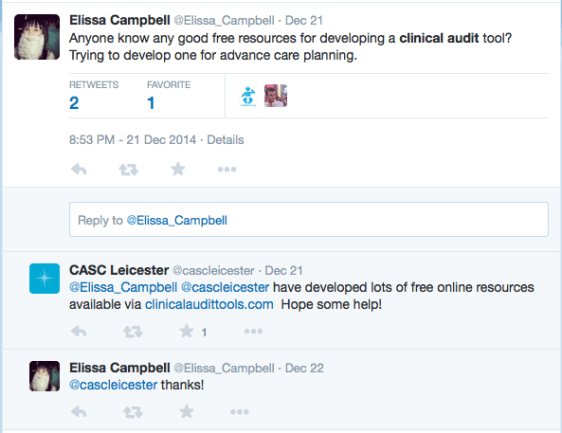
For many clinicians (including this one), their first foray into “research” is through clinical audit. The other day I was looking for some help to develop a clinical audit tool so, of course, I asked Twitter. The Clinical Audit Support Centre (@cascleicester) based in Leicester, UK, directed me to their Clinical Audit Tools resources – including some helpful interactive tools to assist you in deciding whether your project is a clinical audit, and whether it is “doable”. There’s also some blank Microsoft Excel templates to use in your own audit, a blog and a discussion board, which I am yet to explore.


Do you know of any other useful Clinical Audit tools? What are your views on the sometimes controversial topic of clinical audit?

Elsewhere in the Palliverse – social media edition

Social media is a broad term that includes all sorts of online platforms and interactions, from the blogs* I follow (and share) via my RSS reader, to Youtube videos, Facebook, Twitter, LinkedIn, slideshare and beyond.  This week’s “Elsewhere in the Palliverse” visits the intersection of social media, palliative care and research.

*including palliverse.com, of course!


Social media – health care hashtags

Greetings dear readers,

You may have caught up with past posts such as Twitter 101 and Twitter 102.

But, you may ask, how do I know which hashtags will be interesting for me?

Wonder no more. Here is a list from Symplur of healthcare hashtags.

The ones I look at are #HPMglobal (hospice and palliative medicine global), #HPM (you can work that one out), #HCLDR (health care leaders), #HCSMANZ (health care and social media Australia and New Zealand). There are some patient-centred ones I dip into like #BCSM (breast cancer social media) and #LCSM (lung cancer social media).

Continue reading