A resource to assist with Clinical Audit

Screen Shot 2014-12-30 at 10.03.32 pm

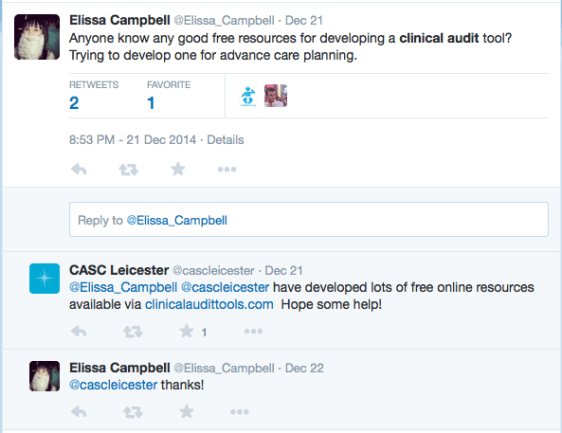
For many clinicians (including this one), their first foray into “research” is through clinical audit. The other day I was looking for some help to develop a clinical audit tool so, of course, I asked Twitter. The Clinical Audit Support Centre (@cascleicester) based in Leicester, UK, directed me to their Clinical Audit Tools resources – including some helpful interactive tools to assist you in deciding whether your project is a clinical audit, and whether it is “doable”. There’s also some blank Microsoft Excel templates to use in your own audit, a blog and a discussion board, which I am yet to explore.


Do you know of any other useful Clinical Audit tools? What are your views on the sometimes controversial topic of clinical audit?

Elsewhere in the Palliverse – social media edition

Social media is a broad term that includes all sorts of online platforms and interactions, from the blogs* I follow (and share) via my RSS reader, to Youtube videos, Facebook, Twitter, LinkedIn, slideshare and beyond.  This week’s “Elsewhere in the Palliverse” visits the intersection of social media, palliative care and research.

*including palliverse.com, of course!


What’s new in research?

New trial published in the Lancet Respiratory Medicine provides evidence for early integration of palliative care in patients with advanced disease suffering from breathlessness.

Higginson and colleagues randomised 105 people with advanced disease and refractory breathlessness (MRC dyspnoea scale score >2) to receive a breathlessness support service or usual care. The breathlessness support service involved, sequentially: 1) An outpatient clinic appointment involving assessment and treatment by respiratory medicine and palliative care clinicians, as well as a breathlessness information and management pack;  2) An allied health home assessment and promotion of self-management techniques approximately 2-3 weeks post the clinic; and 3) A final discharge planning outpatient clinic appointment with a palliative care clinician approximately 4 weeks post the clinic.

Mastery of breathlessness symptoms significantly improved for patients attending the breathlessness support service, compared to usual care (16% improvement, p=0.048). For patients with COPD and interstitial lung disease (but not cancer): survival rate from randomisation to 6 months was greater in those who attended the breathlessness support service (94%) versus usual care (75%), as was overall survival (p=0.048). Total health care costs calculated from patient-reported health service use were not significantly different between groups.

Have a read: http://www.thelancet.com/journals/lanres/article/PIIS2213-2600(14)70226-7/fulltext

Higginson IJ, Bausewein C, Reilly CC, Gao W, Gysels M, Dzingina M et al. An integrated palliative and respiratory care service for patients with advanced disease and refractory breathlessness: a randomised controlled trial. The Lancet Respiratory Medicine. 2014. 2(12):979-987. DOI: 10.1016/S2213-2600(14)70226-7

 

ANNOUNCEMENT – palliative research scholarship in Victoria AND travel grant

Research Masters or PhD Scholarship
The PCRNV will be offering a Masters or PhD scholarship in 2015 for Victorian students that are able to conduct high quality research into palliative care leading to immediate patient benefit.
The scholarship holder will be supported at his/her full salary for the duration of a full-time PhD (three years) or Masters (two years) to undertake research in palliative care. The successful applicant: will be enrolled as Masters or PhD candidate at a Victorian University; will have the majority of the research funded by the PCRNV completed within Victoria and; whom the Primary supervisor and applicant/student are based at a Victorian University (co-investigators and/or collaborators may work interstate or internationally).
The scholarship scheme is the result of a partnership between the Victorian Cancer Agency (VCA) and the PCRNV, and is designed to build research capacity in Victoria.
Stipends for the scholarship will be in line with NHMRC rates and are as followed:

Continue reading

What’s new in research?

Trial published in JCO suggests even experienced clinicians benefit from communication skills training… AND so do their patients!

A study by Fujimori and colleagues examined the effects of a person-centred communication skills training program for 30 oncologists who were randomised to either receive the training or not. A total of 1,192 patients who had consultations with participating oncologists reported their psychological distress, satisfaction, and trust in the oncologist. In addition, oncologists were objectively assessed on their performance and confidence in communication using simulated, videotaped consultations. Those oncologists who received the training improved on several communication outcomes. While the training did not significantly impact patient’s satisfaction with their oncologist, patients reported greater trust in their oncologist and less depression. Results suggest experienced clinicians (9.3 – 30.3 years of practice) can benefit from communication skills training, and accordingly, so do their patients.

Have a read: http://jco.ascopubs.org/content/early/2014/06/09/JCO.2013.51.2756.abstract

Study reference: Fujimori M, Shirai Y, Asai M, Kubota K, Katsumata N, Uchitomi Y. The effect of communication skills training program for oncologists based on patient preferences for communication when receiving bad news: A randomized controlled trial. J Clin Oncol 2014, June 9 [Epub ahead of print]

Elsewhere in the Palliverse – reading list

This TED Talk “How Not To Be Ignorant About the World” by Dr Hans Rosling (@HansRosling – Swedish medical doctor, statistician and Professor of International Health) and his son Ola Rosling is an entertaining and eye-opening look at how our biases and intuition lead to misconceptions. (For the record, I vote like a Swede – not a chimp.)

The beautiful poem Japanese Maple by the Clive James (written while he is dying) has been all over my social media feeds this week. Here’s The Guardian‘s take on why it’s resonating with people.

Bioethicist Ezekiel Emanuel writes in the Atlantic on Why I Hope to Die at 75. And here’s a rebuttal from Alex Smith at GeriPal.

Making a case for the integration of palliative care in policies on ageing and dementia – a European perspective (EAPC Blog)

More on dementia – Ageism and death anxiety (ehospice UK)

In Australia: Call for a Royal Commission into Nursing Home Care (ABC Radio National)

And a more positive look at residential aged care: A Nursing Home Can Be a New Beginning (Adele Horin)

An interview with the Groundswell Project (Dying Wishes – Australian Ageing Agenda)

The NHS (UK) has an End of Life Guidance app! (iTunes store)

The Institute of Medicine (US) released a report entitled “Dying in America: Improving Quality and Honoring Individual Preferences Near the End of Life.” There’s been a lot of discussion about it on palliative care social media and the mainstream media over the past week. Pallimed has a nice summary.

Terminally ill, but constantly hospitalised. (NPR)

Many Palliverse readers would be able to relate to this – The reality of nurses completing their own research (EAPC Blog)

If you haven’t already, consider signing the Montreal Declaration for palliative care (AHPCA Blog)

Also consider crowdfunding Little Stars, a movie about paediatric palliative care.


Striving for better research: Transparency, reproducibility, robustness

Transparency, reproducibility, and robustness… These are central concepts to undertaking thorough research that, importantly, can be replicated or reliably used by the broader field of science to advance medicine… or whatever field it is that we choose to dabble in.

The world’s most influential (i.e. ‘highly cited’) scientific journal Nature, with its impact factor of no less than 38.597 (Thomson Reuters, 2013), has drawn light to “the worrying extent” to which our research “have been found wanting” in terms of reproducibility.

It’s an interesting idea. While our research may be robust enough to pass the test of a reviewer, does it ensure sufficient transparency for reproducibility? And if indeed it’s not reproducible, how can we ever know it’s false?

Have a read: go.nature.com/huhbyr

Elsewhere in the Palliverse – Weekend Reads

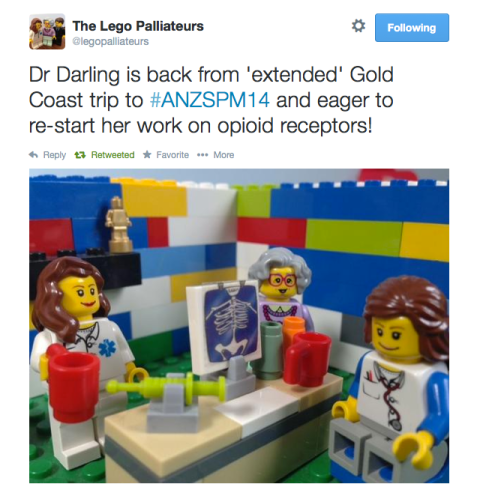
Hot on the heels of the @LegoAcademics come the @LegoPalliateurs. I think these Lego accounts are all the reason you need to try out Twitter!

legopall

Continue reading

Victorian Cancer Agency 2014 funding round

Attention all Victorian researchers!

The Victorian Cancer Agency is pleased to announce the funding round for 2014 is now open. The following grants are currently available: 

Clinical Research Fellowships 
Early Career Seed Grants 
Olivia Newton-John Cancer and Wellness Centre Supportive Care Research PhD Scholarship 

The following grant will be available soon: 

2014 Richard Pratt Fellowships for Prostate Cancer Research 

This application closing dates for all grants is 7 October 2014. 

All grant information is available at: www.victoriancanceragency.org.au/index.php/current-funding-opportunities   

Sonia