Denton lacks understanding of dying process – a social worker’s perspective

Euthanasia machine, displayed in Science Museum, London

Euthanasia machine, displayed in Science Museum, London

There has been much discussion about physician assisted death in the Australian media in recent weeks. Most of the voices have belonged to doctors (eg this one, this one, this one or this one) or Andrew Denton, with little airtime given to people with life-limiting illness, their family members, bereaved carers, or other professionals who care for the dying. We are sharing an opinion from an invaluable member of the palliative care interdisciplinary team, the social worker.

Below, palliative care Social Worker Zoe Mitchell responds to Andrew Denton’s recent article in The Age (“Doctors shouldn’t look away when dying patients are suffering“). Denton claims that according to palliative care philosophy, “while it is ethically unacceptable for a patient to choose a death that is quick and painless, it is ethically acceptable for them to choose a slow, painful death by dehydration and starvation.”

Zoe says, “I had so much respect for Andrew Denton until now. His article is full of false information about palliative care and shows a lack of understanding of the dying process.

I am no doctor, but I have spent over 4 years working with people who were dying, and while to us it may feel like we are ‘starving’ someone…we are not. When someone is dying and the body begins to shut down, it does not need food or fluids. If we force feed someone it can cause more discomfort and possible nausea and vomiting. If we force fluids into someone and their kidneys are shutting down, it just adds to their fluid overload – again causing discomfort, with fluid in the lungs and swollen limbs. Instead of forcing fluids and food on people with no appetite or thirst, we should be providing quality mouth care to ensure they do not have a dry or sore mouth.

The focus needs to be on good care, this is why we have palliative care. To provide holistic support to the dying person, the important people in their lives and the medical teams looking after them, but also to educate them on what a “good death” can look like.

Before we can even discuss the debate of voluntary euthanasia we need to bring the conversation back to how we can support people to not just die well, but live well until death. In order to do this we need more funding and resources to ensure good palliative care is accessible no matter where you live or your socioeconomic status.”

What are your views about Denton’s article, and nutrition and hydration at end of life? Regardless of your personal views on physician-assisted death, do you think he offers a fair depiction of palliative care? Please share below.

Many thanks to Zoe for contributing to the discussion.
3rd Australian Palliative Care Research Colloquium

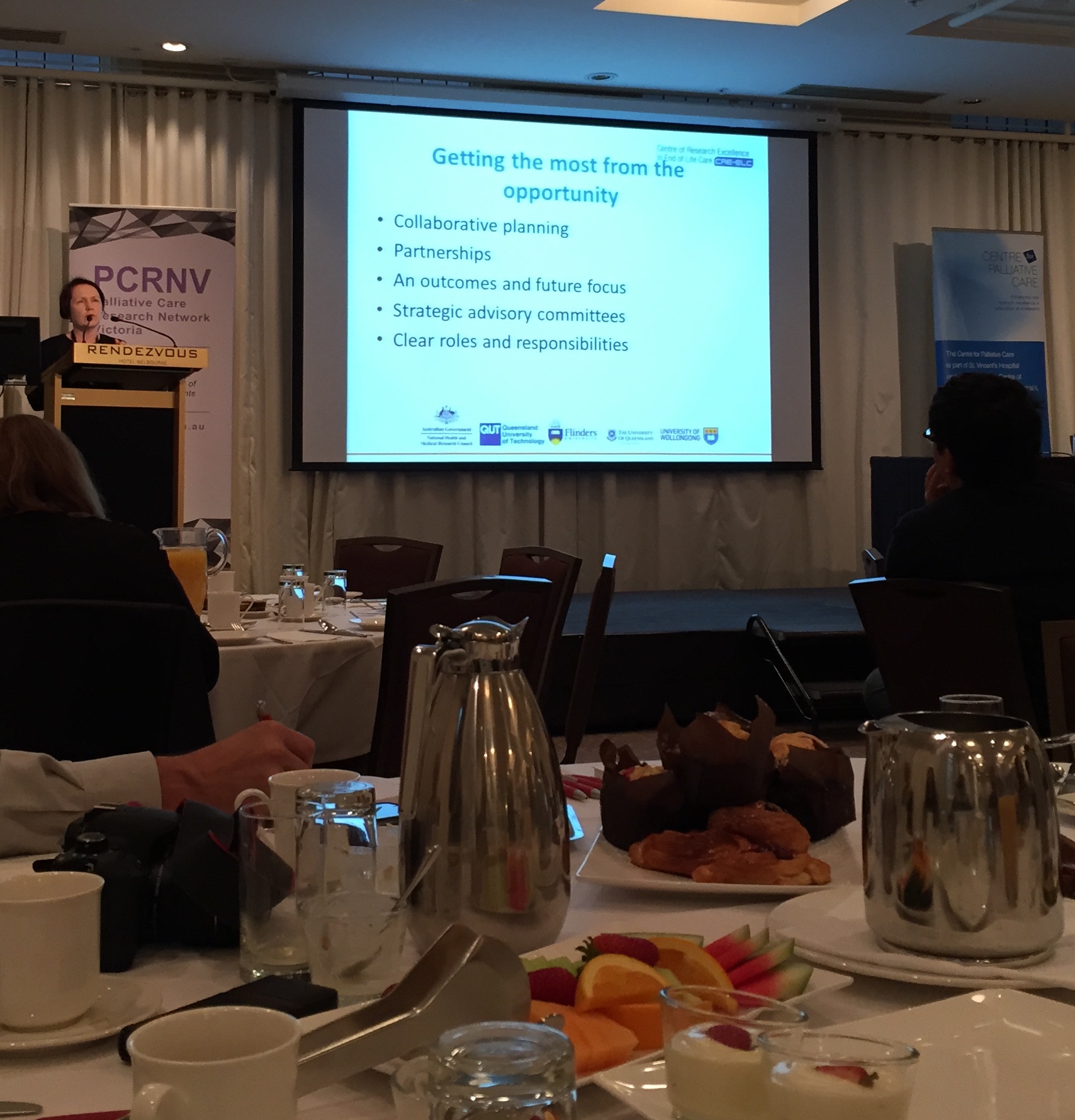
Prof Patsy Yates sharing her reflections on setting up a NHMRC Centre of Research Excellence in end-of-life care at the PCRNV Breakfast Forum

Prof Patsy Yates sharing her reflections on setting up a NHMRC Centre of Research Excellence in End of Life Care at the PCRNV Breakfast Forum

For the third year in a row, the Australian Palliative Care Research Colloquium was held at the Rendezvous Grand Hotel in Melbourne on October 22-23. The meeting was once again preceded by a breakfast forum hosted by Palliative Care Research Network Victoria (PCRNV), which served as a tempting entrée to the two-day main course of fantastic presentations and workshops exploring a diverse range of topics pertaining to palliative care research. Conversations about research continued over tea and meal breaks, next to quality poster presentations, and during the convivial conference dinner on the banks of the Yarra.  Continue reading

#SoMe (social media) meets palliative care again!

Palliverse loves a bit of #SoMe  interacting with palliative care discussions.

If we have not converted you to tweet chats yet, check out this transcript of the healthcare leaders weekly tweet chat which comes out of North America on a Wednesday 1130 AEDT. This week it was on Palliative Care (yay) but it’s often about change, innovation and patient experience in heath.

http://t.co/h8xF4PnUdx

It highlighted again for me the differences between palliative care in the USA and in Australia and New Zealand.  I know from hanging out on tweet chats out of the USA that often you must sign up to forgo all active treatments in order to qualify for hospice care.

I gave NZ a plug as an example of  a country with a good palliative care system (ahead of Aus cos I think NZ is better with community palliative care integration.) Was I right or wrong? What do you think?

Sonia xx

World Hospice and Palliative Care Day 2015

WHPCD15

World Hospice and Palliative Care Day is a global day of action organised by the Worldwide Hospice Palliative Care Alliance and held on the second Saturday of October every year. It aims to:

  • Raise awareness of the needs of people and families living with a life-limiting illness
  • Create opportunities to talk about the issues around improving access to hospice and palliative care around the world
  • Raise funds to develop and support hospice and palliative care services around the world

The theme this year is “Hidden Lives, Hidden Patients” – focusing on people whose palliative care needs are often not recognised, such as children, indigenous people, those living in rural settings, prisoners, soldiers, and lesbian, gay, bisexual, transgender and intersex individuals.

To help to raise awareness about “Hidden Lives, Hidden Patients”, Palliverse and Palliative Care Australia invite everyone to join us for a tweet chat on Thursday, October 8th using the hashtag #PallANZ  Continue reading

Elsewhere in the Palliverse – Weekend Reads

photo by David Mao itsdavoI have a few palliative care links to share this week. If you’re not satisfied, we also share links on our Facebook page and Twitter account (you don’t need your own Twitter account to see what we’re posting), and you can check out our Elsewhere in the Palliverse archives.

At the End of Life Studies blog, Dr Naomi Richards examines the question, “Is the voluntary refusal of food and fluid an alternative to assisted dying“?

Talking About Dying Won’t Kill You, says Palliative Care Australia, writes comedian Jean Kittson (Sydney Morning Herald)

And a palliative care nurse told me that day after day she visited a person dying at home and day after day she walked into a house full of scented candles and rainforest music, until one day she said “Is anyone else sick of these scented candles?” and the family said “Yes”.  “And is anyone else sick of this rainforest music?” And the family said “Yes”. So the nurse said “Well, let’s open some windows, and what music does your mum like? OK, let’s put on some Stones.”

Continue reading

MyPal Podcasts

cover170x170

Do you like technology? Innovation? Palliative care? Research? Why, these things are what @palliverse is all about – and why you/we are here in the first place!

Guess what? These things are exactly what the #MyPal podcasts from @amaranwosu are all about as well. How about that!

Check it out here and also on iTunes. Be amazed. Happy listening!

Elsewhere in the Palliverse – Weekend Reads

photo by David Mao itsdavo

This week’s reading list features stories from around the globe.

Telehealth helps to facilitate home-based palliative care in Taiwan, in one of a series of EAPC blogposts about palliative care in SE Asia (Cloud-based platform for palliative care at home)

Tailored care for older patients with cancer in Latin America: an imminent challenge (British Geriatrics Society blog)

“Although it is unrealistic to believe that someday every older adult with cancer will be treated by a geriatric oncologist, we should make every effort to offer geriatric training to all healthcare professionals and to create bridges between geriatrics and other medical specialties.”

Health advocate and heart attack survivor Carolyn Thomas on the physiological and emotional response to the fear of dying during a heart attack. Continue reading

Elsewhere in the Palliverse – Weekend Reads

photo by David Mao itsdavo

I hope you enjoy this selection of articles (and some links to photos and videos) about palliative care, research and related topics. If you make it to the bottom, I’m interested to know what you think of the last link. Please share your thoughts, and any recommendations, in the comments section.

  • “Why is so difficult to prognositicate?” asks neurologist Jules Montague, examining cases of poor prognostication throughout history. (Why doctors get it wrong, The Guardian UK)
  • Team Palliverse still have a place in our heart for textbooks, and we love it even more when their editors write blog posts. To mark the release of the fifth edition of the Oxford Textbook of Palliative Medicine, the OUP blog is publishing a 3-part series titled “Facing the challenges of palliative care”. Part 1 (Continuity) and Part 2 (Development) are available now. (Oxford University Press)

Continue reading

What don’t we need to do in palliative care research?

I’ve heard the question of what should we be doing in future research many times. But are there things we should not be doing in palliative care research? I’ve only heard this question asked once in a formal conference setting, and it elicited mostly stunned silence, followed by varying levels of opposition and attempts to reframe the question.

Why is this? Continue reading

Special guest post – Dr Chris Sanderson on #lettertome

Dear readers,

We are honoured to bring you a guest post, in fact two, and indeed we hope more, from the fabulous Dr Chris Sanderson, palliative care physician.  I have to say that I was so inspired by this idea, by putting patients at the centre of our communication, where they should be, that I totally stole this idea for my own Change Day pledge.

Below is part one of her description of her pledge for Change Day, #lettertome.

#lettertome : A twitter campaign to improve how we share information with patients.

Social media is such a wonderful space for spreading ideas – and sometimes the simplest ideas may convey a world of significance. Recently on twitter, there was a conversation between various doctors and patient advocates about how we speak to and about our patients, and the subject of doctors’ letters was raised. Thus was born a new hashtag, a pledge for Change Day Australia, and potentially a new way of doing things.

Continue reading