
PIANO lessons

Realisation

Photo by Anastasia Kalinkina on Unsplash

I arrived around the same time as the Eat My Lunch delivery arrived. This was a local social enterprise which had been set up and the concept was that if you bought a lunch, the company would provide a lunch to a student in need. The company had delivered some school lunches to be distributed to the students. From one of the other network attendees I learnt that the school also provided breakfast for the kids as well as lunch. The lady said that she helped with the breakfast serving at least once a week. She admitted to initially being against the idea, that she had believed that children’s nutrition was supposed to be under the remit of their parents. Over time she came to the realisation that due to personal circumstances this was not always possible, and that providing children with one or two meals a day really enhanced their health, and their learning ability. Since then she happily reported to duty each week, and sometimes even filled in shifts for other people.

Disconnection

Photo by Erik Mclean on Unsplash

A family had come back recently from the Islands, the husband was unwell with metastatic cancer. The teacher asked if the patient was under hospice. I thought that service was only for Palagi – The foreigner – the white people. Despite us having been the hospice for the local area for the past 35+ years local people still did not know that we were available to help our local community members regardless of who they are. A gap that we still haven’t been able to bridge despite many years of trying to connect. What we had done over the past three decades just wasn’t working. We need to try something different. The same old, same old just doesn’t cut it any more. What else can we do to make the connection? That we are here for people just like you. We have been trying to recruit to reflect our local demographic. For our staff to look like our community, and we are hiring for inclusion to encourage diversity of thought at all levels of our organisation. People like us look after people like you, we are one and the same.

Traumatisation

Photo by Andre Benz on Unsplash

The family had lost their father and husband due to a brutal act of violence at the local train station. His life was cruelly stolen from them, and the grief was too much for them to handle. They were lost, set adrift in a cruel sea of grief, with no land in sight, no hope of rescue. Every week they would visit the site of his death, the mother and the children, would weep and could not move on with their lives. This important local community hub held onto their agony with an iron grip. A local amenity that could not be avoided, became not just a place to catch a bus or a train, but a deva-station. Transporting them to a painful past, a tormented present and an uncertain future.


Guest Post – Naomi’s Notes – Acceptance

Photo by Markus Winkler on Unsplash

It had been one week since her husband passed away when she went to the cemetery to visit him. She wanted to go earlier but she had been too unwell.  She was tired from the effort of walking and was grateful she could rest on the seat of her walker.  She made her way slowly to her husband’s grave.  In the distance, she could hear the sound of someone sobbing.

She sat looking at the headstone and replayed in her mind memories of when they were together.  It was not her first experience of death, having lost her two year old daughter many years ago.

She recalled many weeks spent at the cemetery mourning her loss.   But then one night she had a dream of angels in a line descending from the sky, each one bearing a candle in their hand.   Then she saw her daughter but her candle was not alight. She rushed towards her daughter when she heard a voice telling her that it was her tears that kept her daughter’s candle from burning.

Continue reading

Bedside Lessons – 20 – Crossing the Line – Part 1

Photo by Max Böhme on Unsplash

I was working on the liaison psychiatry team in my final year of medical school. I went to meet a patient that had self-referred, which was unusual. Psych liaison provides psychiatric input for patients who also have medical issues that have brought them into hospital. I went with the nurse specialist to see the patient, an Englishman in his mid-thirties.

Work had brought him and his Latin American wife across the world. He was a nature documentary maker and had been based in the lower South Island filming the local wildlife. Just before Christmas he became unwell with a severe nosebleed, which required hospital intervention. Simple blood tests revealed grossly abnormal results. Acute Myelocytic Leukaemia (AM bloody helL) was the shocking diagnosis which destroyed their plans for Christmas and life in general. An urgent admission was arranged to our hospital’s Haematology department, which served the entire region. Harsh chemotherapy needed to be started otherwise our patient would’ve only had days left to live.

Continue reading

Bedside Lessons – 16. Summer Flies By

Photo by Max Griss on Unsplash

I opened the curtains this morning and there was a little fly. These have become ubiquitous in the past weeks as we have entered New Zealand’s summer. This fly was doing it’s thing near my bedroom windows and despite still being bleary eyed I tried to catch it with my bare hands. Using my whole hand did not work, the fly was able to weave it’s way between my fingers. After a few flailed attempts, I decided to change my strategy. I would try and catch it between the index finger and thumb of my preferred right hand. I went to grab it, and made contact. The fly was stunned and landed on the window sill, I promptly threw it out the window. Little did I know that this series of events would lead to a communications breakthrough later in the morning.

There was a tension in the room as we walked in. The patient was having suctioning done, but from the sounds of her breathing the fluid that needed to be cleared was deep in her main airways. As people near the end of their lives they are less able to cough, and so a tiny amount of fluid can pool, and these can result in a rattley sounds produced on breathing out. Just like when you are drinking something through a straw, at the end of a drink, a tiny bit of fluid can make a lot noise. The same occurs at the end of a life, a bit of fluid vibrating in a deep airway can be noisy, it probably doesn’t bother the patient so much but can be a source of distress to their family members, and even clinical staff.

The adult children, all of whom were parents themselves, were attentive but all looked scared with deep concern etched on their faces. Their beloved mother had been well up until only three weeks ago. Then a large brain bleed had come out of nowhere, rendering mother unconscious. Off to hospital, with many invasive procedures completed but no significant improvement obtained. The doctors and nurses had tried everything they could, but the patient remained unresponsive.

The family were told that their mother/grandmother was dying, but it took a while to sink in. It is usually hard enough to visit sick loved ones in the hospital, let alone during strict Covid-19 lockdown conditions. A very distressing time for the patient and her family. Their mother who had brought them up well, who was the beloved grandmother to their collected 7 children, was not going to be alive much longer. They hated to see her in such extreme distress, and were trying to help, but really did not know what to do.

Communication was crucial but to begin with the emotional temperature in the room was icy cold. An icebreaker was required as it was difficult to establish any rapport with the patient’s children. The patient herself had not been able to speak or respond for some weeks. Even using our mutual second-language, Mandarin Chinese, I had trouble connecting with the distressed family.

Something must have noticed and sent along a little helper, through the window. A fly was flitting around the patient and we tried to swot it away, but it was persistently dodging all attempts. I readied my special index finger and thumb technique that had served me well this morning, I was primed and ready to strike when the air in the room was disturbed by a whooshing sound.

Continue reading

I think therefore I am? – A definition of Grace

30117339256_85f66c74fa_b

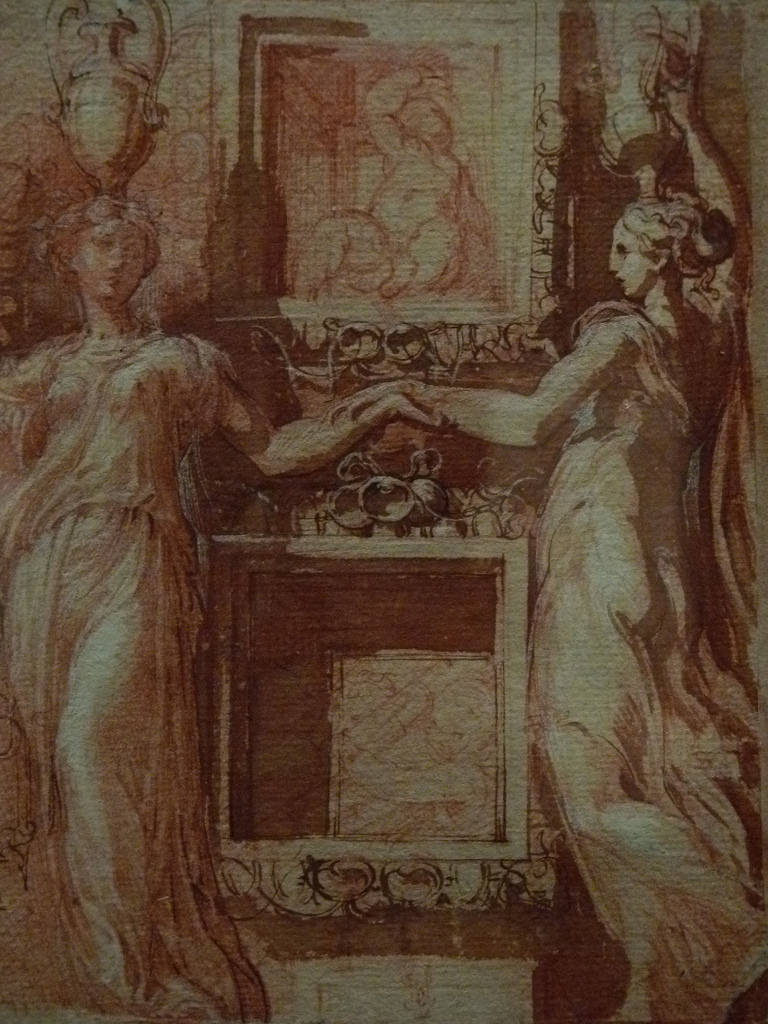
http://www.flickr.com/photos/144232185@N03/30117339256″>PARMIGIANINO,1534-35 – Deux Canéphores se donnant la Main (Louvre INV6466)

In healthcare it is important to set clear boundaries in order to care for yourself and your patients in a sustainable fashion. In the practice of palliative care, boundary setting is even more important, as the therapeutic relationship can be very intense and intimate at times. We have to keep in mind that this relationship will likely end soon, with the death of our patient. It can be a difficult balancing act; using your humanity to make important connections with another human being; while at the same time keeping professional distance to protect the both of you.

That being said, it is inevitable that there will be some cases which will hit you harder than others. When a deeper connection has been made, you will feel the loss and grief much more strongly. Informal reflection with your team members and professional supervision have an important role to play in keeping us palliative care providers safe to continue doing the important job that we have to do. We need to remind ourselves that this is a job that not everyone in healthcare can handle. That those of us who chose to work in palliative care, owe it to ourselves and our patients to look after ourselves. We are a precious resource and if we do not take care of ourselves, we will deny our patients and their families the difference that we can make in their lives, and deaths.

After almost ten years of working exclusively in full-time palliative care practice I would like to share a case that reminded me of just how human I am, and how much value I obtain from professional supervision and from sharing with my team members.

Continue reading

Living with grief & loss: #PallANZ chat

pallanz-201612

Grief and loss is something we will all face at different times throughout our lives. Whether it is the death of our pets, our friends, our children, siblings or parents; the experience and expression of grief in response to these losses can be a very personal and individual thing. Grief can also arise in anticipation of loss. For those living with life-limiting illness, living with the loss of social role and professional identity can be especially challenging.

Thoughts about old, new and future losses can be particularly common during the festive season. For some of us, it may represent an anniversary of the death of a loved one, and bring with it painful memories of loss. Some might be facing their first Christmas ‘alone’, while others may be grappling with the possibility of celebrating their ‘last Christmas’.

While living with grief and loss is a personal experience, we don’t have to endure it on our own. As a community, there are many ways that we can support each other. Join Palliverse and Palliative Care Australia CEO Liz Callaghan (@PCACEO) to reflect on 2016 and talk about grief and loss.

Carers and people with palliative care needs are especially welcome, as are health professionals, researchers, policymakers and interested community members!

If you are new to twitter and tweet chats, see our “idiot’s guide” here: https://palliverse.com/2014/09/03/idiots-guide-to-twitter-for-health-professionals-twitter-101/

Continue reading

Palace of Care – Driving too fast

https://www.youtube.com/watch?v=9OXqBQIA99c

It had all happened so fast, much too fast. Unwell on Tuesday, into hospital on Wednesday. It was all bad news, he was told that he had only possibly a week or two to live. Confronted with his imminent mortality he decided to go to Hospice. He was worried about how his family would cope with him at home, he wanted to make sure that they would be looked after.

They had always done everything together as a couple, right from when they were teenagers. They had made all the important decisions together. But when it came to the decision to go to Hospice he had made it on his own.

Continue reading

#PallANZ tweet chat

PallANZ 201512

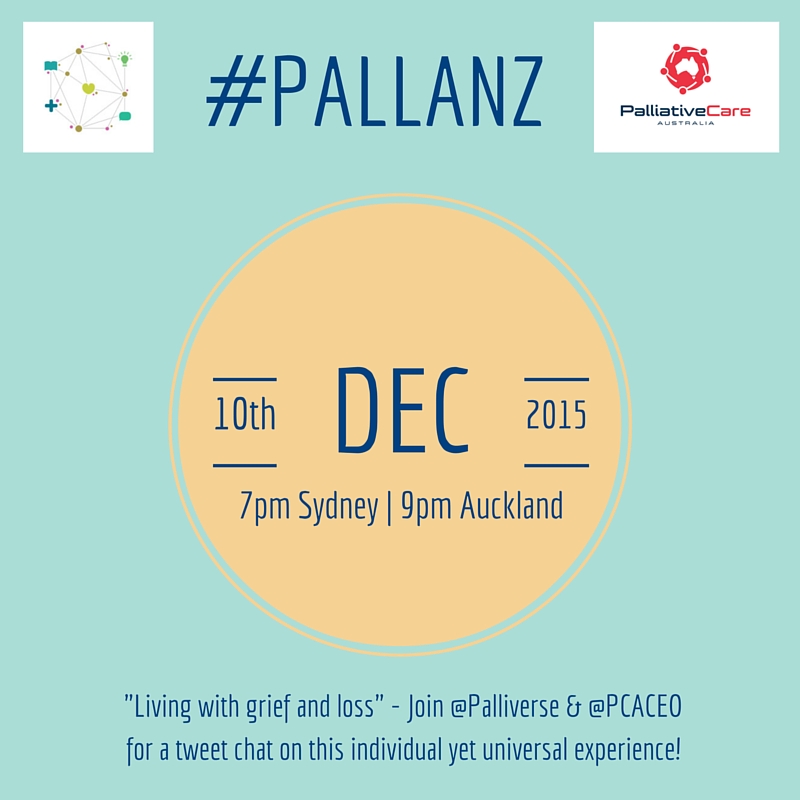
Grief and loss is something we will all face at different times throughout our lives. Whether it is the death of our pets, our friends, our children, siblings or parents; the experience and expression of grief in response to these losses can be a very personal and individual thing. Grief can also arise in anticipation of loss. For those living with life-limiting illness, living with the loss of social role and professional identity can be especially challenging.

Thoughts about old, new and future losses can be particularly common during the festive season. For some of us, it may represent an anniversary of the death of a loved one, and bring with it painful memories of loss. Some might be facing their first Christmas ‘alone’, while others may be grappling with the possibility of celebrating their ‘last Christmas’.

While living with grief and loss is a personal experience, we don’t have to endure it on our own. As a community, there are many ways that we can support each other. Join us to talk openly about living with grief and loss.

TOPIC                    Living with grief and loss

DATE / TIME       10th December, 2015 @ 1900 AEDT

MODERATOR     @Elissa_Campbell

T1 Have you experienced grief and loss? How would you describe it? And what did you need from those around you?

T2 How do children live with grief and loss? How are they different from adults?

T3 What kinds of support are there for people living with grief and loss in your community?

T4 As a community and as individuals, how can we better support those living with grief and loss during the festive season?

Elsewhere in the Palliverse – Weekend Reads

photo by David Mao itsdavo

Welcome to the 23rd edition of Elsewhere in the Palliverse. I hope you find value in this week’s links about palliative care and research – complete with animal story.

You’re welcome, animal-lovers.

As always, please share your thoughts in the comments.


Brand new blog DocGrief is “a dedicated space for health professionals to reflect and explore our relationship with death and grief, particularly when personally affected by a death in the family.” It was started by a rural GP based in South Australia. Her first post is heartfelt and I am following with interest. Continue reading

Elsewhere in the Palliverse – Weekend Reads

photo by David Mao itsdavoI have a few palliative care links to share this week. If you’re not satisfied, we also share links on our Facebook page and Twitter account (you don’t need your own Twitter account to see what we’re posting), and you can check out our Elsewhere in the Palliverse archives.

At the End of Life Studies blog, Dr Naomi Richards examines the question, “Is the voluntary refusal of food and fluid an alternative to assisted dying“?

Talking About Dying Won’t Kill You, says Palliative Care Australia, writes comedian Jean Kittson (Sydney Morning Herald)

And a palliative care nurse told me that day after day she visited a person dying at home and day after day she walked into a house full of scented candles and rainforest music, until one day she said “Is anyone else sick of these scented candles?” and the family said “Yes”.  “And is anyone else sick of this rainforest music?” And the family said “Yes”. So the nurse said “Well, let’s open some windows, and what music does your mum like? OK, let’s put on some Stones.”

Continue reading