Bedside Lessons – 14. Stuck in a moment

Photo by Karsten Winegeart on Unsplash

By the time of his admission he’d been on the steroids for six months, to counter swelling caused by brain metastases. His wife had stopped nursing at the GP practice in order to care for him.

He had been deteriorating in recent weeks and could no longer be reasoned with.

We couldn’t talk to him, he just stared at us blankly when we asked him questions, his wife had to answer for him.

She described him sitting on the bed eating mandarins spitting the seeds out onto the carpet.
She said that he would be horrified if he knew what he had been doing, as he was the tidiest person she knew and he had always been house proud.

The worst thing that had happened was after he had urinated on the bedroom floor having mistaken it for the toilet. He then slipped on his own urine and fell to the floor, luckily he did not hurt himself badly.

I asked if he had any seizures. She said that at times she had seen his arm going rigid, and then he seemed to be even less responsive. She had thought of seizures, but there was no jerking. She had mentioned it to the Oncologists but they had not looked into it any further.

I was intrigued by this. Could it be non-convulsive status epilepticus – repeated ongoing seizures without convulsions leading to decreased consciousness? His wife agreed to a trial of anti-seizure medication. If the medication didn’t make any difference we would stop it.

Continue reading

Palace of Care – It ain’t easy being green

Photo by Georgia de Lotz on Unsplash

She had been told that she would die soon, twice before, but she continued to outlive her prognosis. Stress levels were high, as this time she felt more unwell. Pain was worse and even her lifesaver wasn’t covering her symptoms.

She had complete faith in it, and often credited it as having saved her life. Before she had discovered it she had tried many legal medications but none of them had worked, or had produced intolerable side effects. She had never liked going to the doctor and preferred to have plant-based treatments from her naturopath. The green stuff had calmed her down, with minimal side effects. It had allowed her to go back to work, and she was able to be a mother again.

Being diagnosed with metastatic cancer had really been challenging, but extra doses of the natural product had helped to keep things calm. In recent weeks she had been admitted to hospital twice and was told that she was about to die twice of something called DIC (Disseminated Intravascular Coagulation.) The doctors had explained this as her clotting system going crazy, causing blood clots in her blood vessels, which were painful as blood supply was cut off to affected areas. A dangerous situation as clotting factors ran out, it meant that she was at great risk of bleeding. Caused by her cancer, and with no cure, hence she had been written off by her doctors twice before, and now it was third time lucky.

Continue reading

I think therefore I am? – Can social media help palliative care?

Photo by Matt Collamer on Unsplash

Hi folks,

You might have already come across Hospice Nurse Julie on TikTok.

In her short videos she explains things that we commonly see in end of life care.

Julie McFadden’s engaging videos have gone viral. Awesome!

How else could social media help us in terms of palliative care promotion?

How can we use these platforms for good?

How can we extend our reach further?

Who else can we help to extend their reach?

How can we help our friends and colleagues in other less developed places provide palliative care better?

Many of us around the world, myself included, did not feel at all prepared by health care school curricula which continue to lack palliative care education.

Personally, in my spare time, I am working on a freely downloadable “Dummies Guide to Palliative Care” book aimed at newbie health care practitioners. Contents to include: Did you know there are five main symptoms when people are dying? Here’s how to identify them, and treat them…

Please let me know if you are keen to contribute, as doing it by myself might take longer than if I had some helpers.

James

I think therefore I am? – In-between

Photo by Rohan Reddy on Unsplash

Palliative Care lies in between the usual medical culture of active treatment and the culture of death and dying. Was that what attracted me to Palliative Care, having lived as an in-betweener for most of my life? Growing up between two cultures; Chinese at home and mostly Eurocentric outside of home. This continued for me in University being part of the local Chinese Group but also being part of the newer Asian immigrant group. A bridge is needed between the two groups as the two different cultures can be different in many ways, and may think that they have little in common.

Standard healthcare is directed at saving life, curing disease, fixing things which are broken. Death is looked upon as the great enemy, something to be fought against, railed against until the dying of the light. People have to go to battle against their diseases, go to war, but when it comes to your own bodies the collateral damage may be too much too handle.

Continue reading

Palace of Care – What’s in a word?

Photo by Brett Jordan on Unsplash

It was the second admission for our patient and it was going to be his last one.

He had been beautifully cared for by his family over many months, but the last week had been terrible. He was agitated, restless, and did not know what to do with himself. His wife wanted him to come back into hospice for end of life care.

On admission he was only semi-conscious, agitated and not able to talk clearly. His body was so unwell that his mind was no longer able to be lucid. Although he tried so hard to be there, it looked as if he was in-between two worlds. His family reported that he was seeing ancestors that had died previously.

I didn’t mince words and tried to be as clear to them as possible. No surprises!

He is so unwell, so exhausted. He is dying.

I purposefully used the word dying at least five times during the 15 minutes of my visit.

Continue reading

Palace of Care – The Show Must Not Go On

Photo by Annie Spratt on Unsplash

Hey, welcome to our hospice.

I know that you put on the show for your friends and social media, but you don’t need to do that with us. You don’t have to be all right when you are feeling anything but.

We need to see the real you in order to be able to really help you.

We know how strong and tough you are.

Please don’t use up your precious energy telling us what you think we want to hear.

I will be honest with you but I want you to ask for help when you need it.

We will always use as little medication as we can, but we do not want you to put up with discomfort, we don’t want you to struggle.

We are really keen to help you, if you’ll let us.

Can you do that?

What would make this place feel less like a hospital for you?

Please bring in your own stuff to decorate the walls.

You have made brave decisions recently to stop treatment, which I fully support.

I’d be happy to explain things to your partner when they come in.

Listen to your body, don’t push yourself. Rest when you need to, think of it as a recharge. Ask for help when you need to.

Save your energy for nicer things, more important activities, like spending time with your partner.

If there is anything you disagree with, please let us know.

We’d like to give you back some control of your situation, completing the advance care plan will help.

We are on your side and will be guided by what you want, or don’t want.

Thanks for giving us a go.

Palace of Care – Unfinished Business

Photo by Firmbee.com on Unsplash

I don’t feel well. I’m having trouble breathing. I feel so tired, but all I do is sleep. I’m feeling too weak to walk to the toilet, I almost fell over last night.

The nurses told me that you’ve had bad pain, but that you didn’t want to take pain relief.

I need to finish sorting out my legal affairs, I don’t want to leave too much for my friend to have to deal with.

Our social worker can help you with that stuff, she can talk to your friend. What else is bothering you? You look worried.

Doctor, I think I don’t have much time left, I feel so terrible, I don’t even have energy to talk to my sisters back home. Why do I feel so bad?

You’re getting worse, it’s the cancer, your body can’t handle it anymore. I think you are dying, and you might only have days left to live.

I thought so, I just need to sort my stuff out…

Then you’d be able to let go?

Yes, I don’t think I can hold on for much longer.

I think I can make you more comfortable, putting up with pain will use up your energy even faster, and make you more tired. Can I increase your pain relief a bit? It might make you less tired.

Okay, if you think it will help.

We’re going to get you through this, and even if you fall asleep we will continue to try to make you comfortable. We’re going to get you through this. This is our social worker, she can help you with your stuff.

Thank you doctor.

Please let us know if there is anything else we can help you with. I’ll see you later.

[Wave goodbye]

Palace of Care – Lockdown Locks and Roadblocks

Photo by Mirza Babic on Unsplash

You really need a haircut.

Yeah, lockdown hair. I usually look different, like in my ID photo, I have a nose and a mouth under my mask.

So what do you want?

I’m here to find out how you are.

I can’t keep anything down, whatever I swallow comes back up. I’m too scared to eat anything. There’s something wrong with my poos too, haven’t been for four days, usually go twice a day. Last time it was black and sticky.

Do you have pain?

No, no pain but my tummy is getting bigger, sometimes it’s hard to breathe.

Hmm, listening to your tummy it’s very quiet on the left side, but loud on the right side. What do you think is going on?

I’m feeling worse, much more tired the last few days. What’s happening in my tummy?

We know that you have cancer in your tummy. It can act like speed bumps on a road, slowing down your gut traffic, that’s why your poos have slowed down. If there are enough speed bumps in your tummy they can act like a road block, then traffic can’t get through, and has to come back up, that’s why you’ve been vomiting. We can try to loosen up the roadblock with steroid medication, and we can try and push the traffic through with another medication, but…

But…Go on tell me, I need to know.

Continue reading

I think therefore I am? – My Toe Con Dryer?

Photo by Braňo on Unsplash

Here’s a short story that I have shared with children of various ages who are losing or have lost their mothers.

Prior to Medical School I completed a Biochemistry degree. I learnt all about the important biochemical reactions that sustain life as we know it. Some of the most important reactions require mitochondria, which are present in each and everyone of our cells.

Mitochondria can be thought of as the power plants of each cell. They allow energy to be released, keeping each cell, and each person alive. Without mitochondria we could not live at all.

Another special thing about Mitochondria is that they were likely an introduced species, likely to have developed on their own. Millions of years ago they struck up a relationship with the rest of the cell, and the successful partnership has continued on ever since.

An interesting thing about mitochondria is that they are only passed onto the next generation by the female of the species. Thus in each cell of our bodies there exists a tiny part of our mother, our mitochondria, which if not present, we could not be alive at all.

This started when the very first mother passed on her mitochondria to her children, and from her female children to their children, right until the current day.

No-one can ever take mum away from you. Even though mum may be dying, she will live on in every single cell of your body, along with your memories of her.

Healthcare communication – A network for our region

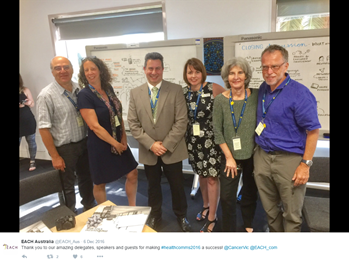
Palliverse was lucky enough to be present for the excellent Teaching communication in Healthcare conference in Melbourne hosted by the Cancer Council Victoria last December.  At this conference multiple members of the European Association of Healthcare Communication including Jonathan Silverman and current president Evelyn Van Weel -Baumgarten joined local representatives of EACH Peter Martin and Megan Chiswell.
healthcomms
During the event the key message was of the importance of communication skills to be able to provide care that is patient-centred, empathetic, safe, ethical, efficient and high-quality.  Unlike many other clinical skills communication is also largely universal in that it is practiced by clinicians in all encounters.  Supporting communication skills education is therefore a critical way of improving the quality of care provided by our healthcare system.

Continue reading