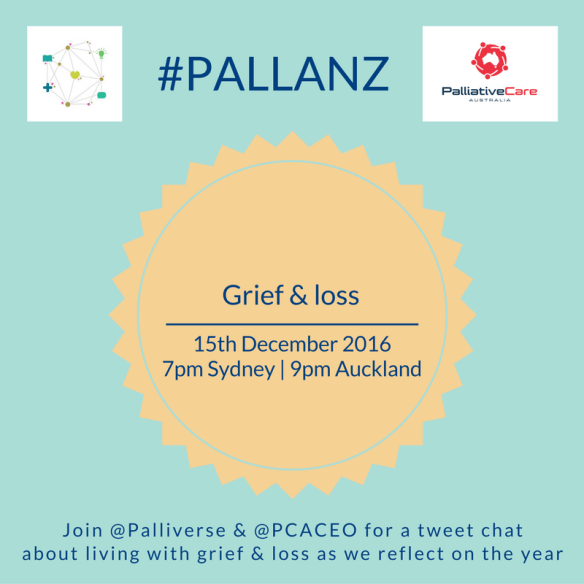
Living with grief & loss: #PallANZ chat

pallanz-201612

Grief and loss is something we will all face at different times throughout our lives. Whether it is the death of our pets, our friends, our children, siblings or parents; the experience and expression of grief in response to these losses can be a very personal and individual thing. Grief can also arise in anticipation of loss. For those living with life-limiting illness, living with the loss of social role and professional identity can be especially challenging.

Thoughts about old, new and future losses can be particularly common during the festive season. For some of us, it may represent an anniversary of the death of a loved one, and bring with it painful memories of loss. Some might be facing their first Christmas ‘alone’, while others may be grappling with the possibility of celebrating their ‘last Christmas’.

While living with grief and loss is a personal experience, we don’t have to endure it on our own. As a community, there are many ways that we can support each other. Join Palliverse and Palliative Care Australia CEO Liz Callaghan (@PCACEO) to reflect on 2016 and talk about grief and loss.

Carers and people with palliative care needs are especially welcome, as are health professionals, researchers, policymakers and interested community members!

If you are new to twitter and tweet chats, see our “idiot’s guide” here: https://palliverse.com/2014/09/03/idiots-guide-to-twitter-for-health-professionals-twitter-101/

Continue reading

free Australian webinars on advance care planning and palliative care

Ilsa Hampton_Feb 2016 2MB_100px.jpg

Decision Assist is running a series of free webinars on advance care planning and palliative care.

For those of you new to webinars, you can watch the presentation live on the internet and interact with the presenters, or just watch the presentation later. Some health services and aged care facilities are watching them together as part of their continuing professional development or education programs.

Here is a link to register. The next one is presented by Ilsa Hampton, CEO, Meaningful Ageing Australia

Decision Assist Aged Care Webinar Series – Grief, trauma and loss
Tuesday 6 December 2016 | 1.30 pm – 2.15 pm AEDT

http://www.webcasts.com.au/decisionassist061216/

Regards, Sonia (who also works for Decision Assist!)


Calling palliative care health professionals for online research experiment – now open worldwide!

If you could only admit one patient to your service today but you have many referrals, which patient would you choose?

FloorBoss XL™ Free-Standing Sign - High-Impact Plastic 25in.H x 12in.W

Palliative Care is in urgent need of a robust and evidence-based system for triaging referrals in an equitable, efficient and transparent manner. If you are a health professional working primarily in palliative care anywhere in the world with at least two years of experience, we want to know your views!

Please take part in this world-first online experiment at  www.tinyurl.com/palliativetriage or for more information contact Dr Beth Russell by email beth.russell@svha.org.au or twitter @DrBethRussell

#4APCRC: 4th Australian Palliative Care Research Colloquium

audience

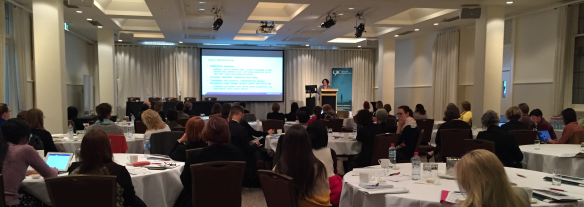
Members of team Palliverse had the pleasure of attending the 4th Australian Palliative Care Research Colloquium between October 27-28th, which was once again held in the comfortable surroundings of the Rendezvous Hotel in Melbourne, Victoria.  Continue reading

#ANZSPM16 tweet chat: Medicinal cannabis and palliative care

anzspm16_medicinal_cannabis

In recent years scientific research into the effects of cannabinoids has been on the increase. Some would say that not-so-scientific research on the effects of cannabis has been underway for many hundreds of years, in many different countries and cultures.

Until recently I didn’t know that our own bodies produce endogenous cannabinoids, the various effects of which are still being studied. 

Two years ago, colleagues had informed me that at the Montreal Conference 2015 it was a ‘smokingly hot’ topic. The most widely studied cannabis-derived cannabinoids are Cannabidiol (CBD) and Tetrahydrocannabinol (THC.) You may have heard of some of the medications that have ‘come to market’ since then:  Continue reading

I think therefore I am/Palace of Care – Hospice New Zealand 2016 Conference Keynote Presentation

Hi everyone,

Here is a copy of my slides from the Keynote presentation that I made on 16/09/16 at the Hospice New Zealand 2016 Conference.

I was intentionally being provocative and I was purposefully trying to challenge the audience’s mindset with the material that I presented, as I believe that New Zealand Hospice/Palliative Care needs to be “shaken up,” if it is to remain relevant. Now it’s your turn, you have been warned…

This slideshow requires JavaScript.

I am working on a version which will have clickable links, and also on a recorded live performance of the presentation. In the meantime the slides with comments have been loaded onto the Palliverse Instagram account.

Cheers,

James

#ANZSPM16 tweet chat: the (hidden) cost of caring

anzspm16-cost-of-caring

A game changer at the recent Australian and New Zealand Society of Palliative medicine 2016 Conference (#ANZSPM16) was Dr Merryn Gott’s plenary presentation on the hidden costs of caring. Little is known about the financial impact of caring for people at the end of life.

She detailed some powerful anecdotes, including the story of two sisters whose mother lay dying in a hospital. The cost of parking was prohibitive and the daughters took it in turns to sit in the car watching out for the parking inspector. When their mother died, only one of the daughters was there; the other was in the car. Continue reading

Art therapy for the palliative care clinician

painting-1

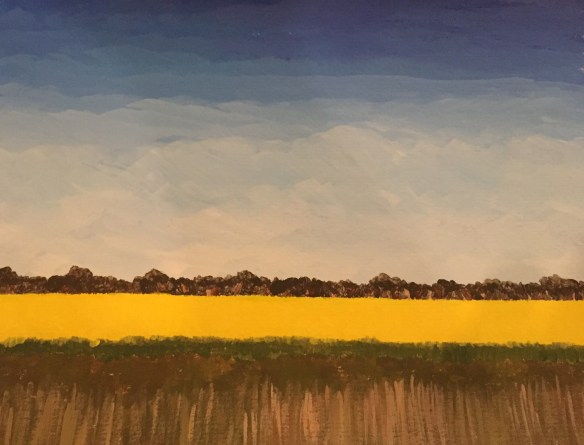
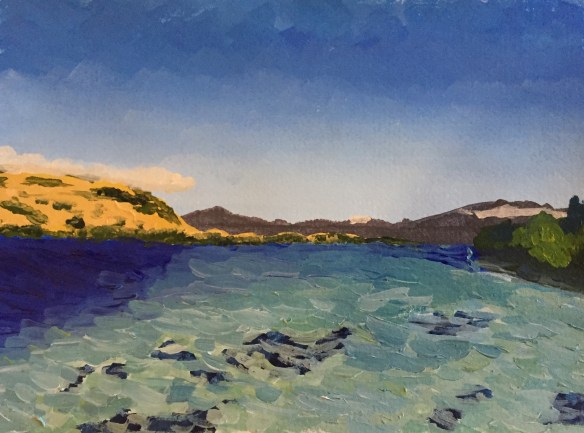
I had wanted to learn to paint for many years, and finally found the time to take some classes during my research fellowship year. It was really good fun and I loved it. Unfortunately, my fellowship year soon finished and clinical commitments meant I could no longer attend the classes.

art-therapy-1

Nevertheless, I decided that I would keep painting, once a week (usually on a Wednesday), just for me. At the end of a busy day, it’s often easier to just slump on the couch and watch some TV. I’ll be honest, sometimes the couch wins. However, I do manage to drag myself out of the house again most Wednesdays, get myself down to the studio for a couple of ours of what I fancifully call my ‘art therapy’ before bed. And when I do, I never regret it.

art-therapy-2

As you can see, I’m just a beginner and still have a lot to learn about painting. But I love losing myself in the work, just thinking about form and colour – anything other than patients and families and suffering and medicine, or audits or guidelines or research or presentations. I also love heading out and painting outdoors when I can get away.

img_5035

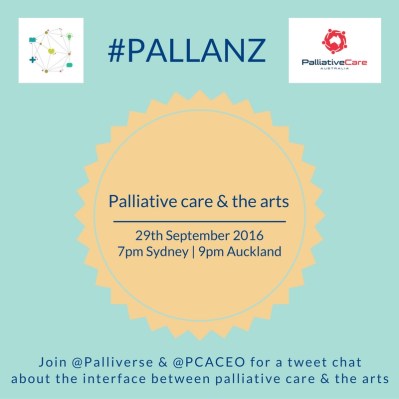
If you also like painting, or any other form of art – please join us for #PallANZ tweet chat on the 29th, which will be on the topic of “palliative care and the arts”! You can find the details here.

#pallanz tweetchat 29/9: Palliative care and the arts **N.B. This chat will be at 10pm NZT due to daylight savings**

pallanz-201609

For as long as our culture has being making art death, dying, and exploring the meaning of our fragile mortal lives have been key themes.  Historically the arts have framed our practices around preparing for dying, celebrating lives, and pondered the traverse into the unknown.  Artists of antiquity often used their media to describe the care for the dying and the dead, reflecting a palliative focus of the arts which continues to this day.


Continue reading

#ANZSPM16 Wrap up

This slideshow requires JavaScript.

Days two and three of the Australian and New Zealand Society of Palliative Medicine (ANZSPM) 2016 Conference: The Changing Landscape of Palliative Care was just as brilliant as the first. The plenary sessions featured:

  • Merryn Gott (@MerrynGott) spoke about the ‘last taboo’ in our community: the invisible and sometimes unexpected costs of providing care at the end of life, which are often not explored in clinical and almost never measured in policymaking and research. She also discussed  the impact of culture, ethnicity and gender on who is bearing these financial and non-financial costs. To find our more, read her open access @PalliativeMedJ article here.
  • Meera Agar (@meera_agar) discussed the growing evidence base around delirium care in the palliative care setting. Management of this complex, distressing, life-threatening, but often reversible syndrome is challenging. Non-pharmacological strategies and a system-wide approach to organizing and delivering care are crucial, as research into various drug treatments continue to demonstrate a lack of clear benefit and the potential for harm. Meera recommends iDelirium for more information about this important area of palliative care.
  • Pippa Hawley reflected on the lack of evidence around the use of medicinal cannabis – despite the immense interest from (and considerable experience of) our communities. How should clinicians respond while the scientific and legal issues are sorted out? Ask questions, keep an open mind & work with our patients!
  • Douglas McGregor explored the interface between heart failure and palliative care. He referenced Sarah Goodlin’s open access article, Merryn Gott’s study while discussing prognostic uncertainty and clinician paralysis; and observed that most guidelines still see palliative care as relevant only at the very end of life, rather than a key component of chronic disease management. Amy Gadaud’s (@agadoudreview was flagged as a good place to start when considering issues around early integration.
  • Sam Bloore stimulated and inspired delegates with his fascinating talk about dying well in a culture of bitcoin and botox. How can palliative care adapt, survive and thrive in this changing cultural landscape characterized by information overload, mindless distraction and incoherence? We must remain a “subversive” counterculture and continue to strive towards caring deeply and meaningfully!

In addition to these amazing plenaries, fully (and at times even over-)subscribed workshops on the overlap between palliative care and addiction medicine / chronic pain, aged care, literature and the arts were held, alongside numerous excellent oral and poster presentations from specialists and trainees. The enthusiastic and well-informed audience present during all of the sessions was another highlight for me (and I’m sure all of the other speakers and delegates)!

It’s been a wonderful few days in Perth. A big thank you to the Conference organizing committee, chaired by Derek Eng (@dr_engd), for inviting team @Palliverse to be part of this great event. Thanks also to all of you for engaging with #ANZSPM16 on social media. Keep an eye out for our upcoming tweet chats, during which we will continue the conversation about the changing landscape of palliative care!