Living every moment when you’re dying

In New Zealand last week we celebrated Hospice Awareness Weak and to tell you the truth I’m not sure how impactful the week actually was. Continue reading

In New Zealand last week we celebrated Hospice Awareness Weak and to tell you the truth I’m not sure how impactful the week actually was. Continue reading
Whatever will be, will be.
He tells me, with a tear in his eye, “She’s my sweetheart.”
She smiles weakly, and her eyes brighten.
He gently kisses her hand in a loving manner.
“No, I am ready.”
“Are you scared?”
“I think I’m dying.”
This blogpost is dedicated to a patient that I never thanked for the part she had to play in my palliative care education.
The sharing of patient stories can have a huge role to play in the education of healthcare practitioners and laypeople. Palliative Care health literacy remains relatively low despite palliative care services having been present in Australia and New Zealand for well over three decades. Relatively few healthcare practitioners let alone members of the general public understand the role that palliative care services can have in the improvement of quality of life. Are we sharing the right stories, in the right places, to the right people?
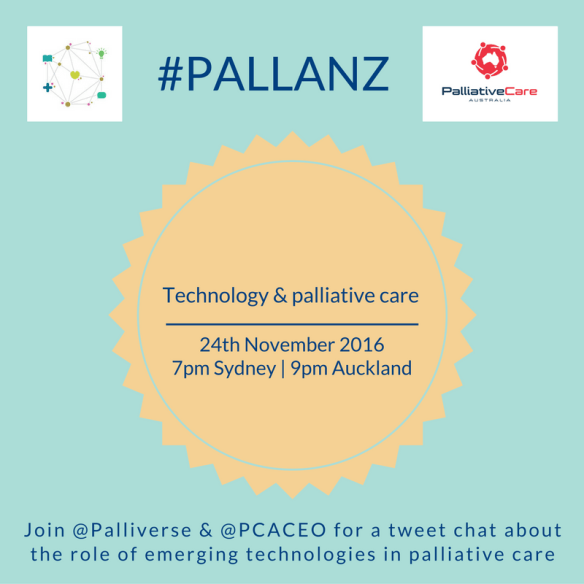
“Never the twain shall meet,” has been the oft repeated refrain when it comes to technology and palliative care.
Palliative care has traditionally focused on providing ‘low-tech and high-touch’ services, are these concepts outdated or have we entered an era of algorithm-driven automaton provided health-care(?) In the next 20 years, 47 to 81% of jobs in the future will be threatened by developing technologies, are palliative care jobs at risk as well? Can the tin-man actually do the job as well if he doesn’t have a heart?
Has science-fiction become science-fact? The team at Melbourne’s own Anatomics are leading the way with custom-made 3D-printed patient implants. What possible impacts could 3D-printing have on palliative care provision? Continue reading

In recent years scientific research into the effects of cannabinoids has been on the increase. Some would say that not-so-scientific research on the effects of cannabis has been underway for many hundreds of years, in many different countries and cultures.
Until recently I didn’t know that our own bodies produce endogenous cannabinoids, the various effects of which are still being studied.
Two years ago, colleagues had informed me that at the Montreal Conference 2015 it was a ‘smokingly hot’ topic. The most widely studied cannabis-derived cannabinoids are Cannabidiol (CBD) and Tetrahydrocannabinol (THC.) You may have heard of some of the medications that have ‘come to market’ since then: Continue reading
Hi everyone,
Here is a copy of my slides from the Keynote presentation that I made on 16/09/16 at the Hospice New Zealand 2016 Conference.
I was intentionally being provocative and I was purposefully trying to challenge the audience’s mindset with the material that I presented, as I believe that New Zealand Hospice/Palliative Care needs to be “shaken up,” if it is to remain relevant. Now it’s your turn, you have been warned…
I am working on a version which will have clickable links, and also on a recorded live performance of the presentation. In the meantime the slides with comments have been loaded onto the Palliverse Instagram account.
Cheers,
James
Hello to my Kiwi brothers and sisters.
Tonight’s tweetchat will be at 10pm NZT, we forgot to factor in the recent daylight savings time change. Please accept our apologies.
James only noticed when he dialled in one hour early to a teleconference with the rest of the team – Talk about feeling like a Nigel No-mates!
Catch you later on if you are still awake.
Cheers,
James for Team Palliverse.

What would happen after the joyous reunion of Poppa and Junior? This was a question asked at our multidisciplinary meeting two and a half months ago. From the accumulated experience of our staff members we thought it could go either of two ways:
It was with great sadness that we learnt that Palliverse contributor Elizabeth Caplice had died.
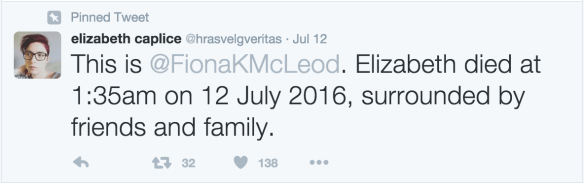
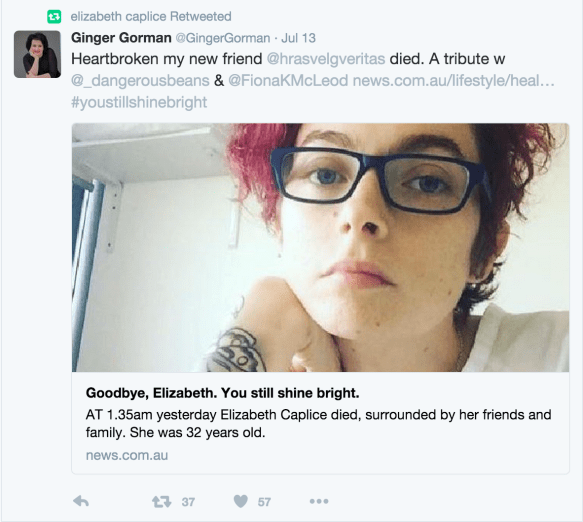
Click here to read Ginger Gorman’s report.
Thank you Elizabeth for your contributions to Palliverse, and for your advocacy for Palliative Care.
Thank you for trying to make the world a better place.
We’d like to extend our deepest condolences to Alex and your loved ones.
Rest in peace Elizabeth.
James Jap on behalf of the Palliverse community.

Cape Reinga the northern-most tip of New Zealand, where the spirits of Maori depart on their final journeys. Photo by Gadfium.
The first time I met the young ladies I had been cross-covering at the hospital, and was taken to see each of them as they both had severe pain and discomfort. They came from completely different backgrounds, had lived completely different lives but somehow ended up on the same journey.
About a week or so later they had both been admitted into our inpatient unit for pain control. Adjustments were made and they became more comfortable, but a few days later pain had returned again, as well as other problems. We had to aim at constantly moving targets, and so it would be over the next three months of their individual roller-coaster rides.
The similarities were startling; the same diagnosis, the same poor response to treatment, and in the end the same prognosis. What was completely different was their individual experiences of the same outcome. Continue reading


 palliverse.com