
Elsewhere in the Palliverse – reading list

This TED Talk “How Not To Be Ignorant About the World” by Dr Hans Rosling (@HansRosling – Swedish medical doctor, statistician and Professor of International Health) and his son Ola Rosling is an entertaining and eye-opening look at how our biases and intuition lead to misconceptions. (For the record, I vote like a Swede – not a chimp.)

The beautiful poem Japanese Maple by the Clive James (written while he is dying) has been all over my social media feeds this week. Here’s The Guardian‘s take on why it’s resonating with people.

Bioethicist Ezekiel Emanuel writes in the Atlantic on Why I Hope to Die at 75. And here’s a rebuttal from Alex Smith at GeriPal.

Making a case for the integration of palliative care in policies on ageing and dementia – a European perspective (EAPC Blog)

More on dementia – Ageism and death anxiety (ehospice UK)

In Australia: Call for a Royal Commission into Nursing Home Care (ABC Radio National)

And a more positive look at residential aged care: A Nursing Home Can Be a New Beginning (Adele Horin)

An interview with the Groundswell Project (Dying Wishes – Australian Ageing Agenda)

The NHS (UK) has an End of Life Guidance app! (iTunes store)

The Institute of Medicine (US) released a report entitled “Dying in America: Improving Quality and Honoring Individual Preferences Near the End of Life.” There’s been a lot of discussion about it on palliative care social media and the mainstream media over the past week. Pallimed has a nice summary.

Terminally ill, but constantly hospitalised. (NPR)

Many Palliverse readers would be able to relate to this – The reality of nurses completing their own research (EAPC Blog)

If you haven’t already, consider signing the Montreal Declaration for palliative care (AHPCA Blog)

Also consider crowdfunding Little Stars, a movie about paediatric palliative care.


How to participate in #hpmJC – palliative care Twitter journal club

Interested in Twitter journal club but not sure what it’s all about? Keep reading.
The next #hpmJC will be held on 29th September 2014, 10pm AEST (noon GMT). It will be hosted from the UK by Dr Ollie Minton (@drol007). The article to be discussed is Diagnosing dying: an integrative literature review, by Kennedy et al. It’s available via open access from BMJ Supportive and Palliative Care.

Twitter journal club is a regular (approximately monthly) “tweet chat”. Unlike a traditional journal club, participants are located all over the world, giving a global perspective to the discussion and sharing their local practices. Sometimes the study authors participate!You don’t need a Twitter account to watch the discussion – simply go to twitter.com and type #hpmJC into the search bar in the top right-hand corner of the page. An even easier option is to visit a website like tweetchat.com or tchat.io – these websites automatically update when anyone tweets with the #hpmJC hashtag. Again, you don’t need to sign in to use these websites.

Continue reading

Elsewhere in the Palliverse – Weekend Reads

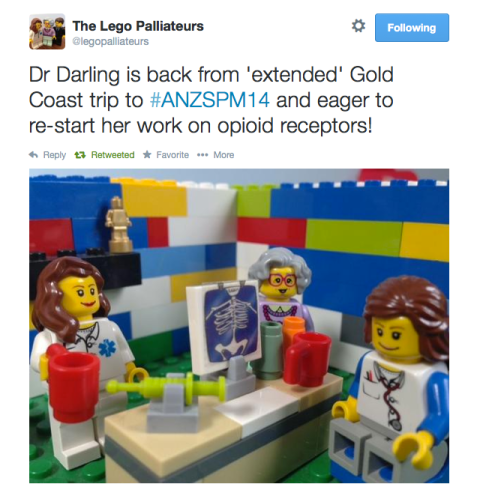
Hot on the heels of the @LegoAcademics come the @LegoPalliateurs. I think these Lego accounts are all the reason you need to try out Twitter!

legopall

Continue reading

Elsewhere in the Palliverse – weekend reads

The recent death of comedian Joan Rivers has brought end-of-life issues to the forefront. Kübler-Ross collaborator David Kessler wrote a piece in the Huffington Post on “Melissa Rivers’ Courageous Decision” to take her mother “off life support”. He gives advice to families going through the same decision-making process. Joan Rivers’ funeral plans, which she wrote about in a 2012 book, have also been getting wide coverage in the mainstream media. (Huffington Post, USA Today, news.com.au)

Nicholas Talley, President of the Royal Australasian College of Physicians (home to the Australasian Chapter of Palliative Medicine and therefore all palliative medicine specialists and trainees in Australia and New Zealand) has called for Australian governments to invest in and support further clinical trials into the benefits and risks of medicinal cannabis. In his piece for The Age, he speaks of humanity, compassion, patient-centred care and evidence-based medicine. (The Age)

Continue reading

#ANZSPM14 Conference Transcript

Team Palliverse are working on a post about the excellent content presented at the Australian and New Zealand Society of Palliative Medicine 2014 Conference that wrapped up yesterday. In the meantime you may wish to catch up on tweets via the #ANZSPM14 transcript (via Symplur)

Elsewhere in the Palliverse…weekend reads

Reads for your weekend from across the Palliverse…

How to determine the order of authorship in an academic paper (@paulisci)

Presenting your research findings at a meeting? Here are some useful tips to improve your delivery (Lifehacker)

As I walk through hospital corridors, I’m always grateful for the beautiful artworks displayed. However, I don’t often stop to consider the themes portrayed. Art columnist Jonathon Jones asks, Should hospital art be jolly – or should it portray the truth about pain? (The Guardian). Meanwhile, More hospitals use the healing power of art (Wall Street Journal). What are your thoughts? Continue reading

Weekend reads

A round-up from elsewhere on the web, which may appeal to the Palliverse community. Topics will include palliative care, healthcare and social media and academic research. (Is this something you’d like to see regularly? If so, please comment or do our quick survey.)

legoacademics140809Those with an interest in research will enjoy the new @Lego_Academics twitter account. (Hint: you don’t need your own twitter account to view it.) It features the first Lego female scientists. The account has >2500 followers and has only been tweeting for 12 hours!

The Guardian reports that a French hospital is opening a wine bar in its palliative care centre, with the aim of “re-humanising” patients. I’ve heard of a palliative care unit with a drinks trolley – does your service have one? Continue reading

Abstract submissions open for 2015 APHC

Online abstract submission is now open for the Asia Pacific Hospice Conference in Taipei, Taiwan (30 April – 3 May 2015), with the theme “Transforming Palliative Care”. More information is available at the conference website.


via @ehospice on twitter

Diabetes management at the end of life

Diabetes management in palliative care is often tricky. Trying to optimise quality of life, and finding a balance between the burden of diabetes treatment (such as checking blood sugars, diabetic diet and medication side effects) and the sequelae of uncontrolled blood sugars (like unpleasant symptoms and infections) is difficult. As a patient’s weight, diet, metabolism and organ function change, the risk of hypoglycaemia (low blood sugar) increases. Adding further difficulty is that patients with chronic diabetes have often spent years being told that they need to keep strict control of their blood sugars, in order to avoid the awful long-term consequences of poorly-controlled diabetes. It can be difficult to convince patients, their families and carers blood sugar control can be relaxed in the palliative care setting. Continue reading