
I think therefore I am? – Only Human

Photo by Isabella and Zsa Fischer on Unsplash

Last week was a heavy one in terms of clinical need. I was completing the latter half of a 12 day stretch and looking back at last week I realised I didn’t do enough self care. I missed my Brazilian Jiu Jitsu (BJJ) session last Monday as I was still feeling the effects of something dodgy I had eaten for lunch on Sunday. The instant weight loss was accompanied by instant energy loss from 36 hours of food poisoning.

My supervisor has been away for over a month and I am overdue for a professional supervision session, which I usually attend at least monthly. There are some months which are harder going in which I may need two sessions a month, and at times when it is especially severe even weekly sessions. The sessions allow me to reflect on my practice and how it affects me. I learn a lot from the sessions and have been attending regular sessions for the past 12 years. They have helped me become a better practitioner and are an important self-care practice.

Seasonal Affective Disorder isn’t usually a problem for me, but after the wettest Auckland July in many, many years I think I developed Rain Affected Despair. No it’s raining again, and again, and again. The down-pouring clouds have clouded my cognition. The constant humidity has led to this human feeling ‘mid’, as the young folks say. The real issue is I didn’t want my carefully styled hair to get wet after spending hours preparing it each morning. Also less opportunities for sunlight exposure.

I participated in many emotionally heavy conversations with patients and their family members last week. Many tears were shed. There were some tragic cases requiring my skills and some of them were challenging and pushed me to work at the top of my scope of practice. Professionally satisfying but the emotional labour was tiring.

I went without my usual Wednesday BJJ session due to a work commitment. I chose to attend a peer support network session as it only occurs once a quarter. It was good but took out another two hours from my day. I missed the physical aspect of BJJ but also the social aspect of catching up with club-mates.

By Friday, day 12, I was worse for wear and in need of a rest. The perfect storm had blown into my town and reminded me of my mere humanity. I have limits and am not a tireless robot. I will work on my self-care more this week, as I really need to.

I think therefore I am? – Take a Break

Photo by JOYUMA on Unsplash

It’s important to be able to switch off and take a rest. We are human beings and are not robots and though we need time to recharge our batteries. There is only so much time we can work before we need to take a break.

We cannot be on duty 24 hours a day as we need some time out from the grind. A job is a job, it can’t be your life, no matter how much you like or love your job. Are you in your job for the right reasons? Who are you doing your job for? Is it for the money or the prestige? For fame and glory?

What impact do you want to have on this world we all live in? What is your definition of success? What will it mean for you to have achieved your goals? What sort of difference do you want to make on other people?

On your days off try not to check your emails. Leave your calendar alone. They will still be there after your short break. They won’t be pining after you, and probably could do with some time away from you as well. There will always be work to fill up any spaces in your day. Nature abhors a vacuum and will find something to fill in your time.

As children we can’t stand being bored, every waking minute needs to be filled with 60 seconds of stimulation. As an adult I long to have a chance to be bored. Each minute is filled with 120 seconds of tasks to be done. There are too many interesting things to do. Too many distractions in life. Becoming bored will allow for some creativity to sneak back into your life.

Allow yourself some down time. Who knows what will pop up? You are not a robot, and even robots need maintenance time and care to run efficiently. Take it easy on yourself. Show yourself some self-care and self-compassion. You deserve it.

I think therefore I am? – Debriefs in brief

Photo by Tim Mossholder on Unsplash

Some cases will hit you in the emotional gut harder. Maybe the situation triggers something inside you, or the patient or their family members remind you of someone that you know. These are the sort of feelings that can be reflected upon during professional supervision sessions. Something has impacted you emotionally and you may not know what it was or why it had such an effect on you. The supervisor can help you to tease this out. It’s like they hold up a mirror that allows you to reflect on your emotional responses to the patient encounter.

The risk of connecting with another human is that as a human being you can feel hurt by the relationship. You need to make a connection to work with someone closely, but the connection puts you at risk of emotional harm. Strict boundaries may help delineate where you stand with each other. Some people you will identify with more and will feel closer to. Professional supervision sessions usually occur monthly and in the times in between, you need other self-care resources.

Debriefing with your team members can be a useful exercise and can lead to team building. Acknowledging the human feelings we all have felt dealing with the case. Some cases are tragic and sadness to some extent is unavoidable. Express the grief, and get over the loss, with your teammates. If you internalise the feelings too much they may make you feel unwell and you will be a less effective clinician. Informal debriefing with colleagues can be a good thing to do. Some cases will require a more formally structured and facilitated debriefing session.

If you are feeling upset about a patient encounter, your team members will likely be feeling similar. Talking through difficult cases with each other can be helpful. Don’t bottle up the emotions. Don’t take them home with you after work. Working in palliative care we do deal with lots of sad stuff, and it can get to you if you do not proactively take care of yourself and your teams. Self-care is an essential practice and is a crucial component of any clinician’s sustainable practice. Please look after yourselves and your teams.

Palace of Care – Micro-breaks

Photo by Clay Banks on Unsplash

In Palliative Care practice I often have emotionally loaded conversations. Tough talks about death and dying are commonplace. Emotions may flow in a raw state and tears may be involved. Sometimes you are confirming people’s greatest fears. They will not be recovering, they will become more unwell, and they will die. The emotional hit can be hard and the energy is felt by the recipient as well as the provider of the information.

Human emotions can be messy and the levels of distress can be high. When in the clinical moment I have to hold it all together, to stay calm as I guide them through the rough waters. I allow the emotions to flow, to be felt as they cannot be denied. Preparing someone for their imminent death can be some of the toughest work I do and some of the most important work I do. I don’t want anyone to have any surprises, they need to know what they are dealing with. The information will be shared in a kind and gentle fashion, but some ideas and concepts hurt when they are heard. The treatment of someone’s existential distress is beyond the effects of any of the medications I prescribe.

After conversations with high emotional stakes, I will call for a break. I will remove myself and my team from the patient room and will leave the inpatient unit itself. We walk upstairs and have a drink in the staff room. We remove ourselves from the fray, even if it is for five minutes. A micro-break is had. Our bodies and minds are taken away from the physical environment where heightened emotions were experienced. We nourish our bodies with some food and drink and take some time out. If possible, we also go out onto the deck to have some fresh air and sunshine.

Soon enough we will be back downstairs to deal with the next case. The short break allows us to be present for the next conversation with our next patient.

I think therefore I am? – Dis/Connect

Photo by John Barkiple on Unsplash

One of the impacts of COVID I have noticed in the past two years is the increase in late diagnoses and subsequent late referrals to palliative care. Access to medical care shifted towards virtual means around the world and people may have put off visits to the doctor as for a while it was not easy to be seen in person.

There have been many late and in some cases too late referrals to palliative care. This creates a scramble situation as our services try to respond to the urgent need. Often in the last two years, we have received patients transferred for end-of-life care who may only have been diagnosed mere weeks before death.

We do the best we can to help them but it can feel rushed. A connection needs to be made to help the patient and their family. Rapport needs to be built and in an ideal world, we would like to have more time to build a therapeutic relationship before the patient becomes too unwell to engage with us fully. We don’t always have this luxury and have to make the connection faster. This is not a smooth process, the stakes are higher, emotions are rawer, and stress levels increased.

A short therapeutic relationship also means disconnection needs to occur in a faster manner as well. We are involved in some cases only for short days or hours in some cases. The ability to connect and disconnect without losing your humanity is an art to be developed. Strong boundary perception is important otherwise we couldn’t continue doing this job day in and day out. A delicate balance is required between connection and disconnection. Attachment and detachment. Involvement but not enmeshment. Empathy and compassion without entanglement. Human commonality and professionalism. We try our best to do enough.

Palace of Care – A difficult post to write

I started writing this post two years ago, and I tried to complete it this time last year but I wasn’t able to. I have finally completed it today, and it serves as a sneak preview chapter for my upcoming book Bedside Lessons which will be available for purchase on Amazon Kindle on 09 June 2022.

Photo by Sooz . on Unsplash

Death Jumps The Fence – I miss my mum

Every Friday I usually wear a fish neck-tie and chips socks, this is in honour of my parents who ran their fish and chip shop for 35 years. Friday was always the busiest day thanks to ancient papal decree. Mum loved to work in the shop and chatted to generations of families who were regular customers. Mum’s eyesight was destroyed by an autoimmune condition called Uveitis. This stopped her from driving her car that she had owned since it was brand new. A red 1982 Toyota Corona – Popularity has decreased since 2020. Not being able to drive limited Mum’s independence. Her partial blindness in one eye, and near total blindness in the other didn’t stop her working. Somehow she would still cross one of my hometown Napier’s busiest street to walk to the shop. She loved serving her customers and always had a friendly smile for them. Apart from rheumatoid arthritis and a blood disorder, Mum’s health was good until her final illness.

It all started early one morning, when severe back pain woke Mum up. She was rushed to hospital and couldn’t move her left leg. The initial differential diagnosis was of a stroke but the head scan did not reveal any brain issues. Further tests discovered a blood clot which had blocked the spinal artery which supplied the area of spinal cord controlling the left leg. Mum had been troubled by a blood disorder for the previous five years. This led to her blood being thicker than usual, which may have caused the clot formation. Blood thinning medication was started. Other tests discovered a suspicious mass lesion in her chest. A biopsy was requested.

Whilst awaiting the biopsy Mum was reviewed by a lung doctor who bluntly told her that she had cancer, and that she would need to have intensive treatments. These would need to be done at the regional cancer therapy centre, two hours drive away. This sent my Mum, who was always a bit anxious, into a tailspin. She stopped eating, couldn’t sleep, and was inconsolable.
Mum had a good memory throughout her life, but in the months prior to this illness she had started having short term memory loss. Looking back at this her illness had likely taken its toll on her memory. Two days after the bluntly delivered unconfirmed diagnosis Mum had forgotten what had been said, and was able to continue her recuperation. She knew that a biopsy had been arranged but could not remember what for. The prospect of it terrified her.

I flew back to Napier on a Friday morning to help Mum get through her biopsy. She was scared and needed her hand held. The radiology team who were performing the biopsy ushered me in the room, and I gently told Mum to take deep breaths. I explained to her in Mandarin Chinese, “There will be some pain from an injection. Then your skin will go numb. They’re about to put in another needle. It shouldn’t hurt, let me know if it does. There will be some pressure but it shouldn’t hurt.”

Continue reading

Bedside Lessons – 21 – Overcast Sky

Photo by Malte Schmidt on Unsplash

100 years ago, when I was still a trainee registrar, I asked myself, “what were we going to do?” I was about to admit the kind of patient that hospital doctors would be eager to transfer to the local hospice. I’d done exactly that in my previous hospital role, but I was then working in the local hospice and would have to deal with the situation myself.

She’d been nauseated for two weeks in hospital. They had tried everything and nothing had worked. The last weeks had been rough for her, and even in that short amount of time she had lost weight. Her appetite was suppressed to nothingness, as she felt too sick to eat anything. The mere sight of food put her off completely.

After I finished the admission I felt miserable myself, some of her misery had rubbed off on me. Was this transference, or counter-transference? Something about the situation that she was in made me feel similar to what she was going through herself. What to do? One option was to stop all treatments and start all over again. That’s what I did.

The next day I found myself leaving the miserable lady until the end of the ward round. I did not want to catch her misery again in the fear that I would spread it throughout our inpatient unit. I was trying to avoid her as yesterday’s experience had made me feel worse for wear. She had made my heart sink and so I put her off for as long as I could. Things hadn’t really changed much, and I had another dose of misery before lunch time.

By day three I felt bad for being unsupportive of the patient and I promised to myself that I would try harder to connect with her and decided to see her earlier in the ward round. It wasn’t her fault that she was so miserable, it was the illness making her so, and we hadn’t been able to control her symptoms. Walking into her room I braced myself for the tidal wave of negativity. I held onto the door jamb as I entered her room, expecting to be sucked into the black hole of her misery.

Continue reading

Bedside Lessons – 9. Doctor to Doctor Part 1

Photo by Usman Yousaf on Unsplash

Doctors are humans too and can become just as unwell as anyone else. When a doctor is assessing another doctor it can feel a bit strange. You might be assessing someone who has had the same training as you have, who may have worked as a doctor for much longer than you have yourself.

I’m usually calm in my approach to patients, well at least that’s what it looks like on the surface. I remember being particularly nervous one day when I was in my second year of being a doctor, as I had to admit one of the Professors that had taught me during medical school. One of the nicer guys who was always generous with his knowledge and time, always trying to nurture the next generations of doctors. He was not well and needed a complete work-up.

I started to see him and the usual procedure involved inserting an IV line and taking off some blood tests. I was about to stab one of Prof’s veins when the head of the department, a female professor, who had also been one of my teachers walked in and watched the proceedings intently. The needle went in, blood was taken, and then my patient Prof number one turned grey and looked like he was about to faint.

Continue reading

I think therefore I am? – Life can literally be too short

Photo by Heather Zabriskie on Unsplash

You’d think that we know this all too well working in palliative care/hospice but we are just as human as everyone else. We also get lost in the busyness of life in general. Rushing from one appointment to the other and having to switch roles as seamlessly as possible. I am no different to anyone else. I don’t have all the answers and am still searching for them myself but I want you to have a think about some questions I raise below.

Life is too short could be a stimulus to reflect on how you spend your time. Are you in a job that you actually enjoy? Do you feel like you are making a difference. We spend a lot of our time at work, 8 or more hours a day, maybe for 40+ hours a week, month after month, year after year. A big chunk of our lives is spent at work, and you may be spending more time with your workmates than you spend with your own loved ones, friends, and family. Are you happy at work or is there something else you’d rather do, somewhere else you want to be? Does it still satisfy you professionally? Are you finding yourself enjoying what you do or do you find yourself putting up with things? What would be your outlook on your job if you only had 10 years left to live? These are questions that we don’t ask ourselves, but are situations that my patients have found themselves in.

Continue reading

Palace of Care – Wellbeing Tips

Hi everyone,

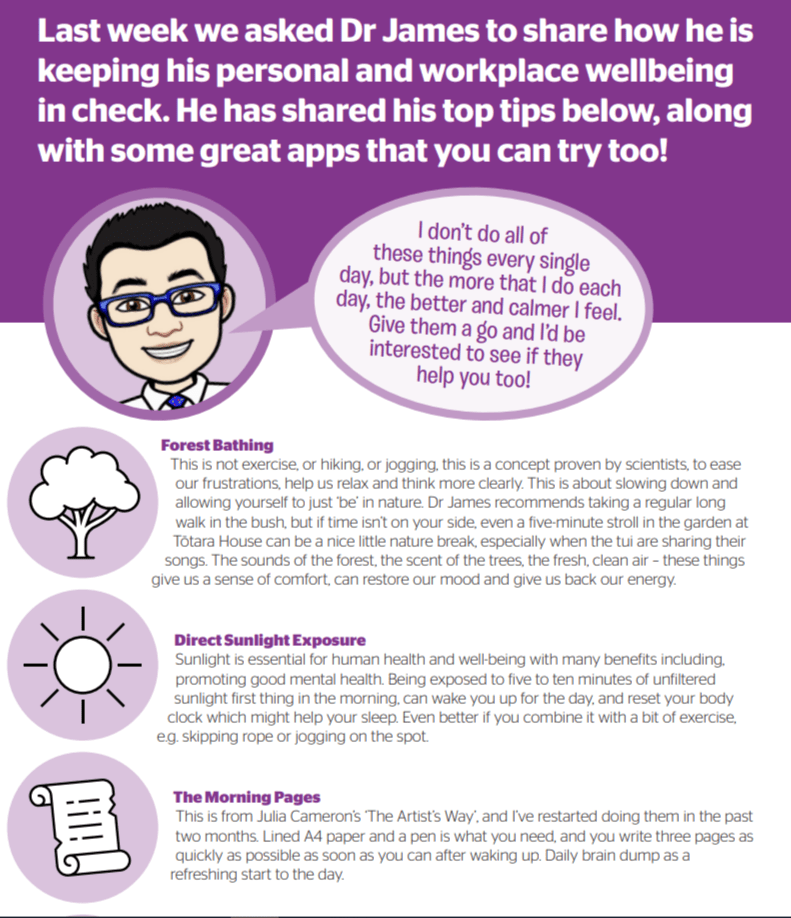
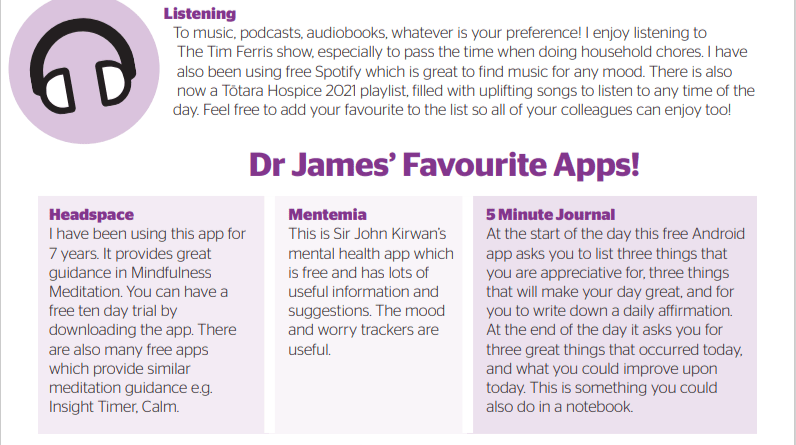
I shared some wellbeing tips with my workmates and they produced a pdf file that you can download.