SCM – Life-long Learning

Introduction

In the past seven weeks, I have been studying academyEX’s Digital and Collaborative Teaching and Learning micro-credential. In this blog post, I will critically analyse contemporary thinking in education. I will then critically analyse the role of digital and collaborative learning in contemporary education. In the second half, I will evaluate my practice against digital and collaborative learning and teaching. Finally, I will evaluate my practice against relevant aspects of sustainability.

Contemporary Thinking in Education

Behaviourism was the main learning theory utilised in my medical training and is reflected in the way I provide teaching as a doctor. Extrinsic motivation was provided by medical school through the set curriculum. I felt like a passive recipient of knowledge and  I was tested on my ability to repeat the vast content provided over many years. This continued in the setting of medical specialist training where even more information was memorised and regurgitated during exams. A lot of knowledge is acquired but is not otherwise utilised, thus retention is poor. Learning was shallow and given the time spent it remains unclear if the return on investment is of high enough value. Other theories of learning need to be considered.

 Constructivism takes a learner-centred approach. People are not completely blank slates when they arrive in medical school and may have come from various backgrounds. Some of us may bring skills and knowledge from our previous work and life experiences. The role of the mentor is to assess our prior knowledge and guide the extension of our development.

Constructionism theory involves the students creating new knowledge structures. Social products are created, and learning is by making and can be aided by technological tools such as the Google Suite and many other apps. Students are encouraged to own their learning and to make it more engaging for themselves.

The medical school shifted to experiential learning in the clinical years when we started seeing patients. I learned by dealing directly with patients and their families. Learning was by doing we were provided with hands-on opportunities. It was more engaging when I was given a chance to assess patients and come up with my own management plans. I practised doing interventions with the use of patient simulators and actors. Time for reflection was provided when I presented my findings to tutors and this also involved review of video footage of assessments. This allowed for the practice of clinical skills in simulated situations.

The role of digital and collaborative learning in contemporary education 

Older education approaches may have taken a cooperative approach in which group members would be assigned various parts of a learning task to do themselves. They would all come back together to present their information to each other. This is similar to a potluck dinner in which the meal that you eat together may be a random collection of dishes which may or may not work together well. 

Contemporary education requires a collaborative approach in which students come together and discuss how they will learn together, utilising a horizontal division of labour. An analogy is when people gather to cook a meal with each other. New skills and knowledge can be learned together. Everyone has a role in putting together the meal and there is a more cohesive outcome. This also helps to model how doctors could work together in collaboration with others. Garnering opinions and information from team members rather than all working completely independently. Complex wicked problems demand input from all team members who each have their individual roles to play. Everyone has a role to play in the learning situation and it models good future behaviour. Collaborating with other doctors or other services is considered good healthcare practice.

How can digital tools be incorporated into this learning? The potential audience of any digital artifacts could be vast, we don’t need to limit ourselves to face-to-face teaching any more. In 2013, when I engaged with online learning companies I was quoted $ 100,000 for the production of four 15-minute modules. In 2023 I can create my own using readily accessible apps, at low or no cost apart from my own labour.

Evaluation of my educational practice against digital and collaborative learning and teaching 

The Covid-19 pandemic forced medical education to try new ways of engaging. The traditional face-to-face tuition could not be done during the many Aotearoa/New Zealand lockdowns we experienced from 2020 onwards. We learned how to do virtual assessments including home visits, clinic sessions and joint visits via the use of video-calling technologies. Joint visits allow different members of the multidisciplinary team to assess a patient together, with each member assessing the situation from their own point of view. One or more members of the team could be present either in person or virtually in a more collaborative approach.

In medical training, experiential learning is via doing with real cases being worked on together. Standard medical assessments involve assessing patients face-to-face. This assessment formulates a problem list and differential diagnoses are considered. A management plan is then drafted to treat the problems identified. Online resources could be checked to assist with any of the prior steps. The case is then presented to the clinical supervisor(s) and together a joint management plan is finalised. As the trainee becomes more experienced their level of supervision decreases until they can work independently. In the future sophisticated patient simulations could be created and could involve various team members assessing the simulated patient at the same time. As artificial intelligence improves, these scenarios could become more and more realistic. Virtual reality technology could allow virtual face-to-face interactions between clinicians and patients regardless of distance. Wearable devices could allow remote physical examination of patients. Communication between clinicians, patients and families could be improved with technology. 

Evaluation of my educational practice against relevant aspects of sustainability 

My educational practice involves teaching various clinicians, patients and their families about palliative care. Western medicine including palliative care has historically been a white person’s medicine and one size has never fit all. Extra effort has been required to take into account people’s cultural origins and particular emphasis has been placed on becoming culturally competent practitioners, to make our environment feel safer for all. Bilingual signage and the use of Te Reo Maori in daily conversations are now part of my workplace. We want our staff/volunteers/students to learn by immersion. 

I work in a healthcare training institution but we are also citizens of the world and must play our part when it comes to climate change. Our organisation has focused on place-based learning. We have removed individual rubbish bins, have centralised waste collection and only have bins available at certain sites on our campus. We want people to actively think about where their waste will end up. What can be composted is put in the appropriate bin as is recyclable material, with an overall effort to reduce what goes to landfill. Upgrading of equipment to more energy-efficient versions continues to be done. Shifting our fleet from a fossil fuel one to an electric vehicle fleet has begun. Simple things such as providing our staff members with reusable cups and water bottles are part of the subtle encouragement of environmental sustainability.

In terms of educational sustainability, we have switched from paper-based materials to the use of digital artifacts. Short video tutorials are available on our intranet and internet sites where educational material has been curated. There is a lot of great content out there already and we encourage our staff and students to create content. We foster a culture of ongoing life-long learning. Our students are encouraged to learn how to find information rather than commit it to memory. They are encouraged to think for themselves on important issues especially how we can prepare for the future. Open questions are asked to stimulate the exploration of topics in a deeper fashion.

Conclusion

I have worked as a medical doctor for almost 24 years. When I graduated it was the start of my life-long learning. Over time, without any training, I have also become a teacher. My teaching style has been behaviourism-based as that was how I was taught. AcademyEX’s digital and collaborative teaching and learning micro-credential has exposed me to contemporary learning theories including online tools to aid teaching. It has made me ponder much about sustainability in all of its forms. It has further opened my mind to new possibilities for student engagement and to consider that my teaching needs a wider audience than people who work in the hospice.  People have all sorts of preconceptions about things especially if they don’t know about them. Many people are still afraid of hospice. How can I use the skills and knowledge I have learned to make hospice/palliative care more widely known? Maybe I’ll write some more blog posts…

References

Olsen, M. & Hergenhahn, B. (2013). An Introduction to Theories of Learning (9th ed.) Pearson.

Cashman et al. (2005). Teachers Discovering Computers: Integrating Technology and Digital Media in the Classroom (4th Ed.) Course Technology.

Kolb, D.A. (1984). Experiential learning: experience as the source of learning and development. Prentice Hall.

Liu, C. H. & Matthews, R. (2005). Vygotsky’s Philosophy: Constructivism and Its Criticisms Examined. International Education Journal, 6(3), 386-399.

Papert, S. & Harel, I. (1991). Constructionism. Ablex Publishing

WikiBooks (n.d.). Blended Learning in K-12/Definition. https://en.wikibooks.org/wiki/Blended_Learning_in_K-12/Definition

Kozar, O. (2010). Towards Better Group Work: Seeing the Difference between Cooperation and Collaboration. English Teaching Forum, 48(2), 16-23.


Adapting to a brave new world. Telehealth in palliative care

We’ve certainly had a change in our practice of palliative care with technological developments and more recently, change has been accelerated by the pandemic.

This fascinating work by Palliverse’s very own Dr Anna Collins and teams at St Vincent’s Hospital, North Adelaide Palliative Care Service and Peter MacCallum Cancer Centre really accurately described what it’s been like for me working as a palliative care physician using telehealth. It’s been terrific for some aspects – we can quickly review the patient without having to drag them into hospital, preserving their energy and disrupting their lives less. However, I really struggle when patients are deteriorating and when they speak languages other than English as their first language.

Their research found that “palliative care patients and doctors at each site found telehealth wasn’t only acceptable (91 per cent and 86 per cent respectively) but also satisfactory (72 per cent and 65 per cent) in most situations.”

In their studies, “involving interviews and surveys of 130 palliative care patients and their doctors following a telehealth appointment, patients in rural and regional area reported telehealth as being highly satisfactory. Doctors too rated it highly satisfactory when a visual link (not just audio) was used, or if the appointment was for a routine review.

“However, patients were less satisfied when care goals or future planning were discussed, and doctors reported it as being less satisfactory when the patient’s condition was changing or rapidly worsening, or if patients spoke a language other than English.

“And both patients and doctors found telehealth unsatisfactory in the presence of changing or unstable symptoms, such as pain which required medication adjustment or change.


image of older patient speaking with a doctor on an iPad screen
Photo by Tima Miroshnichenko on Pexels.com

Safer Care Victoria and the Palliative Care Clinical Network hosted a webinar ‘Clinical Conversation Webinar: Adapting to a Brave New World – the role of Virtual/Telehealth in Palliative Care’

The webinar recording is now available on the Safer Care Victoria Clinical Conversation Webinar Series website.  


National Aotearoa palliative care research day Sunday 6th November 2022 in Christchurch, New Zealand

Photo by Brayden Gray on Unsplash

My colleague Kaye Basire wanted everyone to know about this event which will precede the Hospice New Zealand conference 2022. The draft agenda can be downloaded below:

Aotearoa Palliative Care Research Day – Hybrid Event

We all recognise the importance of research in enhancing patient care. However, clinician led research in Aotearoa is often restrained by lack of support and resources. This is particularly acute in palliative care where there is often a sense of isolation due to the lack of national palliative care research strategy and network.

The Aotearoa Palliative Care Research Day is an opportunity for all current and budding palliative care researchers, to network and share ideas on advancing palliative care research in clinical settings. Prior research experience is not required.

Content of the day includes sharing of experience by practitioners who have incorporated research in their clinical work, translation of research findings into practice/policy and collaboration with academics.

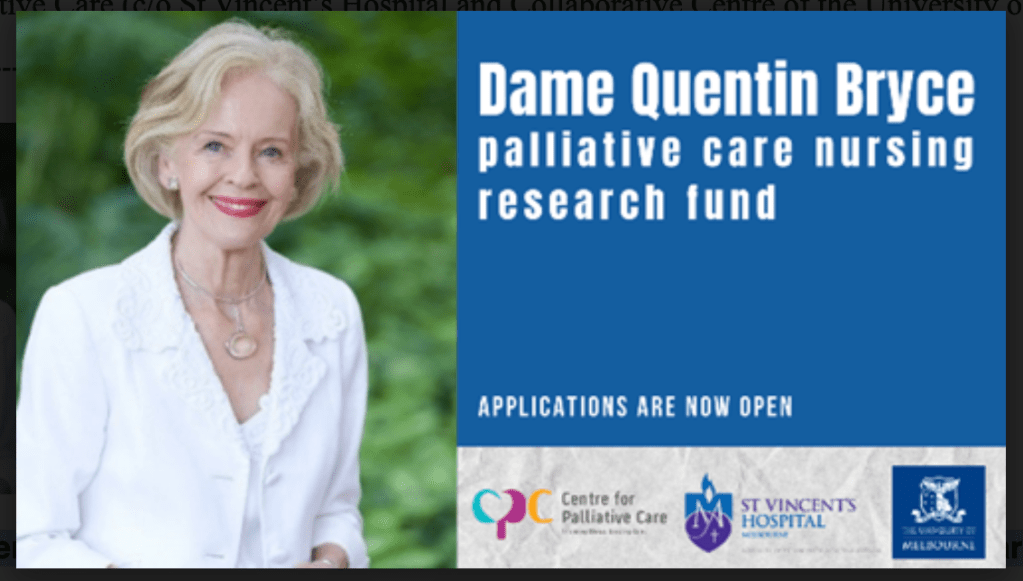
The Dame Quentin Bryce Palliative Care Nursing Research Fund – Applications are now open!

Applications are now open for The Dame Quentin Bryce Palliative Care Nursing Research Fund – a new funding opportunity created to support research into palliative care nursing. The funds are offered by the Centre for Palliative Care (c/o St Vincent’s Hospital) and the Department of Nursing, The University of Melbourne.

Existing scholarship holders are eligible to apply (though please check the terms and conditions of your scholarship before applying).

Applications close on 25th June 2022. Please see the website here for more information and send any enquiries to shs-research@unimelb.edu.au

I think therefore I am? – Milestones

Photo by Towfiqu barbhuiya on Unsplash

There is something about the human spirit, some amazing inner strength that people have that allows them to hold on for special occasions. Two major milestones for people are Christmas Day and New Year’s Day. Out of the past ten years I have worked 8/10 of the New Year’s holidays. What usually happened was that no matter what spiritual belief people had they would likely hold on for Christmas Day, and possibly for New Year’s Day and then we would see a large number of people dying once they had achieved their milestone(s.)

Sometimes it can be living through their wedding anniversary, or beyond a loved one’s birthday.
People often will try not to die on a significant other’s birthday, so that the birthday will not be spoiled from thence on.

How does a comatose person even know the date let alone know what the time is? Somewhere deep inside ticks a very accurate body clock? People may be holding on for special occasions such as the wedding of their child, or grandchild. Or it might be the birth of the newest family member.

In Aotearoa New Zealand a lot depends on the national religion. People will hold on for the Rugby World Cup – the Rubgy League World Cup, not so much.

How can a person sense their environment when they physiologically have been made insensate?

Continue reading

Cancer patients can’t believe everything they read

The stream of information about cancer treatments and cures can be overwhelming. Articles in the media such as the Guardian describe new miracle cures. It’s hard to know what to believe. This article is a good example of how media interpretations of scientific papers can be misleading for patients and families.

Read more here

Research Position Advertised

Research Fellow, Palliative and Supportive Care

HammondCare is looking for a post-doctoral researcher, who has a passion for research which can improve palliative and supportive care.  Working within the Centre for Learning & Research in Palliative Care, the Research Fellow provides high level support for the research effort in palliative & supportive care across the organisation. 

This role offers a post-doctoral researcher an excellent opportunity to develop their research skills, experience and track record within the themes of palliative and supportive care.

  • Position based at Pallister House, Greenwich Hospital.
  • Part time (0.6 FTE), flexible working arrangements. Three years fixed term position.
  • Provide high level support for research in palliative and supportive care

Closing Date: 1st August 2021

For further information about the role and the information pack can be found at  https://www.hammond.com.au/careers/current-vacancies/RF-NSW

For enquiries please contact Prof Josephine Clayton, Director, Centre for Learning & Research in Palliative Care, HammondCare on jclayton@hammond.com.au 

Volunteers sought for research on delirium


TITLE: Development of a core outcome set for effectiveness trials of interventions to prevent and/or treat delirium in palliative care (Del-COrS)

We are currently looking for volunteers including: patients, family members, carers, healthcare professionals and researchers with experience of delirium in palliative care.

Participants would complete two online surveys to establish their views on the outcomes that are important to include in future studies of interventions to prevent or to treat delirium in palliative care. We will subsequently invite participants to a meeting to discuss the findings and vote on outcomes they consider important.

Our goal is to develop international consensus on a core outcome set for research studies of treatments within a palliative care setting to prevent, and/or treat delirium.

Researchers look at the effects of potential treatments on patients by measuring an ‘outcome’. For example, in a study of how well a new delirium treatment works in a palliative care setting, an ‘outcome’ might be: whether a person hurt themselves because of delirium.

When a set of main outcomes has been agreed for a health condition, it’s called a ‘core outcome set’. This would allow all studies of delirium in palliative care to be compared and combined.

Please contact Dr Anna Bryans (Research Team Member) at abb526@york.ac.uk if you are interested in participating and pass on this information to anyone who may wish to take part.  

Immunotherapy Symptoms Clinical Trials: a new paradigm Melbourne Wed 12th June

Would you like to learn more about immunotherapy use and trials in cancer and in palliative care?

Immunotherapy Symptoms Clinical Trials: a new paradigm forum

Palliative, supportive and cancer care professionals are invited to attend the VCCC and CST co-hosted Immunotherapy Symptoms Clinical Trials: a new paradigm forum to progress clinical trials concepts in this evolving oncology field, recognise achievements, celebrate success and make connections for future directions. 

Palliative care progress and achievements

The VCCC Building Trial Group Capability Program initial investment is focused on developing the palliative care group as a key priority area. The group’s development and activities have been underway for more than 12 months; it is timely to celebrate progress and achievements.

Here is a program for the day

Registrations are now open for the palliative care sessions in the afternoon. Please note you will need to register for morning and afternoon sessions separately.

Drugs for #delirium don’t work, and may in fact harm

Meera Agar, University of Technology Sydney

Delirium robs dying people of their autonomy, dignity and last conversations with loved ones, at a time when every moment is precious.

Symptoms are highly distressing to experience and watch. Confusion, incoherent communication, poor attention, agitation, drowsiness and hallucinations are some markers of this common complication for people dying in hospital from cancer and other advanced illnesses. On average one in three people in end-of-life hospital care are affected.

Doctors commonly prescribe antipsychotic medications to try to relieve these symptoms. However, our study just published in JAMA Internal Medicine, raises serious concerns about their safety and efficacy.

So, what are we to do for people experiencing delirium, who are robbed of their mental awareness and ability to communicate?

Continue reading