Breaking Chain

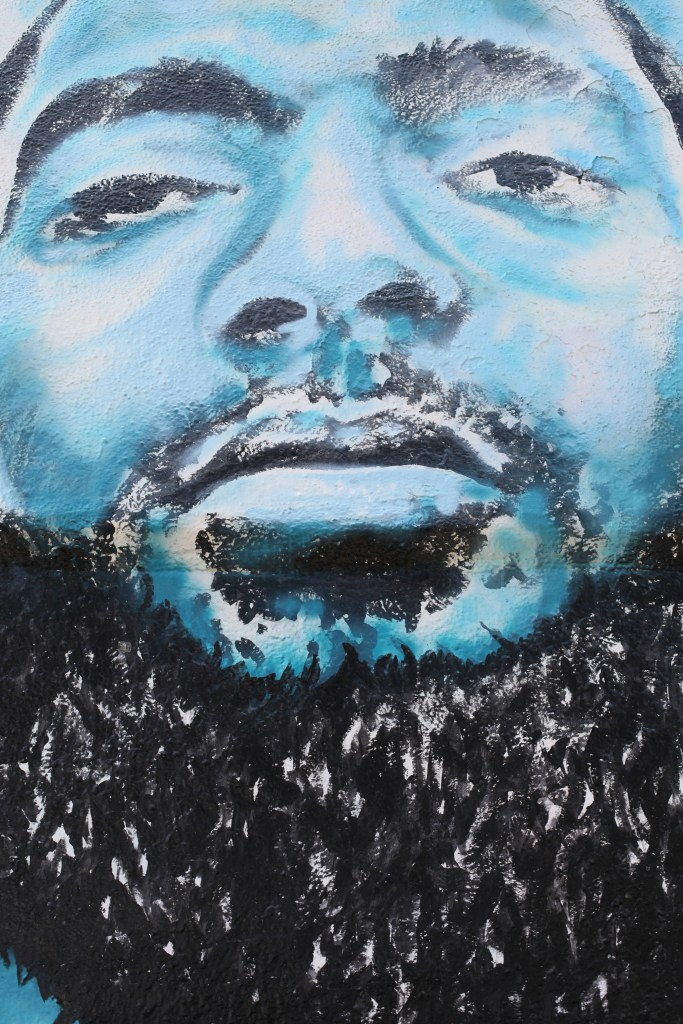
This is an edited transcript of a conversation I had with Cheyne McClung, three days ago. The views and feelings expressed are Cheyne’s and he has given me permission to publish his words and photo.

The diagnosis of MND (Motor Neuron Disease). Was a death sentence. It snuck up on me. It took away things. Previously taken for granted. My ability to walk. My ability to work. Can’t hold my baby. Can’t breathe. Need BiPAP. 24/7. Hard to talk.

What did I do. To deserve this? Everyone said, “Nothing.” “It’s bad luck.” I know it’s. Not my fault. But I didn’t expect. Cruel and unusual. Punishment. MND has taken. So much. The worst is. I can’t go home. That’s where I. Want to be.

They ask me. About treatments. What if I get? Infections. What do I want? I want to live. As long as possible. To be with my. Little girl. She needs special care. Birth injury. I’m missing out. On too much. Her smiles. Trying to crawl. Chances to connect. Running out.

They decided. I can’t go home. Need too much care. They decided I need. Care facility. Hope it is. Close to home. They haven’t found one. It’s been weeks. No-one wants me. My case too. Complicated. I know that. People can do BiPAP. Without healthcare training.

They discriminate against me. I’m 37. MND doesn’t care. How old I am. Would they take me? If I was 65? Don’t get it. Care needs the same. Regardless of age. I’m paralysed. Can only move. My neck a bit. No place wants me. Hospices admitted me. For three weeks. Only. Then what? Give me hope. Then take it away. The uncertainty. Is too much. No one wants me. I’m trapped in. Too hard basket. Solitary confinement. In body shell.

Need escape plans. I don’t want to. Die. But if no. Quality of life. Then better off. Dead. I could stop eating. Not treat infections. My lung specialist. Said he could. Make me comfortable. Then stop BiPAP. All over. All done. Gone. Not yet. Only if. No quality of life.

Will anyone listen? Does anyone care? “Please. I just want. To spend time. With my baby girl. Closer to home. Can anyone help me? Please. Don’t make me beg.”
Palace of Care – Why Me?

Photo by BP Miller on Unsplash

J: Hey man, I’m sorry for your loss. Do you have a few minutes brother?

X: Yeah.

J: Let’s go in there again. [Points to the right] You asked me why your Dad would only talk about it in your presence. I think he knew you would be able to handle it.

X: [Nod]

J: The family meeting the other afternoon was tough. Your Dad told everyone how he felt and what he wanted but the family weren’t able to listen, especially Aunty.

X: [Nod]

J: Even with all the voices raised, I heard what you said, how you advocated strongly on your Dad’s behalf. He heard it as well. You had his back, that’s why he said it in front of you first. You were really there for your him when he needed support the most, that’s something to be proud of. That impressed me, you’re a good man.

X: Thanks Doc.

J: Dad didn’t get exactly what he wanted but the gods heard his cry for help and responded.

X: [Nod]

J: You take care brother.

X: [Handshake]

I think therefore I am? – Mother’s Day

Photo by guille pozzi on Unsplash

Happy Mother’s Day to all mothers out there. A day when we celebrate one who may be one of the most important people in our world. This can be a happy occasion but it can also bring sad memories to those who no longer have a mother. A time when the grief is stirred up a bit more than usual. Memories of the loss of a parent churn from deep inside us. For some, the loss is all too recent, all too raw. You didn’t want her to suffer one minute more but you missed her even before she had died.

She wasn’t her usual self any more. She couldn’t be there as she always had been countless times before. It was hard to see someone so strong become so frail. She had always been of slim build but the weight loss was too difficult to bear witness to. Her severe fatigue made you wish you could gift her some of your energy, but you knew she would never take it. She had trouble being the one who needed care.

She always served her customers well. Put them at ease with her gentle words and friendly smile. She enjoyed seeing the children grow up, just like her children had. From needing everything done to full independence. They had all become adults and parents themselves but she couldn’t help still wanting to take care of them. Nothing changed at the end of her life, she took care of her children and her grandchildren. She wanted to do her best for them, as she always had.

Even after I am gone.
I will still be with you.
A tiny bit of me will live on.
Inside of you my child.
Know that you are loved.

Palace of Care – Guidance

Photo by Thijs Schouten on Unsplash

“This will be a challenge,” was my first impression when I first met the son. His eyes were on the brim of tears, his gritted teeth, I could see he was having a hard time. Our staff had told me that our patient, the mother, had deteriorated steadily during her short admission. Ongoing changes over days meant at the most only days left to live. The staff had also told me that the family were keen on our patient having further treatment for her cancer. They had been trying to feed her more as they believed that if she ate more she would be able to fight her cancer more. She had come in because of worsening nausea and appetite. They were so intent on her getting treatment, that there was a huge mismatch between their goals and our patient’s reality.

As I walked into the room and saw our patient for the first time I thought she looked terrible. Like she she could die at any time. There was a lot of distress in the room. The husband was crying disconsolately while holding her hands. The children and their spouses witnessed this in distress. The gathered grandchildren amplified the distress of the two elder generations. The room went quiet as I examined our patient. Weak thready pulse, hands and feet becoming cooler to touch. She didn’t respond to my voice or when I examined her. Her ragged, wet-sounding breaths were made louder by the intense silence of the room. It was as if everyone was holding their breath, myself included. I finished my examination and took my time coming to a diagnosis. I asked if I could sit down on the spare bed before I addressed the whole family.

“I’m worried about your mother. I think she is getting worse. I think her time is getting shorter, and she doesn’t have long to live.” Tears and sobbing around the room. Nodding indicated surprisingly dawning acceptance. “I know that you wanted your mother to have more treatments. I think if she had chemotherapy it would not make things better, but would make her feel worse, and might shorten her time even more.” “I’m sorry, I wish we could do more for her. The best we can do is to keep her comfortable, to calm down her distress.

They handled the bad news well, “please keep her comfortable.”

I was asked by a colleague why the family couldn’t let her go and wanted her to keep on going with treatments. I replied, “It’s because they love her so much. They just don’t want to lose her. Up until two months ago, she had been well, and then she wasn’t. Now she’s dying.”

The counsellor stayed behind to support the family. She arranged for the husband to have some private time with his wife. He said to her, “I’m going to be okay, I will be looked after by our children and grandchildren. I love you. Do what you need to my dear.”

She died 60 minutes later.

Palace of Care – Country Roads

Photo by Devon MacKay on Unsplash

The odds were against him but he wanted to at least try. Even if he died on the way home it would be worth it. As long as he was heading in the direction of his heart. Back to the ancestral home where generations of his family had lived. No matter how far away from there they had gone they still thought of it as home. Even those who had moved overseas many years ago still maintained the connection.

It was the hardest thing he had ever done, but it was the most important thing for him. He left the place he had lived in for most of his adult life to go on his final journey. It would be a long ride in the car. Bumps in the road hurt him the most, and there were many patches of roughness along the way. He held on, he wanted to make it. His family were expecting him and had made preparations. They had organised a bed in one of the rooms. He hadn’t been back for years, life had been too busy.

He felt so tired, he wasn’t sure if there was enough time left. The doctors had told him days ago that there were only days left. He was so tired. He would only let himself rest for a short time. He had to be awake to will himself to his destination. He tried to keep his eyes open, but his eyelids felt too heavy, he just couldn’t keep them up.

He woke with a start. A large truck had been going in the opposite direction and the vibrations from its wake had shaken their small car. They were on a country road, there were no lights around them, and the road was deserted. They drove alongside a stream, that’s where they used to go eeling when they were kids. Around the corner, they turned and he saw a dim light in the distance. They headed up the gravel driveway, and he saw her in the doorway.

The light from the house reflected in the two wet tracks down her cheeks, “Welcome home son.”

Palace of Care -The After School Run

Photo by Andrew Slifkin on Unsplash

A situation familiar to many modern parents. Making their way through rush hour traffic to pick up their children who possibly attend a number of different schools spread throughout busy cities. The GPS recommended fastest route would only work if your car could sprout wings and fly over traffic. Another of the more stressful times of the day, the morning school drop-off being the first one. You finally arrive at the school gate and then the stress levels increase even more. Hundreds of similar parents vying for a small number of legal car parking spaces. Scanning the roads surrounding the school for a hint of a place to stop. Trying your best not to run anyone over, having to make your way around cars that have double or triple-parked. You make your way onto the grass berm next to the road. You pull your handbrake to immobilise vehicle staking your claim to this treasured location. You rush out of your car and sprint towards the school gate as if you are about to complete a marathon. Exhausted, about to collapse, running on sheer willpower alone. Next up for this sporting event is trying to find your child in a sea of other children wearing completely the same clothing. The good old bastion of conformity the school uniform. A blur of green and blue as children walk, run, skip on their way out of school. Is that my daughter? Is that my son? No, that kid just looks like them. No, that’s one of the more vertically challenged teachers. There’s my precious. As time is running out you haul them over your shoulders in a fireman’s carry and race to your car. Buckling them into their car seat as if it was straitjacket. Only three more to pick up….

Stressful enough on any standard school day, the school pick-up becomes even more stressful when the other parent is dying in the local hospice inpatient unit. At 4pm every afternoon the children of two different families would arrive to see their unwell parent. Typical Kiwi kids wearing a number of different school uniforms. Various lengths of hair, various ages and stages, brought together for the same purpose. Trying to spend as much time as possible with a parent who might not be around for much longer. A heart-warming sight but at the same time heart-breaking. In the future these school aged children would likely remember visiting their parent at the local hospice. I hope that their memories aren’t too bad. I hope it wasn’t a scary place for them. I hope that they felt welcomed. I hope their family tells them later on how meaningful their visits were for their late parent. I hope they are told how much their parent loved them and had tried their best to stay alive as long as possible, much longer than most people did. How their parent held on for their birthdays, their first day of school, or for their graduation and other important milestones. I hope they can remember the happier times when one of their parents wasn’t dying and they always did things as a family.

Every birthday from now on, there will be someone missing from the celebration. Christmas and New Year will not feel the same any more. Life will go on but it will be different. Who will take the kids fishing for eels? Who will teach the kids how to drive? Or how to cook? Or how to sew clothing? Someone will be missing when they turn 21. If they get married, someone else will walk them down the aisle. The youngest kids might not remember much about their parent at all.

Please make the most of each day. Time with children and family is so darn precious.

Palace of Care – Goosebumps

Photo by michael schaffler on Unsplash

What’s in the bowl on the table?

That’s sand and a shell from his favourite beach.

Really?

Yeah, and in the bottle is seawater from the beach. He spent a lot of time on that beach and in that water during his life.

Wow, I’m getting goosebumps just hearing about it. Oh hello, Aunty, how are you?

I’m good. Just let me play him something on my phone.

Oh, what are you playing?

Sounds of waves hitting a beach.

From his favourite beach?

No, but most beaches sound pretty similar, right?

Oh right. That’s a really nice thing to do.

The beach and water are where he is heading. He’s going to see his Uncle and they will go sailing together again.

Just like when he was a kid.

Yeah, that’s when his lifelong love of sailing began. He told us today that he’s ready to go. Do you think he will die today?

He might do, but that’s what I said six days ago. I’m not sure, he’s stronger than most humans. But he may have finally let go. No matter what happens we will keep him comfortable.

Thank you.

Palace of Care – Hold On

Photo by Hu Chen on Unsplash

We’d been trying to admit her for weeks, but she had not been keen. We had her on the admission list for a whole week but she said that she had to sort out something for her children and couldn’t come in. I thought that it might be an excuse, as a lot of people are still scared of hospice. Most people have not had anything to do with hospice but they may have some pre-conceived idea of what hospice might be. Often this is inaccurate, and can generate a lot of fear.

It took some convincing by the hospital palliative care team before she would finally agree to coming in to hospice. She was still nervous but her favourite cousin had promised that she would go in with her. They had grown up together and they were best friends, but this had been taken to a completely different level once the cancer diagnosis had been made five months ago. Something was wrong as she had lost a lot of weight, without trying to. Life had been busy for many years with her five children, and her partner could not always be counted upon. It was her cousin who had attended all the Oncology appointments with her. Her cousin had been there for all the chemotherapy sessions. Having her cousin accompany her to hospice was comforting and if there was anything scary, she would be there for her.

Continue reading

Palace of Care – Father and Son

Photo by Vinicius “amnx” Amano on Unsplash

Covid 19 the gift that keeps on giving. Why does it have to be so generous? It has affected everyone and everything in the world, and the hospice is no different. We have had to impose visiting restrictions on our patients and their families in order to limit spread of the virus. Covid restrictions and quarantine requirements have led to some of the most upsetting situations that I have witnessed during my career.

When someone is dying, it is natural to want to be with them, to support them in their moment of need. They were there for you when you needed them the most, and you want to reciprocate if you can. Even before Covid it could be difficult to travel back home thousands of miles, trying your best to make it before your loved one dies. During Covid it has been that much worse.

My patient came in because of severe pain, a common reason for admission for many of my patients. His wife accompanied him, and they both looked exhausted. His pain had been poorly controlled over the weekend, and the nights had been especially long. The medications did not seem to work for long, they gave him a brief period of respite before the pain would come right back. It was almost cruel to be granted that small packet of relief, and then it would be roughly dragged out of his grasp again. This cycle repeated itself over what felt like a long two days. By Monday they needed help and he was admitted into hospice.

Continue reading

Bedside Lessons – 20 – Crossing the Line – Part 1

Photo by Max Böhme on Unsplash

I was working on the liaison psychiatry team in my final year of medical school. I went to meet a patient that had self-referred, which was unusual. Psych liaison provides psychiatric input for patients who also have medical issues that have brought them into hospital. I went with the nurse specialist to see the patient, an Englishman in his mid-thirties.

Work had brought him and his Latin American wife across the world. He was a nature documentary maker and had been based in the lower South Island filming the local wildlife. Just before Christmas he became unwell with a severe nosebleed, which required hospital intervention. Simple blood tests revealed grossly abnormal results. Acute Myelocytic Leukaemia (AM bloody helL) was the shocking diagnosis which destroyed their plans for Christmas and life in general. An urgent admission was arranged to our hospital’s Haematology department, which served the entire region. Harsh chemotherapy needed to be started otherwise our patient would’ve only had days left to live.

Continue reading