A Tour of the Teams: ImPaCCT

Happy New(ish) Year everyone!

To celebrate we are starting a new segment.  It goes without saying that many people and groups around our region are doing wonderful and exciting work in palliative care research but it can feel a little lonely out there for many of us.  Finding support to develop your idea, and others with a similar interest can be a challenge.  In addition to the palliverse researcher database we thought another way for us all to feel connected was to start to get to know the more established players.  So let’s start with some introductions.  We have been contacting the various academic and research institutions working in palliative research in our region asking them to tell us a little bit about themselves.  “Tour of the teams” will be an ongoing series to bring the responses from these units together.

Unfortunately an actual "tour" was voted as impractical

An actual “tour” was unfortunately deemed impractical

We hope that the “Tour” will help us all be a little more connected and maybe to give us all some ideas of where we can get help to develop that great research idea that we have been sitting on.

The service who gets the gold star for being first off the mark is the ImPaCCT group

Continue reading

Self-care: Is it selfish?

Did you work over the holiday break?

Unlike many times in the past – this year I didn’t work a shift on Christmas Eve; or Christmas day, or even New Years. I spent this time with my family. And I turned off my electronic gadgets (well, for the most part)!

I spent quiet time reading. How refreshing it was to have no agenda, and nothing that just had to be done. The only trouble was that, somehow, this felt quite indulgent.

After all, we are trained to care for others – but perhaps not so enlightened on the art of self-care. Is it selfish? Or does genuine care for others perhaps start with yourself? Continue reading

How to rock the boat without falling out – interested in Change?

For this week’s social media post we visit The Edge and the change and innovation folks from the NHS in the UK. The School for Health and Care Radicals is running a free online course. Here’s what they say about it below…..

Rock the boat and stay in it! Anyone who wants to bring about change has to be ready to break the rules. But in health and social care, that can be really difficult. The art of rocking the boat while staying in it is something it seems no-one is ready to help you learn. That’s where the School for Health and Care Radicals (SHCR) comes in. Brought to you by NHS Improving Quality, the School is entirely based online, is completely free, is backed by the world’s largest health organisation: the UK’s National Health Service (NHS), and is a platform for radicals to learn together, using powerful, guided learning which also qualifies for Continuing Professional Development points*.

The School for Health and Care Radicals is a free, five-week virtual learning programme for change activists in health and care. Five modules Absolutely free 9.30am-11.00am GMT Friday morning online sessions (or catch-up when you’re able) Handbook and study guides Social Guided Learning Use it how you want! If you’ve been frustrated by having to navigate stifling hierarchies to get the changes you know are needed, or criticised for being a dissenter, disruptive or even divisive, then the School for Health and Care Radicals is for you. It’s more than just a school – it’s a platform for learning, and a community of people like you. You can read more about the School on our FAQs page.

See more at: http://www.nhsiq.nhs.uk/9022.aspx#sthash.aphbFb9p.dpuf

I am joining up so I hope to see you there. It’s a good time for south eastern Australia, at 20:30 on a Friday night, but I understand that you can do it at any time. The Edge also publishes an e-newsletter which is free – heaps of interesting and inspiring reading there from thinkers and leaders in health. The Edge makes connections between people worldwide who are interested in transformational change and disruptive innovation in health and care. http://theedge.nhsiq.nhs.uk

Cheers, Sonia

NHMRC seeking feedback on guidelines for use of publicly funded data

Australian researchers: The National Health and Medical Research Council (NHMRC) is currently seeking feedback on their draft guidelines Principles for accessing and using publicly funded data for health research. More information on the NHMRC website.

2014 in review – here are the stats from our first year!

The WordPress.com stats helper monkeys prepared a 2014 annual report for this blog.

Here’s an excerpt:

A New York City subway train holds 1,200 people. This blog was viewed about 5,200 times in 2014. If it were a NYC subway train, it would take about 4 trips to carry that many people.

Click here to see the complete report.

A resource to assist with Clinical Audit

Screen Shot 2014-12-30 at 10.03.32 pm

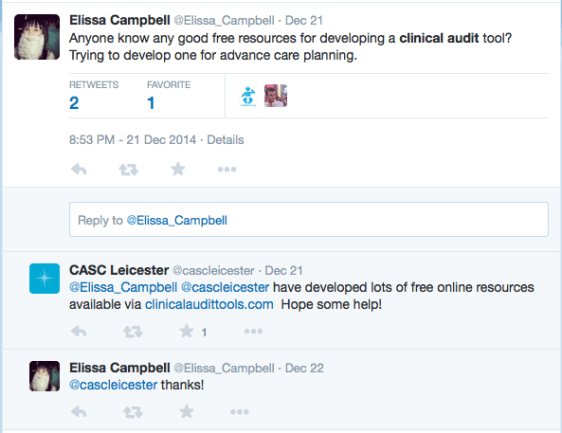
For many clinicians (including this one), their first foray into “research” is through clinical audit. The other day I was looking for some help to develop a clinical audit tool so, of course, I asked Twitter. The Clinical Audit Support Centre (@cascleicester) based in Leicester, UK, directed me to their Clinical Audit Tools resources – including some helpful interactive tools to assist you in deciding whether your project is a clinical audit, and whether it is “doable”. There’s also some blank Microsoft Excel templates to use in your own audit, a blog and a discussion board, which I am yet to explore.


Do you know of any other useful Clinical Audit tools? What are your views on the sometimes controversial topic of clinical audit?

Palliverse researchers database update

4350618884_0958d1f44c_z

(Image: University of Michigan Library Card Catalog by dfulmer / CC BY)

The updated version of the Palliverse researchers database now available!

Have you connected, communicated or collaborated with anyone via the database so far? We’d love to hear about it! Please send us an email at: Palliverse@gmail.com

Merry Christmas and Happy New Year from the Palliverse Team

Centre for Palliative Care – lecture on palliative sedation by A. Prof Jenny Philip

The Centre for Palliative Care in Melbourne runs a series of Hot Topics lectures for the field. They have kindly published videos of their recent talks, which we would like to share with you.

The Palliverse team are going to start a collection of resources in free open access medical and nursing education (#FOAMed and #FOANed) relative to Palliative Care, and here’s the first addition to the collection.

A.Prof Jenny Philip is a wonderful speaker and takes us on a journey through the controversial issue of palliative sedation. Starting with definition (variable) and incidence (also variable), she describes for us some European guidelines on palliative sedation and then guides a panel of experienced palliative care professionals through three cases exploring issues in palliative sedation.

goo.gl/pAm3Y2

Elsewhere in the Palliverse – holiday addition

If you’re lucky enough to have a break over the summer holiday season, I would advise that you to avoid anything work-related. However, if you just can’t pull yourself away from the worlds of palliative care and research, here (in no particular order) are some related links:

Continue reading

PhD Scholarship opportunity in a novel area (is this your early Christmas present?)

Dear members of the palliverse,

We have been informed of a new funding opportunity by the Improving Palliative Care through Clinical Trials (ImPaCCT) NSW network.  Here are the details that they provided.

Palliative Care (Full-Time, $30,000 per annum for 3 years, Based in Sydney) focusing on sleep disturbance in community palliative care patients.

Continue reading