Q&A. Love it or loath it, or maybe a bit of both. But there is no denying that it strikes a chord with a sizable portion of the Australian population who would perhaps rather not be watching A Current Affair, Today Tonight or their new lovechild: The Verdict. Continue reading →
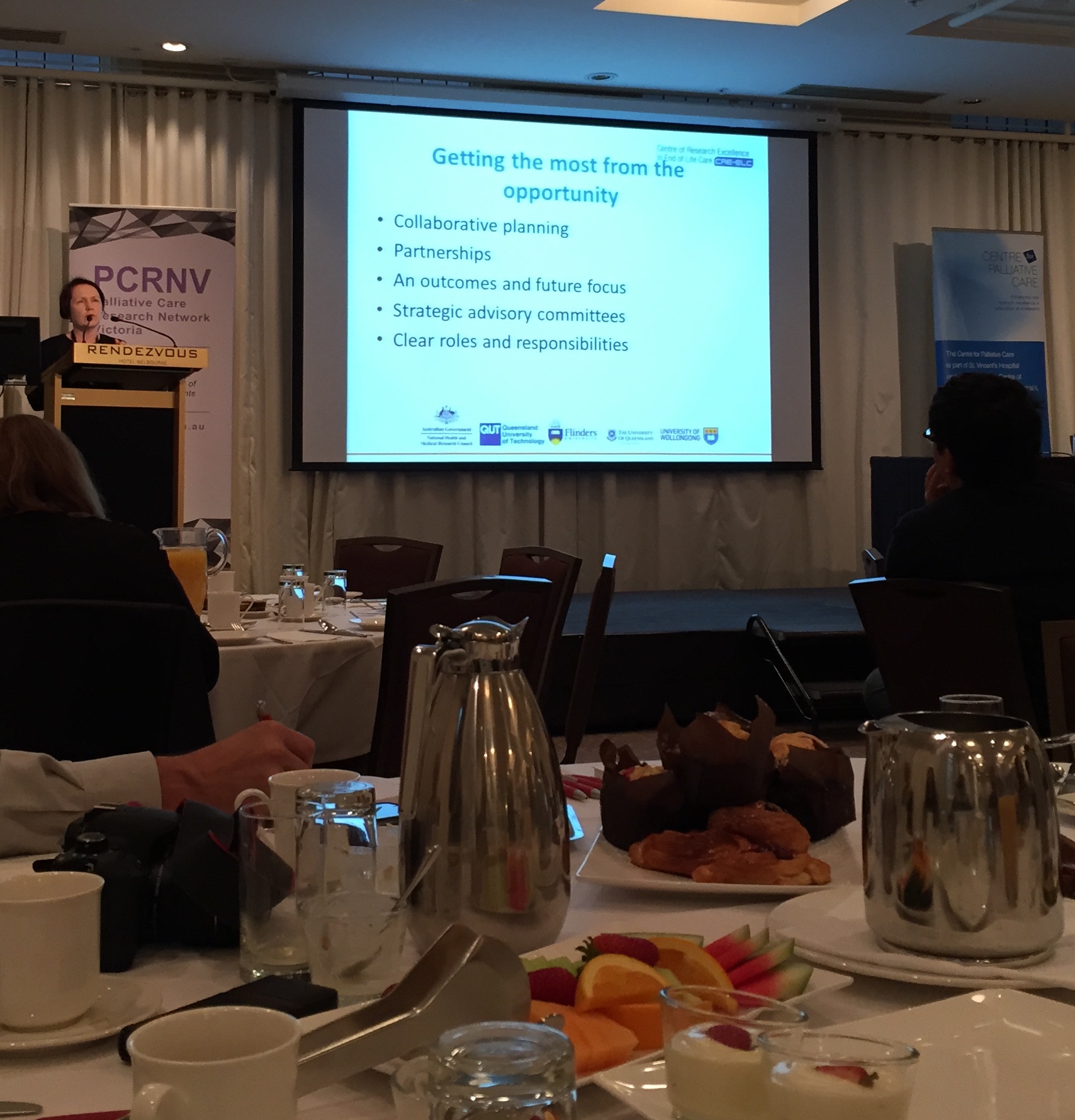
Prof Patsy Yates sharing her reflections on setting up a NHMRC Centre of Research Excellence in End of Life Care at the PCRNV Breakfast Forum
For the third year in a row, the Australian Palliative Care Research Colloquium was held at the Rendezvous Grand Hotel in Melbourne on October 22-23. The meeting was once again preceded by a breakfast forum hosted by Palliative Care Research Network Victoria (PCRNV), which served as a tempting entrée to the two-day main course of fantastic presentations and workshops exploring a diverse range of topics pertaining to palliative care research. Conversations about research continued over tea and meal breaks, next to quality poster presentations, and during the convivial conference dinner on the banks of the Yarra. Continue reading →
“It’s about starting a conversation…[Doctors need to] throw in a phrase like how you going, how’s the old boy, is he getting up, is he getting the job done?”
“…I find men want to talk about it, but someone has to start the conversation with them.”
Pulitzer prize-winner Tina Rosenberg visits La Crosse, Wisconsin, home of the Respecting Choices program, where 96% of adults reportedly participate in advance care planning discussions. (Talking Early About How Life Should End, New York Times).
And we are back! After our very successful inaugural tweet chat last month, let’s rock again with our next effort, and Let’s talk about death, baby together with Palliative Care Australia.
A tweet chat is a virtual meeting on twitter. This chat has the hashtag #pallANZ. Remember to use this hashtag in all your tweets, otherwise people will miss your comment. If you are not familiar with tweet chats, check out our Twitter 101 and 102 articles on this site.
It’s hard to talk about dying, or as we sometimes say (only half joking), the D word.
Here are some great references on the subject recently:
Victorians are being urged to have their say about the services they want to support them at the end of their and their loved ones’ lives.
Many people with a life-limiting illness die in hospital, when they would have preferred to die at home. Figures show that up to 70 per cent of Australians would prefer to die at home, but only 14 per cent actually do so.
A new Discussion Paper – Greater Say for Victorians: Improving End of Life Care – has been released, and consultation will be undertaken in coming months with health professionals, carers, families and members of the community to develop a new state-wide end of life care framework.
The 2015 theme Spiritual Care Together offers those of us working in the area of palliative care an opportunity to take the time to pause; to reflect, and consider the ways in which we all can, and do, contribute to spiritual care for the dying and their families.
Following on from the highly successful inaugural #PallANZ tweet chat last month, we are delighted to announce that we will be hosting another tweet chat in November! Join team Palliverse (@Palliverse) and Liz Callaghan, CEO of Palliative Care Australia (@PCACEO), and “Let’s talk about death, baby!” Share your stories and reflections on having THE conversation with your family, friends, patient, doctor, nurse, spiritual counsellor…
Thinking back to the recent Australian Palliative Care Conference in Melbourne, I was reminded about one of the plenary speaker’s reflections on the first time she, as a doctor, saw a patient after they had died. It prompted me to reflect on my own experience as a nurse, and ask the question – more broadly: who cares, after death?





 palliverse.com