#ANZSPM16 Wrap up

This slideshow requires JavaScript.

Days two and three of the Australian and New Zealand Society of Palliative Medicine (ANZSPM) 2016 Conference: The Changing Landscape of Palliative Care was just as brilliant as the first. The plenary sessions featured:

  • Merryn Gott (@MerrynGott) spoke about the ‘last taboo’ in our community: the invisible and sometimes unexpected costs of providing care at the end of life, which are often not explored in clinical and almost never measured in policymaking and research. She also discussed  the impact of culture, ethnicity and gender on who is bearing these financial and non-financial costs. To find our more, read her open access @PalliativeMedJ article here.
  • Meera Agar (@meera_agar) discussed the growing evidence base around delirium care in the palliative care setting. Management of this complex, distressing, life-threatening, but often reversible syndrome is challenging. Non-pharmacological strategies and a system-wide approach to organizing and delivering care are crucial, as research into various drug treatments continue to demonstrate a lack of clear benefit and the potential for harm. Meera recommends iDelirium for more information about this important area of palliative care.
  • Pippa Hawley reflected on the lack of evidence around the use of medicinal cannabis – despite the immense interest from (and considerable experience of) our communities. How should clinicians respond while the scientific and legal issues are sorted out? Ask questions, keep an open mind & work with our patients!
  • Douglas McGregor explored the interface between heart failure and palliative care. He referenced Sarah Goodlin’s open access article, Merryn Gott’s study while discussing prognostic uncertainty and clinician paralysis; and observed that most guidelines still see palliative care as relevant only at the very end of life, rather than a key component of chronic disease management. Amy Gadaud’s (@agadoudreview was flagged as a good place to start when considering issues around early integration.
  • Sam Bloore stimulated and inspired delegates with his fascinating talk about dying well in a culture of bitcoin and botox. How can palliative care adapt, survive and thrive in this changing cultural landscape characterized by information overload, mindless distraction and incoherence? We must remain a “subversive” counterculture and continue to strive towards caring deeply and meaningfully!

In addition to these amazing plenaries, fully (and at times even over-)subscribed workshops on the overlap between palliative care and addiction medicine / chronic pain, aged care, literature and the arts were held, alongside numerous excellent oral and poster presentations from specialists and trainees. The enthusiastic and well-informed audience present during all of the sessions was another highlight for me (and I’m sure all of the other speakers and delegates)!

It’s been a wonderful few days in Perth. A big thank you to the Conference organizing committee, chaired by Derek Eng (@dr_engd), for inviting team @Palliverse to be part of this great event. Thanks also to all of you for engaging with #ANZSPM16 on social media. Keep an eye out for our upcoming tweet chats, during which we will continue the conversation about the changing landscape of palliative care!


Highlights from day 1 #ANZSPM16

We had a terrific day one at the #ANZSPM16 conference in Perth. The conference, mainly catering to palliative doctors in Australia and New Zealand, takes place in the luxurious Duxton hotel close to the Swan River in Perth.

Continue reading

Highlights from #ANZSPM16 pre-conference workshops

The Australian and New Zealand Society of Palliative Medicine (ANZSPM) 2016 Conference opens today. A number of excellent pre-conference workshops were held yesterday, including:

  • A comprehensive trainee day, including a great workshop from Katrina Anderson on self-care and reflection about love, strength, vulnerability and respect; the use of methadone (Pippa Hawley); the challenges of providing palliative care in residential aged care facilities (Douglas McGregor), patients and families with vulnerable personalities (David Kissane), and the neuroanatomy of distress (Lisa Miller)
  • A great presentation on the role of media in palliative care, followed by a hands-on workshop in the afternoon, under the encouraging guidance of Marie Mills; and
  • Supervisor workshop, lead by Michelle Gold and Brian Le

Team Palliverse will be broadcasting from the #ANZSPM16 Conference for the next three days. If you are at the conference, please come and say g’day – and recharge your devices – at the social media hub!

Room for reflection #ANZSPM16

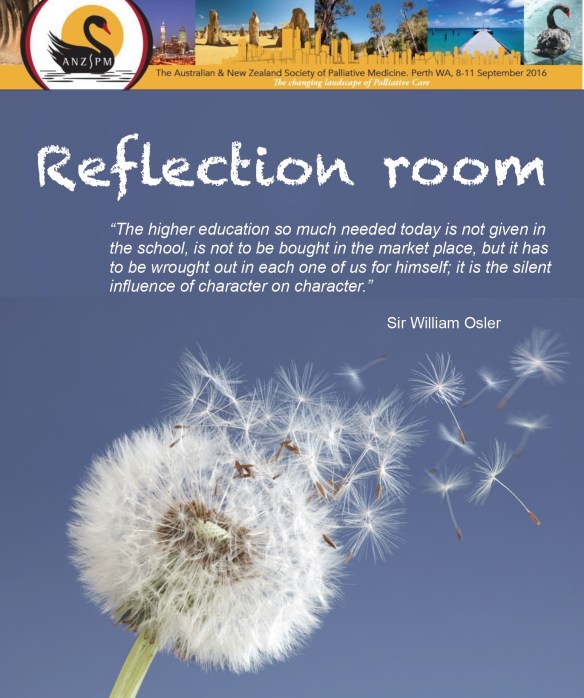
Reflection room

Nothing will sustain you more potently than the power to recognise in your humdrum routine, as perhaps it may be thought, the true poetry of life – the poetry of the commonplace, of the plain, toil-worn woman, with their loves and their joys, their sorrows and their griefs.

– Sir William Osler

In order to enrich the conference theme of honouring the art of palliative medicine, the conference organisers at the upcoming Australian and New Zealand Society of Palliative Medicine (ANSZPM) 2016 Conference in Perth, Western Australia have created a specific room for self reflection.

The Reflection Room will provide a nurturing space for conference participants to consider the human connection that we all experience as palliative care clinicians, and the impact this has on our own personal growth. The room will contain powerful art pieces that depict resilience in the face of dying, which aim to help delegates reflect on their experiences over the course of the conference, undertake guided mindfulness, or most importantly, just be.

Have you been to another conference recently where self-reflection, mindfulness and art featured strongly in the program? Was there space set aside for delegates to practice these activities amidst all the hustle and bustle of the conference program? Was it useful for you?


#ANZSPM16 – How does literature enrich our understanding of illness and dying?

ANZSPM Conf Banner

If, like me, you appreciate the arts and enjoy becoming engrossed in the literature (not indexed on PubMed)—then this workshop is for you!

On the morning of Sunday, 11th September #ANZSPM16 delegates will be treated to the workshop:

From Tolstoy to Garner: How literature enriches our understanding of illness & dying.

The workshop will be facilitated by: Gabrielle Brand, Felicity Hawkins, Carol Douglas, Mary McNulty, Valerie Henry, and Anna Petterson.

For more background on the use of arts and literature in palliative care, continue reading!

Continue reading

Delirium in palliative care – 10 tips in 140 characters

IMG_2618

Here are the first ten tips that came to mind for the management of delirium in specialist palliative care.* Of course, there are many more to list. Please share your top tips in the comments. Continue reading

Delirium: Why we should (palliative) care

In palliative care, delirium is everyone’s business. Anyone can get delirium if they are seriously ill. It is a distressing symptom – for the person with delirium, their loved ones and the professionals who care for them. Although it is common, potentially preventable and may be reversible, it is often missed, misdiagnosed and mismanaged despite our best intentions.

This 5-minute video is an excellent resource for the public and health professionals alike, (and seems to cover everything that it takes me 45 minutes to teach to nurses or doctors!). I discovered it via its co-creator, Delirium Champion Dr MS Krishnan.

This week, I am taking over Palliverse to share posts about delirium in palliative care – from conferences to clinical standards to a heart-wrenching personal story. Continue reading

#ANZSPM16 – understanding demoralisation in palliative care

Screenshot 2016-07-13 22.17.14 copy

Demoralisation has been described as a form of psychological distress that is associated with hopelessness, helplessness, and a loss of meaning and purpose. It has been explored across a number of settings, but is thought to be particularly important in palliative care settings, where it may affect up to 20% of patients who face end-stage disease.

Such a pattern of distress goes to the core of our identity, and presents challenges to well-being and the often-cited idea of ‘living well until we die’. It also has important implications for decision-making and consent in relation to medical treatments.

Practitioners in palliative care understand the far-reaching impact of demoralisation, and Professor David Kissane, along with colleagues at Monash University have been advancing our understanding of this concept Continue reading

The changing landscape of palliative care: #ANZSPM16 conference Sept 2016 Perth

Getting excited about heading to the Australian New Zealand Society for Palliative Medicine conference in September in Perth. With Melbourne’s frigid weather, the thought of a flight to sunny warm Perth in Spring has to be attractive. But more than that, the topic of how palliative care is changing in the 21st century is fascinating.

Continue reading

#ANZSPM16 Conference 2016 – early bird registration closing soon!

ANZSPM 2016

The Australian and New Zealand Society of Palliative Medicine (ANZSPM) will be holding its biennial scientific meeting in Perth between 8-11th September, 2016. The theme of ANZSPM 2016 Conference (#ANZSPM16) is “The Changing Landscape of Palliative Care”.

Palliverse is excited to announce that we will be working with ANZSPM to enhance the overall Conference experience by harnessing the power of social media.  We will be facilitating the sharing of knowledge from the Conference, encouraging discussion and debate within and beyond the Conference halls, and providing hands-on social media support before, during and after the event.

If you haven’t registered yet and you are keen to come, why wait?  You can find out more about the event and register for it here.  And – if you register by the 30th of June you will be eligible for an early-bird discountContinue reading