Reflections on research – a week of firsts

This is the first in a regular series of posts by Palliverse team members about their day-to-day experiences in research roles.

This week was a week of firsts for me. For the first time as a doctor, I am in a role that is primarily non-clinical. On Monday, I commenced a 1-year research fellowship based in theDepartment of Palliative Care at Fiona Stanley Hospital in Perth, Western Australia. It is also the first time I will be in the same position for a whole year (training terms for junior doctors generally ranging from 10 weeks to 6 months duration in WA). It’s the first job I’ve had where it’s my responsibility to set my own schedule, without the routine of ward rounds, clinics, home visits and consult referrals. It’s my first time working at this hospital – in fact, Monday was the first day at this hospital for most of our team. It is a brand new facility. The Emergency Department saw its first ever patient on Tuesday. More patients will be transferred from another hospital over the weekend. Our palliative care team (doctors, nurses and social worker) have come together from various services, care settings and states. It’s a great opportunity for us to learn from each other and so far it’s functioning very well. There is a fantastic energy at this new hospital – all the staff I’ve encountered are enthusiastic about change (for the better) and it is a great opportunity to get things done without the burden of “that’s how we’ve always done it” thinking. Continue reading

Elsewhere in the Palliverse: Weekend Reads

Hi and welcome to the first “Elsewhere in the Palliverse” for 2015. There is an (unintentional) geriatric flavour to this week’s links. This is possibly because today marks the end of a six-month geriatrics rotation for me, or maybe because another year has ended and birthday has passed. Regardless, I hope that Palliverse readers enjoy the following links:

Dementia researchers Muireann Irish and Rebekah Ahmed give their take on the new film adaptation of Still Alice, a novel about a 50 year old woman who is diagnosed with Alzheimer’s disease. Have you read the book? Will you see the movie? (Still Alice: A rare look at how dementia steals memories from millions – The Conversation)

Professor Rod McLeod gives some background on his article in this month’s European Journal of Palliative Care, ‘Making it easier to die at home – an innovative programme in New South Wales, Australia’. (Making it easier to die at home – EAPC Blog)

Continue reading

NHMRC seeking feedback on guidelines for use of publicly funded data

Australian researchers: The National Health and Medical Research Council (NHMRC) is currently seeking feedback on their draft guidelines Principles for accessing and using publicly funded data for health research. More information on the NHMRC website.

A resource to assist with Clinical Audit

Screen Shot 2014-12-30 at 10.03.32 pm

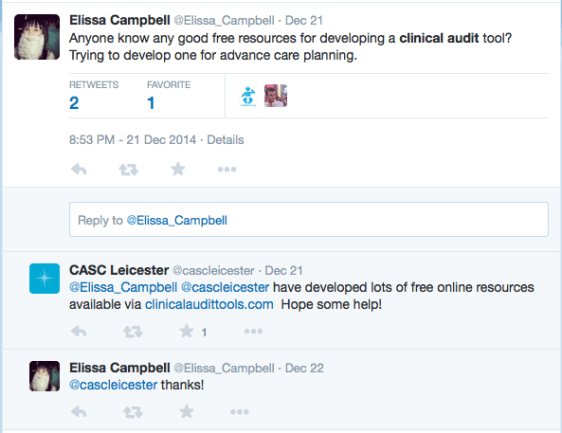
For many clinicians (including this one), their first foray into “research” is through clinical audit. The other day I was looking for some help to develop a clinical audit tool so, of course, I asked Twitter. The Clinical Audit Support Centre (@cascleicester) based in Leicester, UK, directed me to their Clinical Audit Tools resources – including some helpful interactive tools to assist you in deciding whether your project is a clinical audit, and whether it is “doable”. There’s also some blank Microsoft Excel templates to use in your own audit, a blog and a discussion board, which I am yet to explore.


Do you know of any other useful Clinical Audit tools? What are your views on the sometimes controversial topic of clinical audit?

Elsewhere in the Palliverse – holiday addition

If you’re lucky enough to have a break over the summer holiday season, I would advise that you to avoid anything work-related. However, if you just can’t pull yourself away from the worlds of palliative care and research, here (in no particular order) are some related links:

Continue reading

Elsewhere in the Palliverse – social media edition

Social media is a broad term that includes all sorts of online platforms and interactions, from the blogs* I follow (and share) via my RSS reader, to Youtube videos, Facebook, Twitter, LinkedIn, slideshare and beyond.  This week’s “Elsewhere in the Palliverse” visits the intersection of social media, palliative care and research.

*including palliverse.com, of course!


Tweets from the afterlife: social networking with the dead – from @ConversationEDU

This is another article from the Death and Dying series on the fantastic website The Conversation. We’ve shared a couple of these articles before and I would recommend reading the rest over at The Conversation.

Tweets from the afterlife: social networking with the dead

By Bjorn Nansen, University of Melbourne; James Meese, University of Melbourne; Martin Gibbs, University of Melbourne; Michael Arnold, University of Melbourne, and Tamara Kohn, University of Melbourne

Media technologies have operated as both a means of communicating news of a death and memorialising the deceased for a significant period of time, moving from traditional epitaphs, eulogies, wakes and inscription in stone to centuries-old obituaries printed and circulated in newspapers. So where are we now? Continue reading

Toast, heat packs, and other banned substances

I recently fell into a twitter conversation that started with an innocent tweet by Dr Ros Taylor (@hospicedoctor):toasttwitter

I was surprised to learn that toast, a humble source of warmth of comfort, is banned in some hospitals. Continue reading

Elsewhere in the Palliverse – Weekend Reads (featuring zombies)

Here’s some palliative care and research related links to peruse in the week ahead (most found via Twitter):

ABC News interviews Atul Gawande about “modern medicine’s treatment of dying patients.” Dr Gawande is all over social media and the news, even in Australia (and in Legoland)!

Current and former Chairs of the Australian and New Zealand College of Anaesthetists Mortality Sub-Committee write in The Age about the challenges that not for resuscitation orders can pose for anaesthetists.

The ASCO Post reviews a review article from JAMA Internal Medicine, about end-of-life discussions and advanced care planning. In summary, it’s all good.

In Canada’s Globe & Mail, “End-of-life patients aren’t being heard“.

Geriatrician Louise Aronson writes in The Lancet about ageism in medicine, and ageing as “the human life-cycle’s neglected step-child.”

Presenting at a conference? Improve your presentation with zombie apocalypse principles.

Meanwhile, on October 31st, GeriPal explored the unmet palliative care needs of zombies. And check out the zombie pain scale!

Finally, join the weekly (zombie-free) #hpmglobal tweetchat on Monday (17/11/14 at 11pm AEDT) to discuss an article from BMJ Supportive & Palliative Care about support networks of end-of-life carers. #hpmglobal chat is hosted by Aussie ex-pat Dr Jim Cleary (@jfclearywisc), with participants from several continents. For instruction in how to participate in a tweetchat, see Sonia’s post Twitter 102.

I hope you enjoy these and stay safe from zombies!


Elissa


How to draw the line between “good” and “bad” reasons to die (from @ConversationEDU)

By Sascha Callaghan, University of Sydney

A Senate inquiry into legalising voluntary euthanasia for terminally ill people has recommended a conscience vote on the proposed bill after technical matters, such as what constitutes a “terminal illness”, are clarified.

While this is an important step forward in grappling with the idea of the “right to die”, drawing a line at terminal illness for this purpose will be difficult. What’s more, restricting the right to die to people who are terminally ill is very different to what most of us think of as justifiable euthanasia.

Research shows more than 82% of Australians support voluntary euthanasia where “a hopelessly ill patient, experiencing unrelievable suffering, with absolutely no chance of recovering” asks for help to end their life. This description covers terminal illnesses as well as other incurable conditions causing great suffering in which death may not be imminent.

Refusing treatment

As the law stands, mentally competent people can reject medical treatment that will keep them alive. This is the case even when a person is not actually terminally ill. As suicide itself is not unlawful, it remains an option even when the person states their sole motivation for refusing treatment is to end their life.

Courts have confirmed that life-support machines can be turned off, feeding tubes can be removed and hunger strikes in hospital may not be forcibly interfered with by hospital staff. These cases involved people suffering extensive paralysis and chronic debilitating illnesses, all of which caused pain and suffering but were not, strictly speaking, terminal conditions.

Indeed, that was part of the problem the people in these cases faced: in their own estimation, their suffering was great but their lives might go on for a very long time. Still, while all competent patients may refuse medical treatment in order to end their lives, they may not be entitled to active euthanasia under a restricted law.

If it’s not exactly terminal illness that Australians have in mind when they think of who might legitimately seek euthanasia, and if we can tolerate and even condone the suicidal wishes of some people, it is perhaps a particular kind of suffering that we wish to restrict euthanasia to.

Perhaps we feel physical suffering is a better reason for ending one’s life than, say, suffering caused by grief, or shame, or hopelessness. Or perhaps it is the quality of “incurability” that we demand; we are more willing to accept physical illness may be beyond help, than psychiatric illness or emotional pain.

The problem is that while many of us may hold these views, they aren’t empirically true, and opinions differ.

In some jurisdictions where euthanasia is legal, it is also legal to be helped to die because of psychiatric illness when there is “unbearable emotional suffering”. While this has been controversial, groping for objective reasons why only some forms of death decision are all right is doomed to fail because the lines we draw between acceptable and unacceptable death decisions are cultural and arbitrary.

But that doesn’t make such line-drawing invalid.

The right line

To achieve defensible policy, we need to understand what’s really going on when we struggle with legalising assisted suicide. And it is simply this: the decision to die is not an ordinary choice.

Deciding to end one’s life has the quality of tragedy – and not only for people who love you, as not everyone has loved ones. Rather, all our deaths are important because, as the English poet and cleric John Donne wrote, we are all “involved in mankind”.

Death remains tragic no matter how inevitable it is or what causes it. And in a very deep place, human societies have always considered death itself to be bad, in a moral sense.

Death is punishment; in many cultures, it is what separates us from ancient gods. The inevitability of death is the ultimate source of existential suffering because all of us know we will die, as will everyone we love.

So even if we can bring ourselves to accept that a life can be so full of suffering that death is preferable, we still remain deeply anguished about it.

If society is going to be involved in death decisions by giving legal permission for doctors to bring about death, it is important to specify some conditions. But there will be few bright lines to discern between “good” and “bad” reasons for choosing death.

We do need to decide which deaths we are prepared to countenance. We may each decide quite differently. But all of us must think long and hard about where and why we draw those lines.


Editor’s note: Sascha will be on hand to answer questions at 12:30 tomorrow afternoon (November 12). Post any questions about “good” and “bad” reasons to die in the comments below.

The Conversation

Sascha Callaghan received a PhD scholarship from the NHMRC.

This article was originally published on The Conversation.
Read the original article.