
Palace of Care – What’s in a word?

Photo by Davide Zacchello on Unsplash

It was his second admission. He had been beautifully cared for by his family over many months, but the last week had been terrible. He was agitated, restless, and did not know what to do with himself. His wife wanted him to come back into hospice for end of life care.

On arrival he was semi-conscious, agitated and not able to talk clearly. His body was so unwell that his mind was no longer able to be lucid. Although he tried so hard to be there, it looked as if he was in-between two worlds. His family reported that he had seen dead ancestors.

I didn’t want there to be any surprises: I spoke in a quiet voice and tried to be as clear to them as possible, using simple English.

He is so unwell, so exhausted. He is dying.

I purposefully used the word dying at least five times during the 15 minutes of my visit.

When someone is dying everything inside can become all messed up, like he’s in a storm. He doesn’t know which way is up or down, and it might be really scary for him.

End of life delirium/terminal restlessness.

When someone is dying, they become less clear in their thinking, and sleepier. That is Nature or a higher power’s [palms open being raised towards the ceiling] way of protecting the dying person from having to have the full 3D/HD experience of dying.

He could see that his own distress was causing distress to his family, which caused him further distress.

I will change his medications to relax him. We’re going to calm it all down, and we are going to get him through this. We’re going to get you all through this.

I was caught off guard when he suddenly opened his eyes and reached out to shake my hand in both of his. He thanked me for what I had done for him.

Nek minnit – [I was being hugged and I hugged him back.]
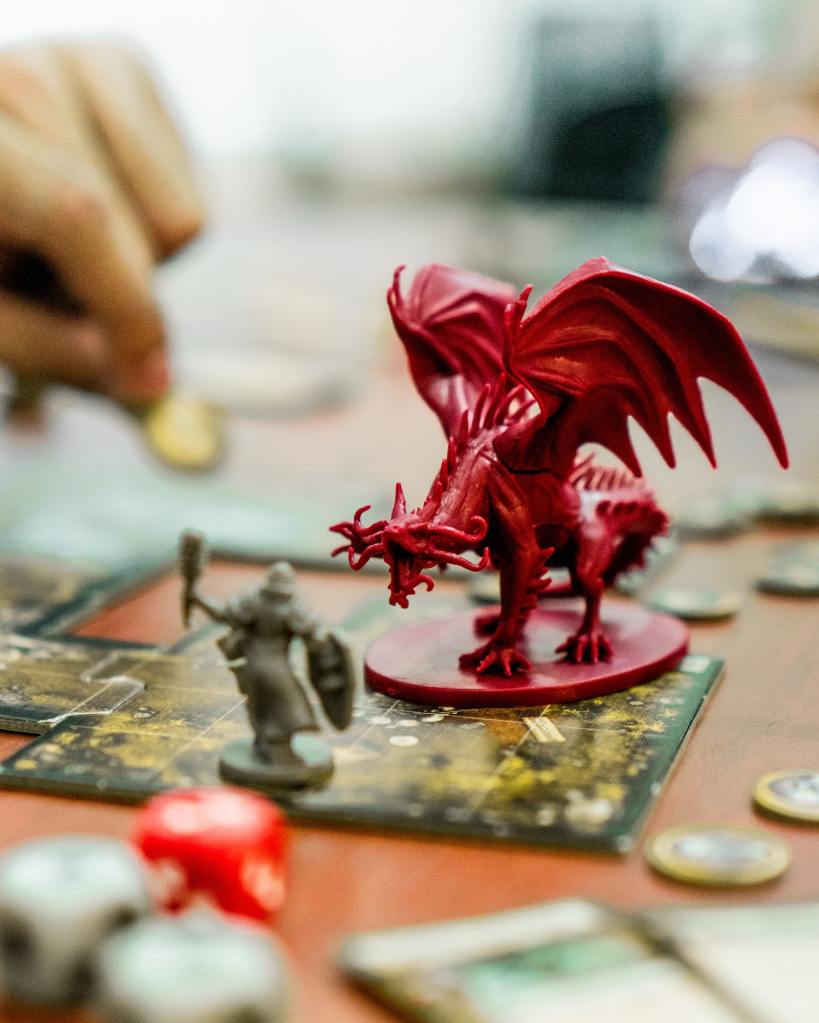
Palace of Care – Charm Person

Photo by Clint Bustrillos on Unsplash

I have only ever played the computerised version of Dungeons and Dragons, the fantasy role-playing game, and the version I played was more of a battle simulator. You went on quests with your band of characters, exploring different places, constantly running into trouble. Fights would involve cold hard steel, and mysterious magical spells. Some spells had obvious intended effects, e.g. Stinking Cloud (now that’s magic that I have understood since I discovered baked beans as a kid,) Hold person. A favourite spell of mine was Charm Person, casting this spell on an enemy could instantly change them into a team-mate.

As I started practising medicine as a junior doctor I often fancifully wished that some of the Dungeons and Dragons spells would work in real life. Over the past 22 years I have searched for Heal Person, Cure wounds, Revivify and have been caught short. If only life was that easy. I often wish that I had a magic wand that could change my patients condition for the better, I really do. Or magic pills or potions that would lead to a cure. Sometimes the best magic I can offer is to soothe suffering, provide comfort, offer support. On occasions I have had to use Charm Person, and sometimes even Charm Monster.

Illness can bring out the worst in people, but some people might not have been all that easy to get along with even when they were physically well. There are no difficult people or patients but at times communicating with humans can prove to be a difficult endeavour.

Continue reading

Palace of Care – You Are All On My Side

Photo by Sorin Gheorghita on Unsplash

The hospital palliative care nurse called me to refer a lady in her late 80s who prior to admission had lived independently until she started falling over. It was minor slips with minor injuries, then moderate trips with moderate injuries. In the past week she had a major fall, resulting in life-threatening injuries. Hospital tests showed that her chemical balances were all out, that a lot of bones and organ tissue had been replaced by cancer. The reason that she had lost her physical balance was that the cancer had invaded her spine, crushing the spinal cord and rendering her lower body weaker and then paralysed. She could no longer move her legs, but unfortunately could feel pain, and in fact her legs had become hypersensitive to pain. The bundle of nerves that make up the spinal cord do not like being pushed on, and scream out in protest.

During her week in hospital she had almost died twice. Each time, somehow she had recovered. Each time she was left devastated that she had recovered. From being fully independent, she had become fully dependent, a situation that she found impossible to tolerate. She had some stern conversations with The Almighty, she was not happy with what he had chosen for her. Her beloved husband had died over 30 years ago and there wasn’t a day that she didn’t think about him. She wished to be at his side again.

She asked the nice hospital palliative care nurse about the assisted dying service that she had heard about. Printed information was provided which was read and digested, with some difficulty as the pain in her legs and bottom still bothered her despite the pain relief she was given. She thought that she would qualify for assisted dying, having met all of the eligibility criteria and still maintaining her decision making capacity. The palliative care nurse said that no-one in the hospital provided the service, but that a referral could be made to the Ministry of Health in order for them to assign a practitioner to her. A process that would usually take two to six weeks to complete. Her ward team made the referral to the national service.

Continue reading

Guest Post – Naomi’s Notes – Making Friends

Photo by Jason Pofahl on Unsplash

The sound of the skipping rope whirring as it hit the ground meant their father was up.  He used to skip every day before he went to work.  

He taught his children resilience, to never give up when learning something new no matter how difficult it was. “You just gotta make friends with it”, he used to say.  

He loved his children and would try and spoil them when he could.   

He fancied himself as a mechanic and would often diagnose the car trouble as needing new spark plugs.  When asked if he had fixed the car he nodded and said  it didn’t need the key to start it, you just had to stand at the front step and clap your hands and it would come.

He was of that generation where you didn’t tell your kids you loved them but you showed them.  When his children told him they loved him it was met by an embarrassed silence.

The removal of his gall bladder heralded the start of his decline. He became increasingly ill and grumpy and as the days moved on he became less communicative.  He was always very direct in his communication. When his children spoke to him on the phone he never said hello or goodbye. He said their name and at the end just hung up.

Continue reading

I think therefore I am? – Final Human(?) Interaction

Photo by Lewis Roberts on Unsplash

With palliative care/hospice patients and their fragile health status, there is a chance that every time you see them might be the last time they ever have a meaningful connection with a fellow human being. Things can change in an instant, people can lose consciousness or clarity. Keeping this in mind, try to make each interaction as pleasant an encounter as you can for the both of you. The following tells of an unpleasant distressing encounter.

I was asked to see an unwell Oncology patient, who was in a lot of pain, and possibly about to die. There was a language barrier in that he did not speak English, thus an interpreter was organised to facilitate communication. That was the idea anyway, what actually happened was different.

The man in bed looked fragile, he had trouble communicating with his family, as he was lapsing in and out of consciousness. The interpreter arrived, a young man, who looked nervous. He stood at the end of the bed and didn’t greet the patient or his family members. The patient was being prepared for a scan and might need to head downstairs at a moment’s notice, so time was of the essence.

Continue reading

I think therefore I am? – We told you so

Photo by Alex Shute on Unsplash

Too young to be dying , only 32, with two toddlers 3 and 1 years old, she hadn’t even been a smoker. She had only had back pain, and on investigation last year, they found that she had metastatic lung cancer.

She came in with terrible pain, hadn’t been able to sleep for most of the week. Her partner, the father of the children, looked just as exhausted. Looking after her and the two tiny children. A tragic situation.

Pain difficult to control, breathing in a distressed fashion. She could barely leave her bed in the last two days.

Usual rule of thumb applied, if changing over months, months left to live, weeks – weeks, days-days, hours-hours.

Over the past four days, a change noted each single day. We estimated that she only had days to short weeks left to live.

We knew that she was supposed to go to Oncology, to have chemotherapy, but we thought she was too unwell.

We rang the Oncologist to discuss this, that we thought that she was dying, with only days to weeks left to live. We recommended that she not have chemotherapy, as we were concerned it would cause her more harm, than any potential benefit.

Continue reading

Palace of Care – Best Laid Plans

Photo by Pedro Miranda on Unsplash

Advance Care Planning (ACP) is recommended for everyone. It allows people to convey what is important to them. It can guide loved ones and health professionals as to what your wishes are in the case of you becoming incapable of expressing yourself. Such a situation is possible for anyone and thus it is recommended to be completed whilst you are well. Although it can be hard to imagine how you would feel or act in the event of severe illness or disability. ACP allows people to take some control of the end of their lives. This is what I want, this is want I don’t want. This is who I want around me. This is how I define what is quality of life for me. This is where I draw the line. It can be a confronting and difficult exercise to complete with your loved ones but it maybe a crucial method to communicate what you really want.

My patient had been diagnosed with MND (Motor Neurone Disease) over a year ago, and after attending the second clinic appointment they had introduced him to ACP. He read through the booklet with his wife, and it appealed to his organised nature. He always had a monthly, yearly and five-yearly plan in action. The doctor had said that most people would die of MND 18 months after diagnosis. This can mean time is running out, and this is not aided by diagnostic delay. All other illness have to be excluded before the diagnosis of MND is confirmed, for most people it is still a death sentence.

Continue reading

Palace of Care – Second Languages Part 2

Photo by Jaddy Liu on Unsplash

I had been on call for the hospital when the little old Chinese man had first presented to hospital. They had discussed his situation, a large stomach cancer which kept on bleeding, and that his Hb level was only 41. My opinion was that he was dying from recurrent bleeding that could not be stopped. My advice was that the hospital team have a discussion with the patient and family about the fact that his bleeding would be a life-ending event, that further transfusions would not be able to keep up with the amount of bleeding that was happening.

Some of my advice was taken, but not everything. It was as if the hospital doctors had spoken to me in a second language, one that didn’t lead to mutual understanding. They did end up having a conversation with the patient and his daughter about no further transfusions, but this was after transfusing one more unit of blood. The hospital doctor could speak Mandarin with the patient and family. He told them that the last unit of blood was an, “especially strong unit of blood, and would give him an extra boost.” Following this final transfusion the patient was sent across to the hospice.

Continue reading

I think therefore I am? – Dropped

Photo by Rod Long on Unsplash

I feel so lost, I feel so alone, aren’t I good enough for you? What did I do wrong? Why did you change so suddenly? I thought you’d always be there for me. I thought you’d have my back.

Many different people may be felt to be the other, this can have a racial basis, or be on a religious basis. People are labeled as other to justify treating them badly, and this is an unjust situation in this day and age. What other justifications are there for bad treatment of our fellow humans?

Palliative care patients may face stigmatisation for being closer to dying than most people. Oh well they’re going to die anyway, so why should we bother taking care of them? Just shove them in the corner and pull the curtain around them, and forget about them. Out of sight and out of mind. Not my problem mate. Who cares they’re dying anyway, not worth me expending any effort on them. I beg to differ, dying people deserve even more respect, as they are about to leave our planet, off to somewhere else, destination unknown. What will happen next? I don’t know.

It hurts to be rejected, to be pushed away, sometimes literally pushed away. I don’t want anything to do with you. Please leave, bad enough when you are trying to find a date, but when you are at the end of your life, how much more hurtful could that feel?

Continue reading

I think therefore I am? – Yearning for connection

Photo by Toa Heftiba on Unsplash

What this palliative care doctor thinks:

It’s not just about language, that’s why Google translate can’t replace human interpreters at the moment. It might be able to translate the words literally from one language to another but it doesn’t yet have the cultural context of where the words came from. The history of the language has not been programmed into it. Take English for example a lot of the words we use are derived from French and other Latin-based languages. You don’t ask for sheep meat, you ask for mutton from the French mouton. Similarly beef, not cow meat, from the French boeuf. A translator program is not the same as an interpreter program. Google Interpret would have to be much more sophisticated and would need cultural programming as well as linguistic programming.

A person may be speaking Chinese, but they are also living Chinese. The food that they eat, the clothes that they wear. Rituals that they follow to celebrate life, and how they deal with death and dying are the missing parts of a person’s identity that cannot be easily translated.
The most important tool I have as a palliative care doctor is my ability to communicate. I make a point of greeting my patients in their native language as much as possible. My accented version of their language is my attempt at providing them with a hint of familiarity. In the area I work in people come from all over the world, from lots of different cultures, with over 200 different languages spoken in our area. I certainly do not know all the greetings that are available but a quick Google search can provide me with at least a few words of greeting. A little demonstration of respect that I have made the effort to try to connect with another human being. It may have taken me ten seconds to type in my query but it can often bring a smile to a weary sufferer, whose illness has taken over their body. Someone for whom English may be a second or third language. A little snippet of home, can make a real difference.

Continue reading