Hot on the heels of the @LegoAcademics come the @LegoPalliateurs. I think these Lego accounts are all the reason you need to try out Twitter!
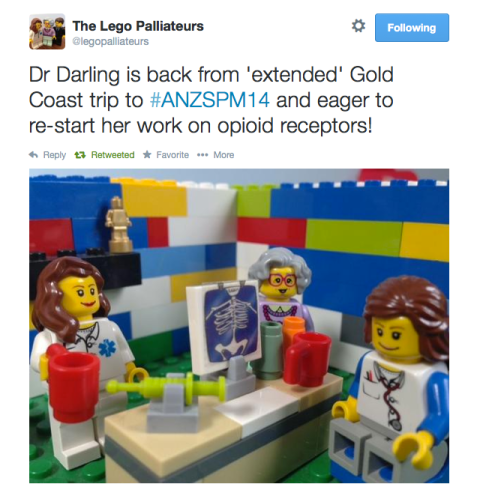

Hot on the heels of the @LegoAcademics come the @LegoPalliateurs. I think these Lego accounts are all the reason you need to try out Twitter!

Hi everyone,
Join me in sharing stories from the lighter/brighter side of Palliative Care.
Cheers,
James
Thanks to Michael Bramwell, from Melbourne City Mission, for the following slides:
It’s always a great pleasure to learn a new word and I had such a pleasure this week with “analgesia dolorosa”. In fact, two new terms as it’s also known as analgesia algera.
A pain specialist colleague (thanks C) used the term in reference to a patient who had presented with chest wall numbness and such severe nipple pain on light touch that he has difficulty wearing shirts. He went on to be diagnosed with a metastatic malignancy infitrating his thoracic vertebrae.
So, analgesia dolorosa is different from hyperalgesia which is an increased pain sensation from a normally painful stimulus, and I guess a variation on allodynia which is pain from a normally non painful stimulus.
Drop it in to a ward round near you and amaze your colleagues!
Sonia
The recent death of comedian Joan Rivers has brought end-of-life issues to the forefront. Kübler-Ross collaborator David Kessler wrote a piece in the Huffington Post on “Melissa Rivers’ Courageous Decision” to take her mother “off life support”. He gives advice to families going through the same decision-making process. Joan Rivers’ funeral plans, which she wrote about in a 2012 book, have also been getting wide coverage in the mainstream media. (Huffington Post, USA Today, news.com.au)
Nicholas Talley, President of the Royal Australasian College of Physicians (home to the Australasian Chapter of Palliative Medicine and therefore all palliative medicine specialists and trainees in Australia and New Zealand) has called for Australian governments to invest in and support further clinical trials into the benefits and risks of medicinal cannabis. In his piece for The Age, he speaks of humanity, compassion, patient-centred care and evidence-based medicine. (The Age)
Team Palliverse are working on a post about the excellent content presented at the Australian and New Zealand Society of Palliative Medicine 2014 Conference that wrapped up yesterday. In the meantime you may wish to catch up on tweets via the #ANZSPM14 transcript (via Symplur)
Decision Assist is seeking applications from eligible organisations for enabling grants to support projects that aim to implement linkage strategies that have the potential to improve the quality of end-of-life care for older people in residential and community settings.
Applications close September 12. More information can be found here.
Researchers from UWA are currently conducting research on factors influencing advance care planning, we would like to invite you to participate in a short online survey.
The survey should take approximately 20 minutes to complete, and your responses will be anonymous. If you are interested in participating, please follow the link below to read the Information Sheet, before responding to the survey items on this website.
Many thanks for your time and thoughtful responses!
Posted by Craig Sinclair @craigbsinclair
“I don’t get Twitter.”
“I don’t have time to … um, tweet!”
“Nobody cares what I had for lunch.”
As an (ahem) senior medical staff member I get a lot of raised eyebrows when I talk about Twitter. Some people (most people?) haven’t actually had a look themselves but have views about it being lightweight, superficial and a time waster.
Twitter is part of a revolution in health care; we are moving from the one-way “doctor knows best” model to a two-way dialogue in which patients and carers are actively engaged with health professionals and participate in their own health care.
I use Twitter mostly professionally. Surprised? Since I joined, the answer to the question, “Did you see the xyz paper?” has turned from a probably ‘No’ to a certain ‘Yes’. I have seen everything! I have “met” amazing people all around the world; patients, carers, other health professionals, health care leaders.
There are heaps of articles about why health care professionals should use Twitter online.
For me, the benefits in Twitter are in
For research, it’s an amazing tool to bring together ideas and people and talk about their work. When I was looking at setting up a project to improve breathlessness in palliative patients, I asked my Twitter mates as well as doing a formal lit search. They kindly send me a stack of stuff including some unpublished data by leaders in the field which I had no way of knowing about otherwise. I was able to connect with people doing similar work in the UK.
Here’s a proper talk about how to get on to Twitter
My quick summary would be
“interested in learning about #palliative opioid use in africa #hpmglobal”
Next time… twitter 102 – I know what a hashtag is – what’s next?
Cheers, Sonia
Some references:
http://futuredocsblog.com/top-twitter-myths-tips/
Should doctors use Twitter? http://www.amednews.com/article/20090629/business/306299993/4/

