Team Palliverse is excited to be presenting at the upcoming Palliative Care Research Network Victoria (PCRNV) Forum on March 24th at 5pm AEDT (2pm AWST; 7pm NZDT). We will be talking about the use of social media in palliative care research and clinical practice. Join us in person, via webinar or on twitter!
Category Archives: research
Reflections on research – supervision and deadlines
Like @Elissa_Campbell, five weeks ago, rather than starting a new clinical rotation at the beginning of the medical year, I too embarked on a research fellowship. For the next twelve months, instead of trying to fit in training requirements and research projects around clinical duties, I have the luxury of being able to devote pretty much all of my time to thinking and learning about research, reading studies properly instead of quickly scanning through papers, and talking to other researchers and clinicians – who are almost always encouraging, interested and incredibly generous with their time and advice.
A Tour of the Teams: Centre for Palliative Care, Melbourne
The Centre for Palliative Care is the academic arm of the palliative care service based at St Vincent’s Hospital, Melbourne. It is a collaborative centre of the University of Melbourne and has a goal and vision to enhance palliative care provision through enhancing research and education in the state of Victoria, Australia.
As such, the Centre has a significant research output with both clinician and academic researchers in the programs of:
- models of palliative care delivery;
- psychosocial support; and
- clinical and symptom trials.
8 Things I Wish I’d Known Before Starting My First Research Project
This is advice I give to people starting out in advanced training in palliative medicine (or geriatric medicine, my other training specialty) when asked about research projects*. It may also be relevant to other clinicians wanting to start out in research. The advice is based on my own experience and from talking to other trainees. One-hundred hours into your project, you do not want to discover that your study design is flawed or your results invalid. This advice may help to prevent that.
- Your research supervisor does not need to be the same person as your clinical supervisor. Unless your clinical supervisor is also a researcher, I would advise looking for someone else to supervise you, who has a research background. They do not need to come from your specialty or profession (although obviously some familiarity with your broad research topic is important). They may be based in a different city or country (although it may create complications with ethics approvals if your supervisor is from different institution).
Your supervisor can guide you through your study design. This improves the likelihood of producing valid results, which you can then publish and add to palliative care knowledge for the benefit of palliative care patients (because this is why we’re doing this research thing, right?)
If you’re not sure where to start looking for a supervisor, ask an academic in your field if they can recommend anyone. If you want to do palliative care research, the Palliverse researcher database is a good place to start.
- Librarians are very helpful. Most hospitals or health services have librarians who can assist you to use search engines, citation managers and other programs more efficiently. The library probably has resources that you don’t even know about.
A Tour of the Teams: ImPaCCT
Happy New(ish) Year everyone!
To celebrate we are starting a new segment. It goes without saying that many people and groups around our region are doing wonderful and exciting work in palliative care research but it can feel a little lonely out there for many of us. Finding support to develop your idea, and others with a similar interest can be a challenge. In addition to the palliverse researcher database we thought another way for us all to feel connected was to start to get to know the more established players. So let’s start with some introductions. We have been contacting the various academic and research institutions working in palliative research in our region asking them to tell us a little bit about themselves. “Tour of the teams” will be an ongoing series to bring the responses from these units together.
We hope that the “Tour” will help us all be a little more connected and maybe to give us all some ideas of where we can get help to develop that great research idea that we have been sitting on.
The service who gets the gold star for being first off the mark is the ImPaCCT group
NHMRC seeking feedback on guidelines for use of publicly funded data
Australian researchers: The National Health and Medical Research Council (NHMRC) is currently seeking feedback on their draft guidelines Principles for accessing and using publicly funded data for health research. More information on the NHMRC website.
A resource to assist with Clinical Audit
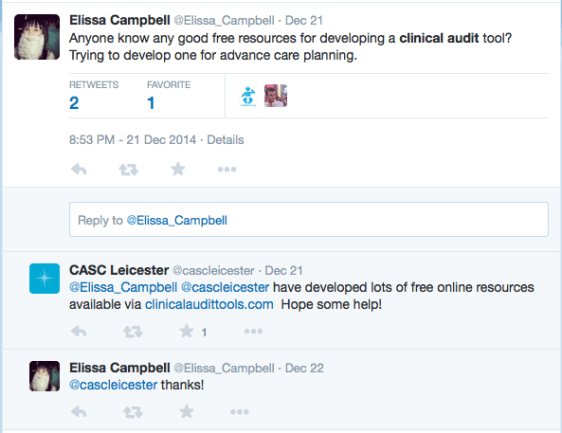
For many clinicians (including this one), their first foray into “research” is through clinical audit. The other day I was looking for some help to develop a clinical audit tool so, of course, I asked Twitter. The Clinical Audit Support Centre (@cascleicester) based in Leicester, UK, directed me to their Clinical Audit Tools resources – including some helpful interactive tools to assist you in deciding whether your project is a clinical audit, and whether it is “doable”. There’s also some blank Microsoft Excel templates to use in your own audit, a blog and a discussion board, which I am yet to explore.
Do you know of any other useful Clinical Audit tools? What are your views on the sometimes controversial topic of clinical audit?
Palliverse researchers database update
(Image: University of Michigan Library Card Catalog by dfulmer / CC BY)
The updated version of the Palliverse researchers database now available!
Have you connected, communicated or collaborated with anyone via the database so far? We’d love to hear about it! Please send us an email at: Palliverse@gmail.com
Merry Christmas and Happy New Year from the Palliverse Team
What’s new in research?
New trial published in the Lancet Respiratory Medicine provides evidence for early integration of palliative care in patients with advanced disease suffering from breathlessness.
Higginson and colleagues randomised 105 people with advanced disease and refractory breathlessness (MRC dyspnoea scale score >2) to receive a breathlessness support service or usual care. The breathlessness support service involved, sequentially: 1) An outpatient clinic appointment involving assessment and treatment by respiratory medicine and palliative care clinicians, as well as a breathlessness information and management pack; 2) An allied health home assessment and promotion of self-management techniques approximately 2-3 weeks post the clinic; and 3) A final discharge planning outpatient clinic appointment with a palliative care clinician approximately 4 weeks post the clinic.
Mastery of breathlessness symptoms significantly improved for patients attending the breathlessness support service, compared to usual care (16% improvement, p=0.048). For patients with COPD and interstitial lung disease (but not cancer): survival rate from randomisation to 6 months was greater in those who attended the breathlessness support service (94%) versus usual care (75%), as was overall survival (p=0.048). Total health care costs calculated from patient-reported health service use were not significantly different between groups.
Have a read: http://www.thelancet.com/journals/lanres/article/PIIS2213-2600(14)70226-7/fulltext
Higginson IJ, Bausewein C, Reilly CC, Gao W, Gysels M, Dzingina M et al. An integrated palliative and respiratory care service for patients with advanced disease and refractory breathlessness: a randomised controlled trial. The Lancet Respiratory Medicine. 2014. 2(12):979-987. DOI: 10.1016/S2213-2600(14)70226-7