Palace of Care – Dehumidifier

Photo by Laårk Boshoff on Unsplash

We didn’t know what was keeping him going. He hadn’t eaten anything for ten days. No drinks for days. Somehow he was still producing urine. Where did it come from? His son speculated that he was drawing the water out of the room’s atmosphere. “Dad’s become a dehumidifier.”

He had outlived many doctors’ prognostication attempts, including my own. “Anyone else would’ve died a week ago. He’s not anyone else he’s stronger than most people.” Somehow he had stayed alive with his metastatic cancer for four years. He had received multiple treatments over the years. They had kept him alive, but the last three months had been a struggle. He had lost 20kg over the years of illness. 10kg had been lost in the past three months because of severe nausea.

The cancer was cruel as it melted his body away it took away his appetite. His once mighty frame was reduced to skin and bone. He still wasn’t used to his reflection, it had continued to change. Despite all of the weight loss, one thing he never lost was his sense of humour.

In life he had always done things in his way, at his own pace and it was no different in his death. The family maintained their long vigil, and he remained mostly asleep but responsive when he was awake. If our staff found evidence of his imminent death we would inform them. We also warned them that sometimes people don’t want anyone to be around at the point of death and that he might slip away when an opportunity presented itself.

He was kept calm and comfortable. His family were supported and our patient died three days later.

Palace of Care – Existence

Photo by Marija Zaric on Unsplash

Yes, it’s become a struggle, every day.

I get halfway through making lunch then I have to rest. When I finish making it I have to rest again before eating.

Heh, my only entertainment is going to the lavvy. And that’s no fun.

Every time I move I need to go to the toilet. Nothing much comes out and it’s exhausting.

Sometimes I make a mess and that’s even more stuff to clean up. I don’t have the energy.

COVID. I thought it would be the end of me. I was almost disappointed when I recovered.

Don’t get me wrong, if I wasn’t sick like this I’d be happy to continue living, but I have these illnesses. Nothing is going away, it’s only going to get worse.

I don’t want to be here any longer than necessary. This is existence. Not a life.

Blood transfusion? What’s the point? So I can live longer to get worse?

No, I wouldn’t want you to treat a chest infection. Yes, Let nature take its course.

No resuscitation.

Yes, you do understand me. Thank you.

You listen to what I want, nice for a change.

Palliative care for patients with Parkinson’s disease

I often work in a palliative consultation service, and we are seeing more patients with chronic neurological conditions like Parkinson’s Disease. Parkinson’s disease is a progressive neurological disease that causes tremors (shaking), slowness of movement and stiffness. It can cause changes in facial expression so that people look expressionless. and changes in handwriting and speech too. We have to be careful not to prescribe medications that can make things worse, like for example, we currently give Metoclopramide (maxolon or pramin) for nausea but we need to avoid this medication in a person with Parkinson’s Disease.

Tanja Bahro and the team from the Southern Metropolitan Palliative Care Consortium in Melbourne Australia conducted a survey and found that palliative care clinicians wanted to know more about caring for patients with PD. Not being able to find a guide, they wrote their own! Please email Tanja for a copy tanja.bahro@smrpcc.org.au. They’ve had great feedback from users.

Tanja, tell us about your resource:

“Parkinson’s Disease – Issues for the Palliative Care Team” is a practical resource for people working in specialist palliative care, who are caring for people who are dying both with and from Parkinson’s Disease (PD). It was developed by our project officer Lee-Anne Henley with the great help of Dr Jim Howe, a very experienced neurologist in the area of progressive neurological conditions and palliative care, as well as Robert Wojnar, a pharmacist at Cabrini with a special interest in PD. The resource explains the main issues for people with PD at end-of-life and describes considerations and solutions. It also includes a practical care plan on which we have received some excellent feedback.

What gap did you see that lead you to develop it?

Because of the long trajectory, it is difficult for a health care team to know when people with PD should be referred to palliative care. A lot of PD patients also enter a nursing home and then at times lose contact with their neurologist. This can result in people not being referred to palliative care when appropriate and missing out on a multidisciplinary approach to care when the neurologist is no longer involved. Medication management can be difficult with PD patients, as some medications need to be continued to keep the patient comfortable but might also interact with medications commonly used for palliative care. We undertook a survey of palliative care staff and found that people wanted to know more, so we tried to find clinical guidelines or similar resources. When we couldn’t find anything we thought we’d better develop something ourselves!

How will it help patients and clinicians?

We hope to achieve greater awareness of appropriate referral to palliative care and we’re working on that. With the resource, we anticipate that palliative care clinicians will liaise more with the neurologist— they now have a simple and comprehensive guide to the main issues for people with PD and can therefore act quicker and prevent some of the pitfalls. Our next project is to adapt the resource for the residential aged care sector, but that’s more complex because we must take into account that the clinicians there might not have specialist palliative care knowledge.

How can people get the resource?

We want to make sure that we distribute the resource only to clinicians with experience in palliative care, so we haven’t put it on our website, but pc clinicians can just contact me on tanja.bahro@smrpcc.org.au and I’ll email it to them very quickly.

Palace of Care – Requested Letter

Photo by Álvaro Serrano on Unsplash

This was a first for me in my 23 year medical career. My patient’s family requested we write a letter to be read out at the funeral.

To our dear patient and their lovely family,

Thank you for allowing us the privilege of looking after you.

We know to start with you were scared of hospice and were not keen to be under our care.

You changed your mind once you met us. Our whole team enjoyed getting to know you and your caring family.

We are glad we could help you feel more comfortable, as we could see you had suffered a lot, as had your family who witnessed your suffering.

Your family had looked after you so well at home and that’s why you were able to make it to your 80th birthday. It was a testament to the loving care they provided to you.

Thank you for allowing us to look after you in your final days.

You were so unwell but we were so glad to share smiles and laughter with you and your family during your time in our inpatient unit.

Your friends and family will miss talking with you and hearing you sing, but everyone is glad you do not have to suffer any longer.

It was our pleasure to look after you and your family. That’s why hospice is here, to look after people just like you and me in the community.

We wish you and your family a fond farewell.

Kind regards,

Dr James Jap on behalf of the Hospice Team

Palace of Care – Lost

Photo by Jeffrey Hamilton on Unsplash

Life-limiting illnesses are associated with many losses. Loss of control is one of the worst losses of all. As the condition progresses the losses continue to accumulate and some may be worse than others depending on each person. Things that were taken for granted are missed greatly and some of the losses can be especially cruel. Each of them is grieved over.

She loved to talk and would chatter away from morning to night, until the last months of her life. Her friends couldn’t recognise her voice when they phoned each other. Her voice sounded as hoarse as a young pop star before rehabilitative larynx surgery. Her breathing worsened and she wasn’t able to produce the volumes she was used to speaking at. As the weeks went by her voice played hide and seek and became harder to track down. Only a whisper was left, and even her family couldn’t understand what she said at times.

Continue reading

Palace of Care – Doting Children

Photo by Philippe Jausions on Unsplash

“The Oncologist told us they would only live for another three weeks.”

“When was that?”

“Three months ago.”

“The good care you and your sibling provided kept them going. Now they are tired, and their body can’t handle the cancer anymore.”

“We are at breaking point ourselves. We can’t sleep well, and the tears keep coming.”

“You are both very close to your parent, you have looked after them well.”

“The last months had been hard, but the last weeks have been terrible. We have had to help with everything.”

“They are exhausted. Yesterday they told me they thought their time was short, that death would happen soon. I agree with them. We will get them through this, and get you and your sibling through this too.”

“The phlegm is causing them distress, and the breathing. They couldn’t relax last night. The medications helped briefly but then they couldn’t lie still. I kept awake too. They keep on asking for water, but it will go into the lung. Their swallowing is getting worse.”

“If it will make them feel better they can have some water. It won’t make things much worse but might bring them some comfort. If they developed an infection I wouldn’t treat it, as it might be gentler to die of the infection rather than dying of cancer. We’ll change the medications to make them more comfortable.”

“Please do, make them comfortable. Too much suffering already. They were always proud of their appearance but in the last weeks, no energy to do anything.”

“They’ve hated not being able to do what they want?”

“Yes, they even asked about assisted dying. They’ve always been so independent, not being able to do anything for themselves has been awful.”

“Natural death is going to happen soon, they wouldn’t make it through the assisted dying assessment process. They’re likely going to fall asleep soon. We’ll keep them comfortable.”

“Thank you doctor, can we stay here in the hospice.”

“Of course, you all need to stay here, we’ll look after you all.”

Guest Post – PRR – EMPTY EXPERIENCES

Photo by Stainless Images on Unsplash

I have spoken previously about impermanence, but it is good to be reminded of it because it is the very nature of everything, and we suffer if we don’t accept that. We try to fight or deny impermanence because we see it in a negative way – change and death. But when we accept impermanence we develop a true appreciation for every moment of life.

For example, the magic of a sunset is its temporary appearance, just like a rainbow. It appears under special circumstances and only remains for a short time. And we have to be in the right place at the right time to see it. That’s why we stop for a brief moment of awe when we see a rainbow. If it were to last forever we’d take it for granted and never really appreciate it. At the same time, we don’t suffer or lament its passing once it disappears. Knowing its impermanence means we don’t become attached to it, therefore we can experience joy at its appearance yet let it go when it disappears.

It is interesting that almost everybody is able to do that, yet we all suffer so much because of attachment to other things in our lives, thinking of them as permanent. We suffer when we have some loss, separation, decay and all kinds of changes that are part of life. Sadly, it seems only after we lose someone or something do we really appreciate it. When it is actually too late.

This is why contemplating impermanence is so important – not to depress or upset us but to help us fully appreciate life and everything in it. Once we understand impermanence we can enjoy every moment, just like the fleeting appearance of a rainbow. The company of loved ones, nature, material comfort etc, when we fully appreciate the moment, we can give ourselves to it completely and really experience it. And when that moment is over, we let it go. Of course we still have our memories, but we shouldn’t cling to them or allow the past to dominate our present. Instead we should use our past as inspiration to improve everything that we do now.

Even for the worst experiences in life, contemplating impermanence is helpful as we understand that nothing lasts forever,……

PRR

I think therefore I am? – The most beautiful sound I ever heard…

Photo by darin ashby on Unsplash

Over the past two years despite all the stressors faced there has been a sound heard increasingly throughout the corridors of the hospice. As many doors and windows have been left open to allow greater ventilation to allow viruses and other infective materials to be circulated out of the building but the sound of the wind is not the subject of this post. It has been cold at times during the winter and the sound of fan heaters has been present at times but again it is not interesting enough to merit any writing. When patients are breathless an electric fan is lent to them for them to have the breathlessness relieving air across the face which is more effective than oxygen and other prescribed treatments for people who can’t catch their breath. Our cleaning staff continue to work tirelessly to keep our premises clean, without their efforts we could not keep our operation running, and the importance of their infection control toil cannot be underestimated. The sound of vacuuming, wiping and mopping are commonly heard again and are not the subject of this piece.

The sound can be contagious. When you hear it you feel different. It is something that resonates inside you and it makes you feel more human and less alone. It can change your facial expression in an instant. It can lead to a sudden and rapid expulsion of air from your body. No, I am not talking about passing gas, that’s what anaesthetists do for a living, I work in palliative care. The brass band will not produce these sorts of sounds, but maybe the sound belongs in the orchestra’s wind section. Sometimes, playing an air guitar or the world’s tiniest violin can produce the sound.

Continue reading

I think therefore I am? – Communication Skills for Serious Illness Conversations

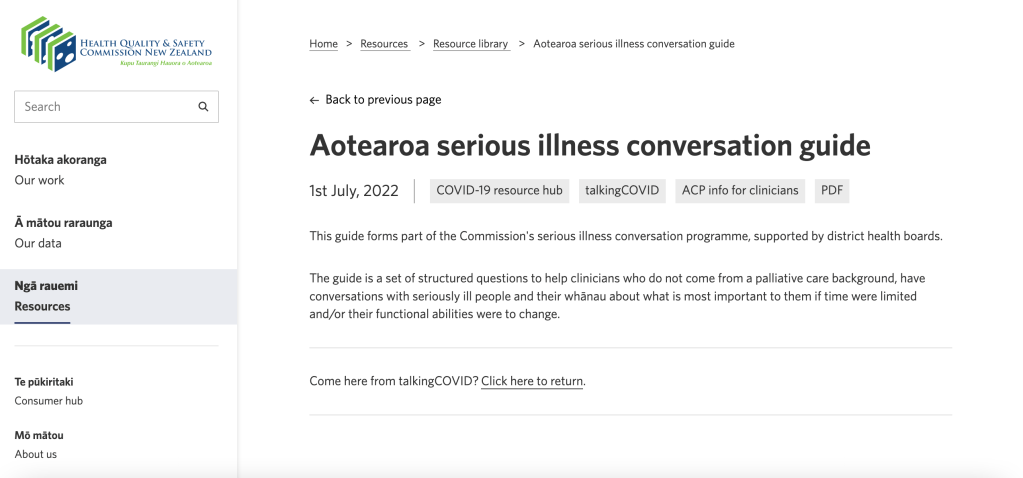
A little bird told me that a great combination if you are wanting to improve your communication skills when it comes to palliative care situations is to check out the resources below.

The Serious Illness Conversation Guide can provide you guidance and structure for conversations.

Whilst Vital Talk courses and their app can help you to manage the emotional content of these important conversations.

I think therefore I am? – Health(?) System Reforms

Photo by Towfiqu barbhuiya on Unsplash

I’ve worked as a medical doctor for almost 23 years. In all of that time I have not worked in a health system but in a sickness system. The last 15 years of my career I have worked in palliative care where we deal with the end of sickness, the end of life. I look after people who are dealing with the consequences of Diabetes and other long-term conditions that people die of. People of Māori and Pasifika ethnicity in the community I serve die of these diseases and cancers at much earlier ages than the rest of the population.

In hospice/palliative care we pride ourselves on providing whole person care through a Te Whare Tapa Whā lens. Health is not just about tinana/physical health but must also include wairua/spiritual health, hinengaro/emotional health and whānau/social health. Why do we save the best care till last? All people of Aotearoa New Zealand should be receiving whole person care from pre-cradle until after grave.

With the New Zealand health reforms we have an opportunity to transform our health system into a wellbeing system. We have an opportunity to transform the lives of generations to come, to give them the opportunity for better quality of life, throughout their entire life span. Why save the best for last? What can you do today to make for a better tomorrow? Together we can do this, but it will require different mindsets.

That’s the way it’s always been done.