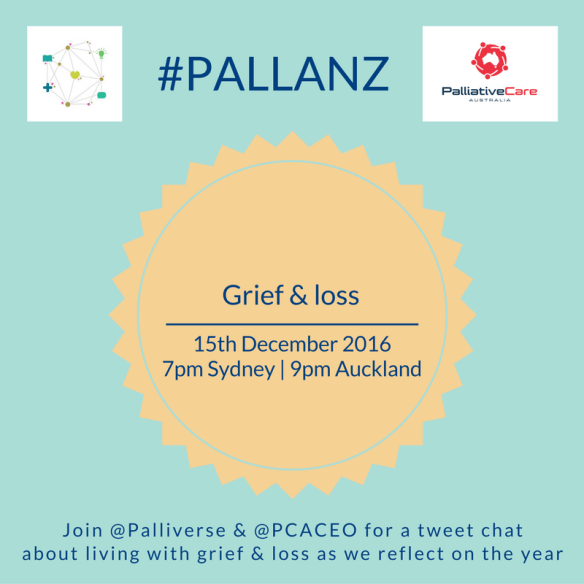
Living with grief & loss: #PallANZ chat

pallanz-201612

Grief and loss is something we will all face at different times throughout our lives. Whether it is the death of our pets, our friends, our children, siblings or parents; the experience and expression of grief in response to these losses can be a very personal and individual thing. Grief can also arise in anticipation of loss. For those living with life-limiting illness, living with the loss of social role and professional identity can be especially challenging.

Thoughts about old, new and future losses can be particularly common during the festive season. For some of us, it may represent an anniversary of the death of a loved one, and bring with it painful memories of loss. Some might be facing their first Christmas ‘alone’, while others may be grappling with the possibility of celebrating their ‘last Christmas’.

While living with grief and loss is a personal experience, we don’t have to endure it on our own. As a community, there are many ways that we can support each other. Join Palliverse and Palliative Care Australia CEO Liz Callaghan (@PCACEO) to reflect on 2016 and talk about grief and loss.

Carers and people with palliative care needs are especially welcome, as are health professionals, researchers, policymakers and interested community members!

If you are new to twitter and tweet chats, see our “idiot’s guide” here: https://palliverse.com/2014/09/03/idiots-guide-to-twitter-for-health-professionals-twitter-101/

Continue reading

Drugs for #delirium don’t work, and may in fact harm

Meera Agar, University of Technology Sydney

Delirium robs dying people of their autonomy, dignity and last conversations with loved ones, at a time when every moment is precious.

Symptoms are highly distressing to experience and watch. Confusion, incoherent communication, poor attention, agitation, drowsiness and hallucinations are some markers of this common complication for people dying in hospital from cancer and other advanced illnesses. On average one in three people in end-of-life hospital care are affected.

Doctors commonly prescribe antipsychotic medications to try to relieve these symptoms. However, our study just published in JAMA Internal Medicine, raises serious concerns about their safety and efficacy.

So, what are we to do for people experiencing delirium, who are robbed of their mental awareness and ability to communicate?

Continue reading

free Australian webinars on advance care planning and palliative care

Ilsa Hampton_Feb 2016 2MB_100px.jpg

Decision Assist is running a series of free webinars on advance care planning and palliative care.

For those of you new to webinars, you can watch the presentation live on the internet and interact with the presenters, or just watch the presentation later. Some health services and aged care facilities are watching them together as part of their continuing professional development or education programs.

Here is a link to register. The next one is presented by Ilsa Hampton, CEO, Meaningful Ageing Australia

Decision Assist Aged Care Webinar Series – Grief, trauma and loss
Tuesday 6 December 2016 | 1.30 pm – 2.15 pm AEDT

http://www.webcasts.com.au/decisionassist061216/

Regards, Sonia (who also works for Decision Assist!)


the death talker

We all struggle to live a good life but what about a good death? Can we ever be truly prepared for the inevitable?

Molly Carlile is a ‘death talker’ who is committed to helping Australians ‘die well’. She talks about physician-assisted dying, planning for death, and the need for a cultural shift in the way we think about death and dying.

Here is a link from the ABCs Radio National to an interview with Molly Carlile, palliative care activist and author.

#PALLANZ November tweetchat: Technology and palliative care

pallanz-201611

“Never the twain shall meet,” has been the oft repeated refrain when it comes to technology and palliative care.

Palliative care has traditionally focused on providing ‘low-tech and high-touch’ services, are these concepts outdated or have we entered an era of algorithm-driven automaton provided health-care(?) In the next 20 years, 47 to 81% of jobs in the future will be threatened by developing technologies, are palliative care jobs at risk as well? Can the tin-man actually do the job as well if he doesn’t have a heart?

Has science-fiction become science-fact? The team at Melbourne’s own Anatomics are leading the way with custom-made 3D-printed patient implants. What possible impacts could 3D-printing have on palliative care provision? Continue reading

Calling palliative care health professionals for online research experiment – now open worldwide!

If you could only admit one patient to your service today but you have many referrals, which patient would you choose?

FloorBoss XL™ Free-Standing Sign - High-Impact Plastic 25in.H x 12in.W

Palliative Care is in urgent need of a robust and evidence-based system for triaging referrals in an equitable, efficient and transparent manner. If you are a health professional working primarily in palliative care anywhere in the world with at least two years of experience, we want to know your views!

Please take part in this world-first online experiment at  www.tinyurl.com/palliativetriage or for more information contact Dr Beth Russell by email beth.russell@svha.org.au or twitter @DrBethRussell

#4APCRC: 4th Australian Palliative Care Research Colloquium

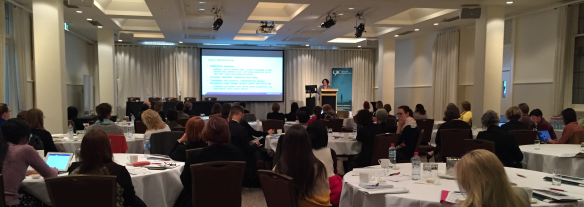
audience

Members of team Palliverse had the pleasure of attending the 4th Australian Palliative Care Research Colloquium between October 27-28th, which was once again held in the comfortable surroundings of the Rendezvous Hotel in Melbourne, Victoria.  Continue reading

Palliative Care WA 2016 Conference: Registrations Open

Banner1.jpg

Registrations for the Palliative Care WA State Conference are now open. The conference will be held on 29-30 November 2016 at Joondalup Resort. Online registration is available here. Look forward to seeing you there!

Unspoken… a theatrical perspective on advance care planning

End-of-life care and decision making is not something many people feel comfortable discussing, and yet is a conversation that all of us would benefit from having.

In order to generate awareness of and discussion around Advance Care Planning, Health Issues Centre is presenting a theatrically inspired event in Melbourne titled Unspoken (What Will Become of Me?).

Continue reading

#PALLANZ October tweetchat: Euthanasia and palliative care

PallANZ 201610.png

I have seen few topics that can simultaneously enliven a dinner party conversation and create such moral divides as the debate about euthanasia and physician-assisted suicide. Conversation increases in volume and speed. Wine glasses are clutched tightly to chests. Slippery slopes, autonomy, choice, sanctities and human rights to life and death are bandied across the room. Other party-goers are drawn in, almost against their will.

While this dinner party conversation may eventually give way to renovations or school holiday plans, the public debate continues.

Perhaps it takes hold so readily because we all share such a deep stake in the issue. Whether committed to autonomous, communitarian, religious, ideological or professional positions, we are all part of a broader community, sharing a common experience of human life and death.

Continue reading