Palace of Care – Doting Children

Photo by Philippe Jausions on Unsplash

“The Oncologist told us they would only live for another three weeks.”

“When was that?”

“Three months ago.”

“The good care you and your sibling provided kept them going. Now they are tired, and their body can’t handle the cancer anymore.”

“We are at breaking point ourselves. We can’t sleep well, and the tears keep coming.”

“You are both very close to your parent, you have looked after them well.”

“The last months had been hard, but the last weeks have been terrible. We have had to help with everything.”

“They are exhausted. Yesterday they told me they thought their time was short, that death would happen soon. I agree with them. We will get them through this, and get you and your sibling through this too.”

“The phlegm is causing them distress, and the breathing. They couldn’t relax last night. The medications helped briefly but then they couldn’t lie still. I kept awake too. They keep on asking for water, but it will go into the lung. Their swallowing is getting worse.”

“If it will make them feel better they can have some water. It won’t make things much worse but might bring them some comfort. If they developed an infection I wouldn’t treat it, as it might be gentler to die of the infection rather than dying of cancer. We’ll change the medications to make them more comfortable.”

“Please do, make them comfortable. Too much suffering already. They were always proud of their appearance but in the last weeks, no energy to do anything.”

“They’ve hated not being able to do what they want?”

“Yes, they even asked about assisted dying. They’ve always been so independent, not being able to do anything for themselves has been awful.”

“Natural death is going to happen soon, they wouldn’t make it through the assisted dying assessment process. They’re likely going to fall asleep soon. We’ll keep them comfortable.”

“Thank you doctor, can we stay here in the hospice.”

“Of course, you all need to stay here, we’ll look after you all.”

Guest Post – PRR – EMPTY EXPERIENCES

Photo by Stainless Images on Unsplash

I have spoken previously about impermanence, but it is good to be reminded of it because it is the very nature of everything, and we suffer if we don’t accept that. We try to fight or deny impermanence because we see it in a negative way – change and death. But when we accept impermanence we develop a true appreciation for every moment of life.

For example, the magic of a sunset is its temporary appearance, just like a rainbow. It appears under special circumstances and only remains for a short time. And we have to be in the right place at the right time to see it. That’s why we stop for a brief moment of awe when we see a rainbow. If it were to last forever we’d take it for granted and never really appreciate it. At the same time, we don’t suffer or lament its passing once it disappears. Knowing its impermanence means we don’t become attached to it, therefore we can experience joy at its appearance yet let it go when it disappears.

It is interesting that almost everybody is able to do that, yet we all suffer so much because of attachment to other things in our lives, thinking of them as permanent. We suffer when we have some loss, separation, decay and all kinds of changes that are part of life. Sadly, it seems only after we lose someone or something do we really appreciate it. When it is actually too late.

This is why contemplating impermanence is so important – not to depress or upset us but to help us fully appreciate life and everything in it. Once we understand impermanence we can enjoy every moment, just like the fleeting appearance of a rainbow. The company of loved ones, nature, material comfort etc, when we fully appreciate the moment, we can give ourselves to it completely and really experience it. And when that moment is over, we let it go. Of course we still have our memories, but we shouldn’t cling to them or allow the past to dominate our present. Instead we should use our past as inspiration to improve everything that we do now.

Even for the worst experiences in life, contemplating impermanence is helpful as we understand that nothing lasts forever,……

PRR

I think therefore I am? – The most beautiful sound I ever heard…

Photo by darin ashby on Unsplash

Over the past two years despite all the stressors faced there has been a sound heard increasingly throughout the corridors of the hospice. As many doors and windows have been left open to allow greater ventilation to allow viruses and other infective materials to be circulated out of the building but the sound of the wind is not the subject of this post. It has been cold at times during the winter and the sound of fan heaters has been present at times but again it is not interesting enough to merit any writing. When patients are breathless an electric fan is lent to them for them to have the breathlessness relieving air across the face which is more effective than oxygen and other prescribed treatments for people who can’t catch their breath. Our cleaning staff continue to work tirelessly to keep our premises clean, without their efforts we could not keep our operation running, and the importance of their infection control toil cannot be underestimated. The sound of vacuuming, wiping and mopping are commonly heard again and are not the subject of this piece.

The sound can be contagious. When you hear it you feel different. It is something that resonates inside you and it makes you feel more human and less alone. It can change your facial expression in an instant. It can lead to a sudden and rapid expulsion of air from your body. No, I am not talking about passing gas, that’s what anaesthetists do for a living, I work in palliative care. The brass band will not produce these sorts of sounds, but maybe the sound belongs in the orchestra’s wind section. Sometimes, playing an air guitar or the world’s tiniest violin can produce the sound.

Continue reading

I think therefore I am? – Communication Skills for Serious Illness Conversations

A little bird told me that a great combination if you are wanting to improve your communication skills when it comes to palliative care situations is to check out the resources below.

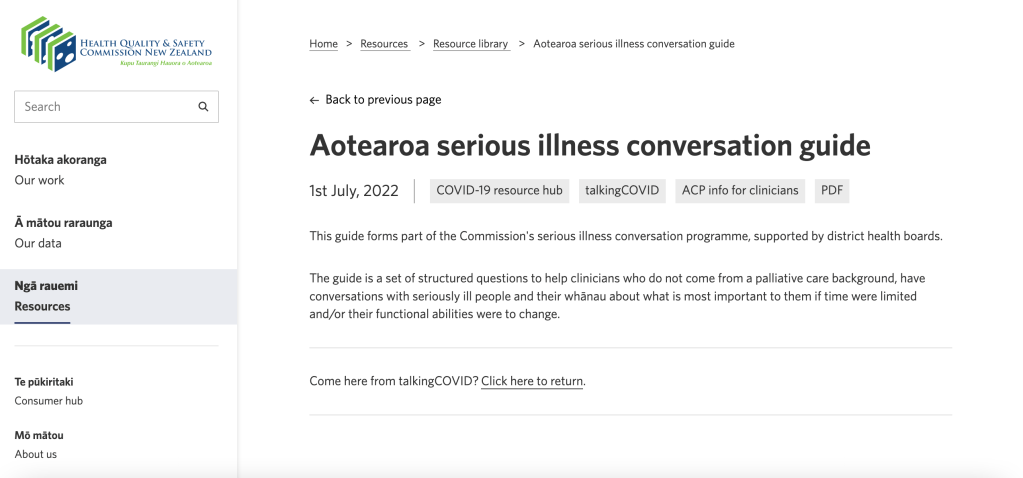
The Serious Illness Conversation Guide can provide you guidance and structure for conversations.

Whilst Vital Talk courses and their app can help you to manage the emotional content of these important conversations.

I think therefore I am? – Health(?) System Reforms

Photo by Towfiqu barbhuiya on Unsplash

I’ve worked as a medical doctor for almost 23 years. In all of that time I have not worked in a health system but in a sickness system. The last 15 years of my career I have worked in palliative care where we deal with the end of sickness, the end of life. I look after people who are dealing with the consequences of Diabetes and other long-term conditions that people die of. People of Māori and Pasifika ethnicity in the community I serve die of these diseases and cancers at much earlier ages than the rest of the population.

In hospice/palliative care we pride ourselves on providing whole person care through a Te Whare Tapa Whā lens. Health is not just about tinana/physical health but must also include wairua/spiritual health, hinengaro/emotional health and whānau/social health. Why do we save the best care till last? All people of Aotearoa New Zealand should be receiving whole person care from pre-cradle until after grave.

With the New Zealand health reforms we have an opportunity to transform our health system into a wellbeing system. We have an opportunity to transform the lives of generations to come, to give them the opportunity for better quality of life, throughout their entire life span. Why save the best for last? What can you do today to make for a better tomorrow? Together we can do this, but it will require different mindsets.

That’s the way it’s always been done.

Palace of Care – Strongest

Photo of Cassia Fistula by Winston Chen on Unsplash

“Hey, long time no see.”

“Hello Doctor, how are you?”

“I’m good, how are you doing?”

“I’m sleepy and tired, that’s what I do. I sleep most of the day and the night.”

“Do you have any pain?”

“No, the pain is well controlled. The urine is still bubbly. Why is that?”

“Your cancer has caused a connection between your bowel and bladder. It’s called a fistula. It’s a sign that it is getting worse.”

“Yes, I am getting worse. I felt so unwell the other day. I thought that my end had come. I just felt so deeply tired. I couldn’t get out of bed for two days. My family and the hospice staff thought I was going to die.”

“Then you woke up again today?”

“Yes, and I’m going to spend some time at home. How long have I got left?”

“I don’t know. I thought you were days away from dying a few times over the past weeks. You keep on proving me wrong, over and over again. You’re stronger than most humans. I think you’re the strongest person I have met in my 15 years of working in palliative care. I don’t know how you do it.”

“I don’t know either. I feel so tired, but I keep on hanging on.”

“You’re being yourself. I wish I could be more accurate with your timeline. You are deteriorating but your willpower is still strong, but your body is fading.”

“Yes, my memory has gone, and I talk to people who are not there, sometimes for a long time.”

“Is that distressing you?”

“No, it isn’t too bad. I can handle it but I get irritated sometimes.”

“Let us know if it gets too annoying, and we can adjust your medications.”

“Okay.”

“You enjoy your time at home. I’ll see you tomorrow.”

“Thanks Doctor.”

I think therefore I am? – On Death and Dying

Photo by NOAA on Unsplash

I virtually attended a Palliative Medicine conference over the past three days and have heard talks from a wide range of speakers. Included were a gastroenterologist and a haematologist both from specialties who are still unsure about which patients to refer to palliative care, and when to refer them.

It becomes a self-fulfilling prophecy if all the referrals we get are very late then we cannot do as much for the patients and their families. If the referral only arrives 72 hours before death or two weeks before death, does that mean palliative care is synonymous with end-of-life care? But that is not what we are trying to do in reality. Our services are happy to work alongside other specialties. A patient can be on the liver transplant waiting list and also receive palliative care from the local hospice. This is different to the USA where admission to the hospice programme means you cannot have ‘active’ treatments anymore. We have many patients who are still on their palliative chemotherapy/radiotherapy/immunotherapy and many other active treatments including haemodialysis. Even as the patient undergoes various treatments we are keen to help reduce suffering in its many forms, both physical and emotional, spiritual, and social.

How can we get this important message across? A patient referred to palliative care/hospice doesn’t mean that you have given up on them. One of my mentors Dr David Perez who worked in Medical Oncology would talk to his patients about coming to the point where there were no more active Oncology treatments available and the time had come for Active Palliative Care.

Continue reading

I think therefore I am? – On Utopias

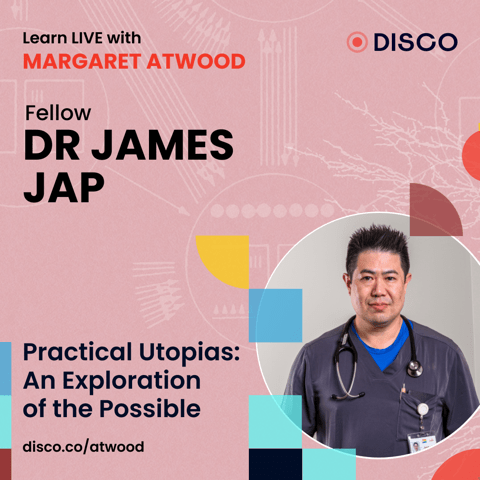
From next week I’m joining 199 others to explore the concept of utopias.

“To create a future that works, we must work together.” – Margaret Atwood

I’m proud to have been selected as a Fellow in Practical Utopias: An Exploration of the Possible led by @MargaretAtwood on @discolearn!

This is a once-in-a-lifetime opportunity to learn and collaborate with 200 changemakers from around the globe to unlock practical solutions to some of humanity’s biggest challenges, the climate crisis being foremost. 

Want to play a part in co-designing a better future? Get involved: https://disco.co/atwood

I’m currently doing some of the preparatory readings and as part of my personal preparation I’m reading the Report of the Lancet Commission on the Value of Death.

The Lancet Commission on the Value of Death sets out five principles of a realistic utopia, a new vision of how death and dying could be.

Click the link above and check it out for yourself.

I think therefore I am? – When in Rome

Photo by Zheka Boychenko on Unsplash

People come from many different places each with its own culture. This includes medical cultures and different ways of dealing with end-of-life care situations. I have talked to visiting New Zealand-trained registrars who had visited relatives overseas. One registrar talked about how upset he had been when he visited his grandmother who lived in a residential care facility in Asia. He knew she had end-stage dementia but was shocked by the number of invasive treatments she received as standard care. His grandmother had refused food and drink which is common in end-stage dementia. In the New Zealand setting, this would lead to a conversation in which the family would be prepared for the impending death of their loved one. The patient would be kept comfortable and nature would take its course. Not so for the registrar’s grandmother who had not been able to consent to any treatments for several years. With the approval of the next of kin, a feeding tube was inserted through her abdominal wall into her stomach. This allowed for liquid meal replacements to be pumped directly into her stomach.

This kept her alive and maintained her quantity of life, but this did not improve her quality of life. She remained unable to talk and could not recognise family members. After the registrar visited his grandmother he was upset and tried to convince his relatives to change the grandmother’s management plan, to allow for her to die naturally. He failed to shift his local family’s thinking, as the grandmother was receiving the standard treatment. The local medical culture was one of preserving the quantity of life at all costs, with no adjustment made for quality of life. The registrar was troubled by the medical culture clash.

Patients and their families may experience a medical culture clash when dealing with our local health system. They may find it hard to accept that there are no further treatments available. Helpful friends and family may make things more difficult with their unsolicited advice. “Back home this would never happen. The patient would be on intravenous fluids, and artificial nutrition, and would be having a lot of investigations.” This can make a stressful situation more so. People try to help but the way they do things may increase stress and suffering. Each case needs to be dealt with individually and with respectability.

I think therefore I am? – My Left-Handed Life

Photo by Mahdiar Mahmoodi on Unsplash

Life is full of changes. Change is one constant you can count on always being there. Things happen and you have a choice to make. Whether to accept the changes or not. My injured right middle finger has led to some adaptations in my daily life. I have been using my left hand a lot more than usual. I have had to count on it for many of the things I do daily. For example, I have had to modify my showering and toileting. The application of armpit deodorant and body moisturiser was difficult the first few times but the seldom used nerve pathways supplying my left hand have had to spring into action. Dishwashing and cooking have become newer left-handed experiences.

I have had to modify my typing style. Have I consciously avoided typing the word ‘milk’? Or was it another symptom of my adult lactose intolerance? Problems of this ilk never troubled me before. Likely they will disappear once the finger has healed. I hope it will heal and I am not left with a permanent disability. I’ve had to perform physical examinations with my left hand. What other effects has this partial left-handedness had on my brain?

How would it feel to permanently lose body functions? These are situations which my patients have to grapple with. Incurable illness can lead to permanent loss of ability – disability. This may lead to the permanent loss of jobs and other important life roles. The losses all add up and add to the burden of suffering. When your actual whole person is threatened, and life as you knew it will never fully return. Each loss is grieved over and may or may not be accepted. A distressed physical body affects the emotions, affects the spirit, and affects your family/community. The ripples can affect many people in the wake of the initial insult.

How do people stop themselves from falling into despair when there is nothing guaranteed apart from ongoing deterioration? Some people cope well, others don’t cope at all, and most people are somewhere in between. A rock and a hard place? They need help, guidance and optimisation of community support. What can be done to make life less difficult? Which services or staff members need to be involved?