The Rural and Remote Institute of Palliative Medicine (RRIPM) has released a draft of the proceedings of their Round Table Workshop held last month in Canberra. Participants included consumers and community advocates, clinicians and managers, college and peak body leaders, as well as state and federal government representatives.
Recommendations from the workshop will guide implementation of the next phase of the RRIPM project:
Maintain independence, with clearly defined roles and expectations when working in partnership across participating organisations
Advocate for the establishment of a tri-partite group [RACP, RACGP and ACRRM] to strengthen training alignment
Launch a trial network across training ready locations
Consider proposed actions relating to education and training, leadership and governance, capacity building and relationships for implementation in Year 1 to Year 3
Seek guidance from the Office of the National Rural Health Commissioner, and other jurisdictional representatives to identify future funding sources
To receive regular updates on project progress please register your interest with the project team via email rripmproject@anzspm.org.au
The Rural and Remote Institute of Palliative Medicine (RRIPM) has released a draft of their scoping review into specialist palliative medicine training in rural Australia and are now inviting everyone interested in improving rural palliative medicine to provide feedback before 12th February 2024 by emailing the Project Manager at RRIPMproject@anzspm.org.au
The family were trying to protect our patient. They knew that his time would be short, that he would die soon. They didn’t want him to know this as the last time he had been given such bad news he had reacted poorly. They said he had been in tears for two days after the hospital doctors had told him bluntly that he could die at any time. They didn’t want a repeat of what had happened. If he only had a short time left they wanted him to enjoy it as much as possible. This was what his life partner wanted, the person who knew him better than anyone else. The love of his life.
Did he know what was going on? Probably. He had said he thought things were bad. We had not denied this. He was the one feeling every single discomfort. He was the one who was exhausted from lying in bed doing nothing. He was the one whose body continued deteriorating on an almost daily basis. He was the one who had asked to be admitted. He was worried about how his family were coping with looking after him at home. He had been told weeks prior to this admission that he possibly only had days left to live. When we asked him if there was anything he still needed to do, any unfinished business, the reply was,” No. I’ve done everything I can. I’ve done well. I have no regrets. I have a good family. We raised our children well.”
Our duty of care is to our patients. “First do no harm“ is the first principle we follow. Would telling him what he probably already knew be of benefit or would it cause harm? It was unclear as we didn’t know him well enough. For some people knowing they might only have a few days left could provide relief. They might be thankful that their suffering would not go on for much longer. For others, the short time left would provoke anxiety and distress. They would be upset by the thought of having to leave their family for the final time. If he were to directly ask us, we could not lie to him. But if he never asked we would not raise the question ourselves. His partner had made the decision. The survivors of his death had to be given the opportunity to do what was right for their family. No matter what would happen, we promised that we would try our best to keep him comfortable in what time remained.
Reincarnation was one of the topics of conversation in the first room this morning. Our patient was a believer and had told his wife that she would come back as a dog. Unfortunately one of their daughters had died only a few years ago. It is always difficult for parents to deal with, as it goes against nature’s order to have a child die before a parent. One of the tragedies in life that elderly people would like to avoid if at all possible. Their daughter had died but had left her traces everywhere.
She had always loved butterflies, and had grown lots of swan plants in order to provide food for her favourite Monarch butterflies. She had a keen eye for their caterpillars and could see them from a distance, their yellow, black and white lines indicating their presence. She especially loved the pupae/cocoons that would form as the caterpillars went through the biggest changes in their lives, metamorphosis. Coming out the other side of the process transformed, with a new outlook on life and the ability to fly. Looking so different in colour scheme and features. She had always loved to have butterflies around. In some cultures it is believed that butterflies are visiting dead friends and family members who have come to see you from the other side of the grave. This is a comforting thing to have your ancestors come to see how you are.
Our patient had been steadily deteriorating over the past week, and he and the family had derived some comfort in being visited by Monarch butterflies. It was thought that their late daughter/sister was visiting their father as he entered his final cocoon state, just before dying. I told them that when people die in our hospice we would affix a butterfly to the door.
I have often drawn cocoons on our patient list board to indicate that people are undergoing the final transformation in their life, the dying process. One in which everything starts to wind down, the heart, lungs and other organ functions change. A person becomes sleepier, and less clear in their mind, Nature or a higher power’s way of protecting the dying person from the full experience of dying.
“Please keep on talking to him, he can hear you, but might not be able to respond to you.” Family members were considering leaving for home to come back again soon, but I advised that he could die at anytime, and that traveling under lockdown restrictions was not as easy as usual. Probably better to hang around and support each other for a few more days.
The Australian and New Zealand Society of Palliative Medicine 2018 Conference #ANZSPM18 is off the a great start, with many excellent plenaries & proffered papers presented on day 1 – following an excellent Trainee Day & pre-Conference workshop on thought leadership.
Day 2 promises to be even more awesome, starting off with keynote speaker Tom Le Blanc sharing his insights on collaboration & integration between palliative care & haematology. The rest of the day will feature a variety of plenaries & concurrent sessions on the new frontiers of palliative medicine – the theme of the conference. I’m also looking forward to the conference dinner tonight!
You can find the sides for my presentation on Palliative Care in Heart & Lung Transplantation here: HLTX PC ANZSPM18 Chi Li
Beautiful spaces inside the Victorian Comprehensive Cancer Centre, the new home of the Peter MacCallum Cancer Centre in Melbourne, Australia
[The following article by Dr Sarah Dunlop, advanced trainee in palliative medicine, was first published in the Australian & New Zealand Society of Palliative Medicine (ANZSPM) Newsletter. The next ANZSPM study day will be held on September 6th in Sydney prior the the upcoming ANZSPM 2018 Conference. Follow #ANZSPM18 for updates from this biennial meeting – Chi]
While there are many benefits of living in Western Australia (the weather, the beaches, and charming, debonair palliative medicine trainees), there are also downsides to living in one of the most isolated cities in the world… specifically the isolation! The decision to travel interstate to a course or conference usually hinges on three questions: can I get the time off, can I afford it, and is it going to improve my practice? So after charming my colleagues into giving a debonair trainee a day off and boarding the red-eye to Melbourne, I can confirm that the Study Day for Trainees and New Fellows met all my requirements. Continue reading →
We at Palliverse love a conference, especially one that “brings together doctors working in palliative care” in Aotearoa/New Zealand.
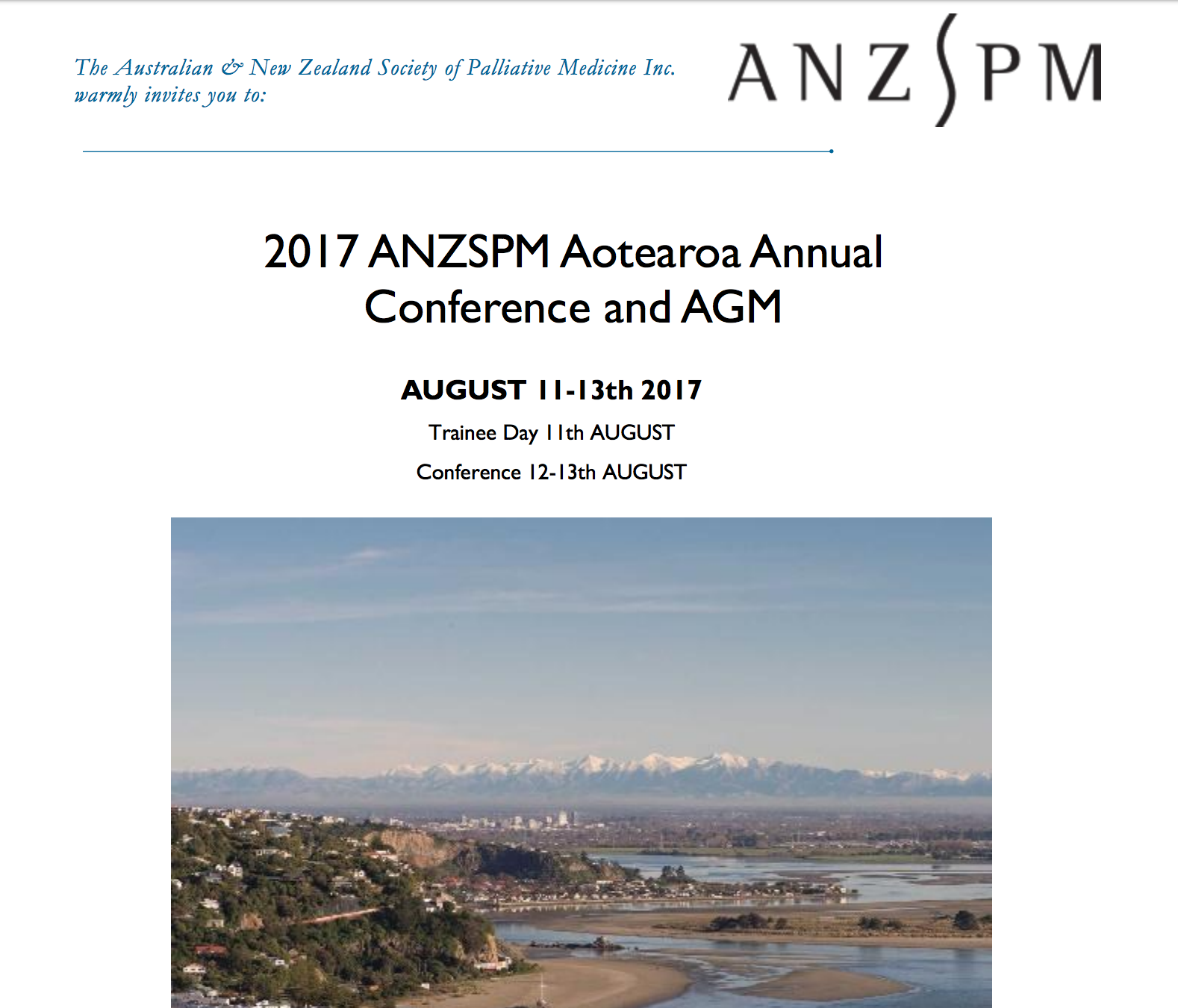
The 2017 ANZSPM Aotearoa Annual Conference and AGM will be held in Christchurch this year. It all starts off with the Trainee Day on 11/08/17 which is open to all Palliative Medicine trainees, General Practitioners with a special interest in Palliative Care and Medical officers working in Palliative Care.
The 2017 Annual Education Update Programme is packed with many topics of interest, and will be a good opportunity to catch up with what is going on all over the country, as well as catching up with new and old friends. This year Dr Wendy Pattemore will be introducing a new session called, “Wild Successes and Fabulous Failures,” which will provide an opportunity to share how Palliative Care is done in your own ‘patch’.
We think delirium is a pretty big deal here at Palliverse, having devoted quite a few blog posts over the years to discussing this important issue in palliative care.
Chaired by @Meera_Agar – the lead author of the seminal paper examining the role of antipsychotics in the management of delirium symptoms in the palliative care setting, which was published in JAMA Internal Medicine earlier this year – the session will feature presentations from Professor Agar, as well as:
Dr Simon Allan, palliative care physician, Director of Palliative Care at Arohanui Hospice in New Zealand and the current President of the Australasian Chapter of Palliative Medicine, the Royal Australasian College of Physicians,
Dr Chris Moran, geriatrician from Alfred Health and research fellow at Monash University, and
Dr Justin Dwyer, psychiatrist and Medical Director of the Psychosocial Cancer Care service at St Vincent’s Hospital, Melbourne.
After the presentations, a panel discussion involving the speakers will offer the audience plenty of opportunities to further explore this hot topic in palliative care.
Of course, delirium is just one of the many great topics that will be examined in detail during the fourth iteration of this biennial meeting. To find out more about the #ANZSPM17 Update, and to take advantage of the early bird registration rate until May 24th, go to: https://willorganise.eventsair.com/QuickEventWebsitePortal/2017-anzspm-update/update
In recent years scientific research into the effects of cannabinoids has been on the increase. Some would say that not-so-scientific research on the effects of cannabis has been underway for many hundreds of years, in many different countries and cultures.
Until recently I didn’t know that our own bodies produce endogenous cannabinoids, the various effects of which are still being studied.
Two years ago, colleagues had informed me that at the Montreal Conference 2015 it was a ‘smokingly hot’ topic. The most widely studied cannabis-derived cannabinoids are Cannabidiol(CBD) and Tetrahydrocannabinol (THC.) You may have heard of some of the medications that have ‘come to market’ since then: Continue reading →
She detailed some powerful anecdotes, including the story of two sisters whose mother lay dying in a hospital. The cost of parking was prohibitive and the daughters took it in turns to sit in the car watching out for the parking inspector. When their mother died, only one of the daughters was there; the other was in the car. Continue reading →









 palliverse.com