The physical and emotional roller-coaster ride continued for our patient and their family. Close to death one week, then an incomplete recovery. No longer imminently dying, but far from sustainably living. A plateau in the journey, like being stuck in transit with no clear plan of when the next part of the trip would continue. He still wanted to start his journey up to heaven, but his flight had not been called yet. He improved a bit more to the point that he was slightly better than when he first arrived. This was disappointing for him as he felt he was heading in the direction opposite to where he wanted to go. He maintained his faith and stayed calm. His Lego showcase continued to fill the room. Extra shelf space had to be organized. He was worried that he was taking up a bed that could be utilised by someone with greater needs than him.
Nothing changes when nothing changes. Sometimes a small nudge is required for situations to change. We decided to start discharge planning again as he was holding his own. We didn’t want to make him anxious as we had with the previous discharge plan so we talked to his family about it and not to him. He continued to do well, more Lego assembling occurred over the next weeks while his family found him a suitable place. He remained active around our ward, walking around slowly between Lego sessions. A new skin infection appeared but it wasn’t too painful for him. We had promised him again that we would not start any antibiotics and we stuck to our word.
For most of my time in medical school, I thought I was going to train to become a paediatrician. That all changed after I went to Taiwan to do my medical elective in Paediatric Oncology. After five weeks on the child cancer ward, I realised I couldn’t become a paediatrician. I found I couldn’t handle working with critically unwell and dying children. I decided to become an adults-only doctor and didn’t look after children anymore.
Fast forward 11 years and I was in the final year of my Palliative Medicine training, and I was working in the local hospice. In New Zealand, the definition of adults is those 16 years old and over. We had admitted a 16-year-old immigrant schoolgirl and she was dying of metastatic bowel cancer. It is highly unusual to have bowel cancer at such a young age. What she had was aggressive and deadly. Physically it was challenging to control her symptoms but that was the easier part of dealing with her case. Looking after such a young person made the case difficult for me and other staff members. She was the same age as some staff members’ children or grandchildren. Most of us were not used to working professionally with adolescents.
We had admitted her for end-of-life care and it looked like she had limited time left. The prospect of her dying alone made all of us feel uncomfortable. The girl needed parental support but the girl’s mother had died and her father had to go back to their home country to deal with urgent matters. She had no other family and was alone in New Zealand, apart from similarly aged school friends. How could we help her through this?
Her cries for help would be answered by a church pastor, who stepped in and became a mother figure for our young patient. This lady moved in and provided motherly support during the toughest of times. The pastor and her husband (also a pastor) arranged for the girl’s father to return to New Zealand. The pastor stayed with the girl at our hospice for the last weeks of her short life.
It was sad that our young patient was dying, but it was so nice that the pastor was there to provide maternal support. It was good to know that there were still some good people around who could be counted on. Our patient was kept comfortable and died after her father had come back from overseas. In many ways a memorable case of someone who died far too young.
The two brothers of my patient had asked to speak with me. We went to the little visitors lounge which was next door to their brother’s room. They wanted to know what was happening to their brother. They knew he was unwell but they needed to know the extent of his illness as they needed to make plans for the rest of the family.
I recounted the history of their brother’s illness. Worsening cancer had led to worsening pain, which we had only just controlled a week after he had been admitted. The pain had been troubling him for months but he had been too scared to interact with our hospice team. It was only in the past week when the pain had become unbearable that he had agreed to let us help him. I was about to talk about what I had seen, a daily deterioration in their brother’s condition when there was a tap at the window.
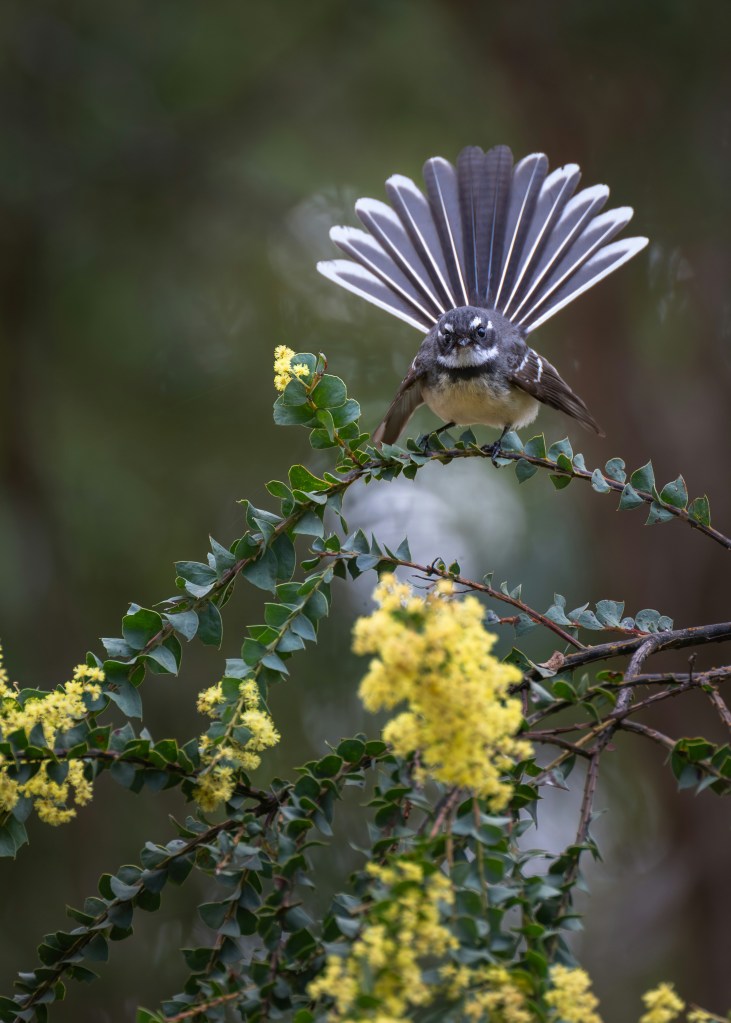
Tap, tap, tap. It was a branch from the tree outside hitting the window of the lounge. It was moving because a bird was flying from one part of the branch to another. A small bird with a grey back, light brown belly and white and black tail feathers shaped like a fan – A fantail. The brothers looked at each other through widened eyes, they looked scared. “It’s a fantail. You know what that means.”
Pīwakawaka/Fantail: in Māori mythology a messenger, brings news of death from the gods to the people.
We talked about how I thought their brother was dying. I thought he might only have days left to live and that we would try our best to keep him as comfortable as possible.
The odds were against him but he wanted to at least try. Even if he died on the way home it would be worth it. As long as he was heading in the direction of his heart. Back to the ancestral home where generations of his family had lived. No matter how far away from there they had gone they still thought of it as home. Even those who had moved overseas many years ago still maintained the connection.
It was the hardest thing he had ever done, but it was the most important thing for him. He left the place he had lived in for most of his adult life to go on his final journey. It would be a long ride in the car. Bumps in the road hurt him the most, and there were many patches of roughness along the way. He held on, he wanted to make it. His family were expecting him and had made preparations. They had organised a bed in one of the rooms. He hadn’t been back for years, life had been too busy.
He felt so tired, he wasn’t sure if there was enough time left. The doctors had told him days ago that there were only days left. He was so tired. He would only let himself rest for a short time. He had to be awake to will himself to his destination. He tried to keep his eyes open, but his eyelids felt too heavy, he just couldn’t keep them up.
He woke with a start. A large truck had been going in the opposite direction and the vibrations from its wake had shaken their small car. They were on a country road, there were no lights around them, and the road was deserted. They drove alongside a stream, that’s where they used to go eeling when they were kids. Around the corner, they turned and he saw a dim light in the distance. They headed up the gravel driveway, and he saw her in the doorway.
The light from the house reflected in the two wet tracks down her cheeks, “Welcome home son.”
He wanted to go home. It wasn’t going to be easy, but that’s what he wanted most of all. To go back to where it had all begun. Back to his ancestral home. He was at risk of dying on the way but it was important that he at least try. It wouldn’t be easy for his family. There was much less formal support available in the small town he was born in. He would have to rely on his family members to look after him.
The practicalities needed to be sorted out. Who could provide equipment and home support? These things can be hard enough to arrange urgently in metropolitan areas let alone in rural New Zealand. The postcode lottery of our health system continues to provide a stark reality check. Healthcare provision levels depend on where you live. If you live in the city, you will likely be well-supported. Outside of our big cities, the local support networks are much more limited. The country mouse and the city mouse have very different quality of living, and also quality of dying.
An exceptional case called for a lot of networking to make the trip home as smooth as possible. What medications would be needed? Where would he get his medications from? What was going to happen overnight? What would happen when he died? Who would fill out the required certificates? We didn’t have all the answers and we needed to make our plans up as we went along.
Our patient was dying, earlier in the day his wife had asked how long he had left to live. I had told her I wasn’t sure, but it was likely he only had hours to short days left to live. It usually is hard to tell but in his case it was even harder as our team were surprised that he was still alive. We had expected him to die two days ago. He was a strong young man who didn’t want to die. He continued to hold on. I talked about no matter how much time was left that we would try our best to keep him calm, to keep him comfortable. We’re going to get you through this.
His daughter was just outside of the room. She was cutting out pictures from magazines and she was assembling a collage. There was a picture of a beach. Someone had a straw hat on and holding a fishing rod. There was some pictures of indoor furniture. I think there might’ve been a fluffy toy bunny in another picture. She had a glue stick in her other hand and she was rearranging the images on the blank sheet of paper in front of her. She had seen her father become more unwell over the past month, increasingly so in the past week.
It’s not standard practice for us to provide meals to family members but we do make exceptions at times. We arranged for meals for both of his children and their mother, catered for by our hospice kitchen. The children were given the choice of ordering either the fish and chips, or the chicken nuggets and chips. This was extra exciting for them, they would have their own tray of food, including dessert. What a treat. They could eat together with their mother who had her own tray. Father had been too unwell to swallow anything for the past week, and had slept most of the last three days.
A happy half hour that they shared together doing something normal. There had been too little of that in recent weeks. Long days and nights in hospital had been stressful. The children didn’t get much time with their parents together. The time was precious for them, and hopefully it allowed for a nicer memory to be formed.
Our patient died peacefully later on that same night. The room became crowded as many other family members came in to pay their respects.
The next day his wife asked us how much the bill was. When the interpreter told her that there was no charge, she burst into tears.
When we first met her she was only four months old. She didn’t have much hair. She had bright eyes which were interested in everything around her. If you looked at her and tried to interact with her she would give you a big smile. During her dad’s first admission, we saw her almost every day during the weeks she was there with her family. They all went home when her dad’s pain was controlled.
I next saw her a few weeks later. She had put on weight, her cheeks were chubby. Her little arms and legs looked bigger. She had been feeding well. When she smiled two dimples would appear. Her dad wasn’t doing so well, he didn’t feel like eating. When we entered the main corridor of the house I didn’t realise that he was doubled over on the floor, his forehead on the flat part of the armchair. He looked pale and his arms had lost muscle, his cheekbones had become more noticeable. Especially when he grimaced in pain. We made some adjustments to try and make him more comfortable. He was keen to stay at home as much as possible. She gave us another huge smile when we waved goodbye to her.
One month later she had grown. She had started to vocalise and her smile would be accompanied by the cute noises she would make when we interacted with her. Her dad looked beyond exhausted, he spoke softly and at times we couldn’t understand what he was saying. He looked sad, and his face seemed to be stuck in a frown. She had started eating solids and the family told us that she had been given a pork rib which worked better than any of the pacifiers they had tried. Her dad ate less and less. He couldn’t handle much solid food. He preferred to drink liquids, only small amounts.
Her older siblings would come in after school and the children would all play together. The little girl would laugh and babble as brothers and sisters played with her. They enjoyed that she had become more fun to play with than when she was younger. Their dad was more and more sleepy. Less and less interactive. He tried his best to be awake when all the children were there. It was a struggle as he was so weak and tired. Talking had become difficult, so he started using hand signals, his sign language. Lil’ Smiley continued becoming more lively, as her dad became less lively. He needed help to cradle her in his arms as he didn’t have the strength to do it by himself any more.
After her final visit, she was placed in her baby capsule, before heading out the front door to the family car. Those deep dimples appeared again as our staff waved goodbye. Her dad had already left via our back door. He had been laid down in a different kind of capsule, and he was going to travel in a stranger’s long vehicle. We hoped that wherever he had gone, that he could smile again as his suffering had ended.
We had to remind ourselves every day when driving down the hospice driveway to be careful when entering the car park. The pickup truck was always parked in the first parking space. A long vehicle anyway but the driver would always have it parked so the back part of the truck would be sticking out into the main thoroughfare. Everyone else who wanted to park in the hospice car park would have to make sure that they didn’t hit the back of the pickup truck. It had gotten to the point that local authorities were considering installing a specific traffic light to warn other drivers of the potential danger. No matter what time of the day or night it was the pickup truck was always there, for months on end. It was an almost constant presence that we could tell time by the shadows cast by the sun shining on it – a Japanese assembly-line manufactured sundial weighing over a tonne. Local mosses tried to grow on it with limited success. If you looked up the hospice campus on Google Maps the truck would appear on the provided image. It was always there, for months.
The truck belonged to the father of one of our younger patients. A shy young man who was very private and did not want anyone but his father to help him with showering. A devoted father who doted on his ailing son. He had attended every specialist appointment with his son. He wanted to be involved in every treatment discussion and decision. He tried to do his best to keep his son alive, and it worked to some extent. He was ever vigilant on behalf of his boy, as at the start of the son’s illness it had taken a while for him to be diagnosed. The son’s plight was reflective of the health disparities that affect some members of our population. The reality of institutional racism throughout our health system meant that the son’s story about abdominal pain and weight loss was discounted for six months. By the time his terminal cancer diagnosis was finally made, the cancer had spread to many parts of his body, causing a lot of pain.
The father and son had both been scared of hospice when they were first referred. Their oncologist had to persuade them to give us a go. Our staff assessed his pain control which was poor and asked him to consider admission into our inpatient unit for pain control. It took many conversations and for the pain to become unbearable before they were admitted. Everything needed to be discussed with the father, he couldn’t trust the healthcare system because of the way they had treated his son in the past. Given New Zealand’s track record, I couldn’t blame him for his lack of trust. On the first admission, we were able to bring the pain under control quickly, and days later he went home.
Over the next months, our patient would be re-admitted several times. His father would be there with him most days, and hence the pickup truck became part of our car park again. Our patient’s health slowly deteriorated over many weeks. The father and son who had been so wary in regards to coming into hospice were now too scared to leave. They felt safer in our place than in their place. In the last weeks of his stay, there were several times when we thought our patient was about to die, that he was parked too close to the edge of the clifftop and was falling over. Somehow he would reverse his way back to the edge again. Less than a week later it looked like this was it, half of the chassis was over the cliff edge. Some incredible inner strength would pull him back again. The doctors stopped trying to prognosticate, we kept getting it wrong. Anyone else would have died weeks or months ago.
It came as a shock to all of us when we didn’t have to take a wider berth when navigating our car park. The pickup truck which had been there for almost half a year was gone. The father did not need to stay in the hospice any more. His son had been taken away in another long vehicle by another exit for his final journey. After many months together with them, most of us didn’t get the chance to say goodbye, to the son or the father. That’s the way it goes sometimes, we don’t always get a chance to partake in the closure that we need. Goodbye. We wish you safe travels, both of you.
A situation familiar to many modern parents. Making their way through rush hour traffic to pick up their children who possibly attend a number of different schools spread throughout busy cities. The GPS recommended fastest route would only work if your car could sprout wings and fly over traffic. Another of the more stressful times of the day, the morning school drop-off being the first one. You finally arrive at the school gate and then the stress levels increase even more. Hundreds of similar parents vying for a small number of legal car parking spaces. Scanning the roads surrounding the school for a hint of a place to stop. Trying your best not to run anyone over, having to make your way around cars that have double or triple-parked. You make your way onto the grass berm next to the road. You pull your handbrake to immobilise vehicle staking your claim to this treasured location. You rush out of your car and sprint towards the school gate as if you are about to complete a marathon. Exhausted, about to collapse, running on sheer willpower alone. Next up for this sporting event is trying to find your child in a sea of other children wearing completely the same clothing. The good old bastion of conformity the school uniform. A blur of green and blue as children walk, run, skip on their way out of school. Is that my daughter? Is that my son? No, that kid just looks like them. No, that’s one of the more vertically challenged teachers. There’s my precious. As time is running out you haul them over your shoulders in a fireman’s carry and race to your car. Buckling them into their car seat as if it was straitjacket. Only three more to pick up….
Stressful enough on any standard school day, the school pick-up becomes even more stressful when the other parent is dying in the local hospice inpatient unit. At 4pm every afternoon the children of two different families would arrive to see their unwell parent. Typical Kiwi kids wearing a number of different school uniforms. Various lengths of hair, various ages and stages, brought together for the same purpose. Trying to spend as much time as possible with a parent who might not be around for much longer. A heart-warming sight but at the same time heart-breaking. In the future these school aged children would likely remember visiting their parent at the local hospice. I hope that their memories aren’t too bad. I hope it wasn’t a scary place for them. I hope that they felt welcomed. I hope their family tells them later on how meaningful their visits were for their late parent. I hope they are told how much their parent loved them and had tried their best to stay alive as long as possible, much longer than most people did. How their parent held on for their birthdays, their first day of school, or for their graduation and other important milestones. I hope they can remember the happier times when one of their parents wasn’t dying and they always did things as a family.
Every birthday from now on, there will be someone missing from the celebration. Christmas and New Year will not feel the same any more. Life will go on but it will be different. Who will take the kids fishing for eels? Who will teach the kids how to drive? Or how to cook? Or how to sew clothing? Someone will be missing when they turn 21. If they get married, someone else will walk them down the aisle. The youngest kids might not remember much about their parent at all.
Please make the most of each day. Time with children and family is so darn precious.






 palliverse.com