
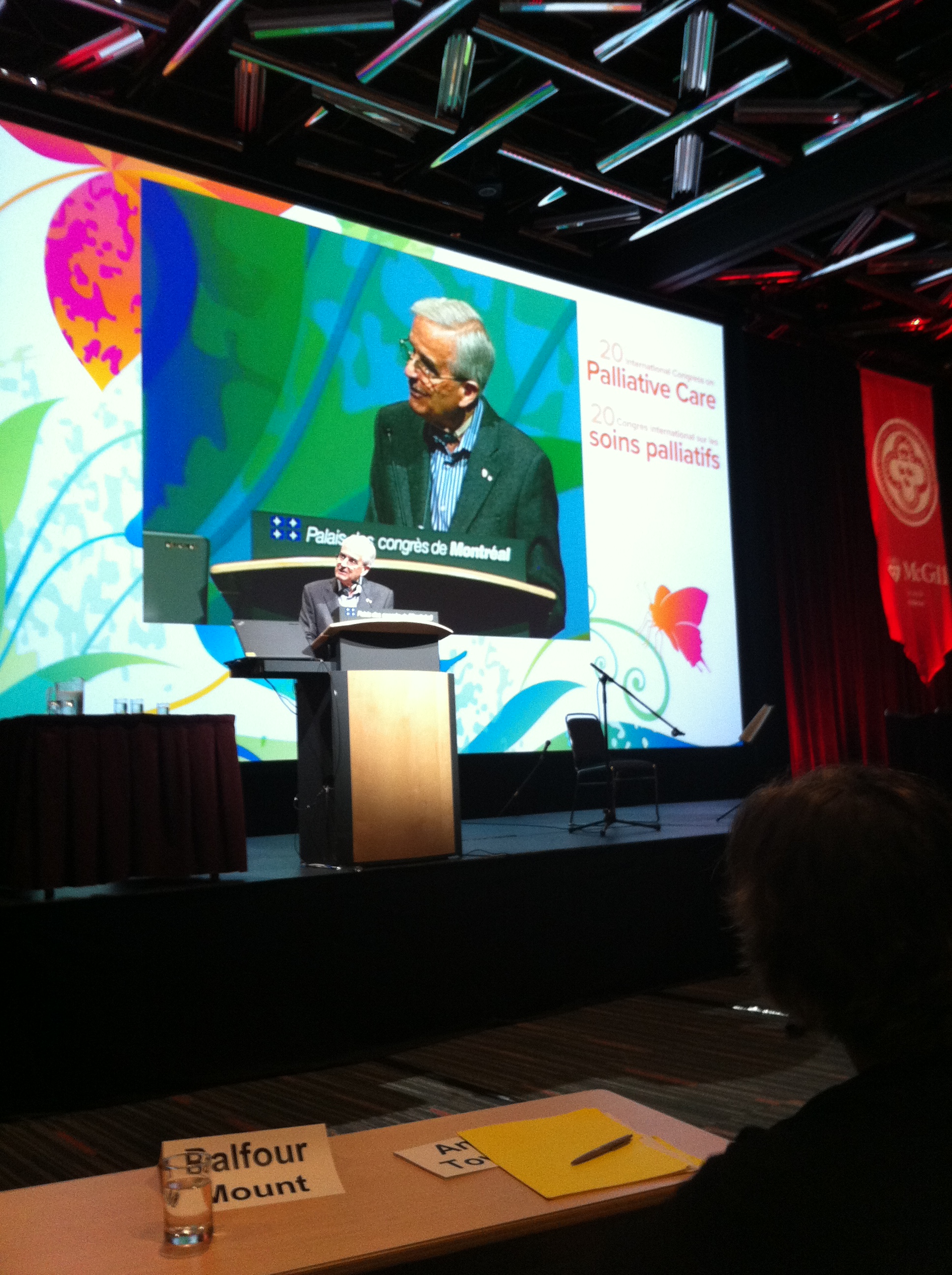
Brief reflections from Montreal – plus a selection of posters!

Balfour Mount 1

The 20th International Congress on Palliative Care was held in Montreal, Canada between 9-12 September 2014. Overall, it was a wonderful conference with:

  • Thought-provoking plenaries and masterful workshops
  • Knowledgeable speakers and engaged audiences
  • A wide range of parallel sessions covering diverse topics from basic pharmacology to service delivery and development to spirituality, psychology and ethics, catering for every member of the palliative care team
  • Wonderful moments of reflection
  • Opportunities to meet new friends and catch up with old colleagues

… all set in the beautiful city of Montreal, which had a decidedly European feel to it, with all the cobblestoned streets in Old Town, as well as the rapid-fire French in our ears. Continue reading
Top 5 advances in Oncology… what’s your vote?

Undoubtedly the practice of palliative care has radically changed and continues to be influenced by the development and use of new, biological agents in cancer. Medscape has surveyed health care professional for their views on the top 5 advances in Oncology in the last 50 years. Can you guess? Do you agree with their choices? The below is taken from http://www.medscape.com/viewarticle/831867?nlid=65887_2201

Continue reading

How to participate in #hpmJC – palliative care Twitter journal club

Interested in Twitter journal club but not sure what it’s all about? Keep reading.
The next #hpmJC will be held on 29th September 2014, 10pm AEST (noon GMT). It will be hosted from the UK by Dr Ollie Minton (@drol007). The article to be discussed is Diagnosing dying: an integrative literature review, by Kennedy et al. It’s available via open access from BMJ Supportive and Palliative Care.

Twitter journal club is a regular (approximately monthly) “tweet chat”. Unlike a traditional journal club, participants are located all over the world, giving a global perspective to the discussion and sharing their local practices. Sometimes the study authors participate!You don’t need a Twitter account to watch the discussion – simply go to twitter.com and type #hpmJC into the search bar in the top right-hand corner of the page. An even easier option is to visit a website like tweetchat.com or tchat.io – these websites automatically update when anyone tweets with the #hpmJC hashtag. Again, you don’t need to sign in to use these websites.

Continue reading

Striving for better research: Transparency, reproducibility, robustness

Transparency, reproducibility, and robustness… These are central concepts to undertaking thorough research that, importantly, can be replicated or reliably used by the broader field of science to advance medicine… or whatever field it is that we choose to dabble in.

The world’s most influential (i.e. ‘highly cited’) scientific journal Nature, with its impact factor of no less than 38.597 (Thomson Reuters, 2013), has drawn light to “the worrying extent” to which our research “have been found wanting” in terms of reproducibility.

It’s an interesting idea. While our research may be robust enough to pass the test of a reviewer, does it ensure sufficient transparency for reproducibility? And if indeed it’s not reproducible, how can we ever know it’s false?

Have a read: go.nature.com/huhbyr

Elsewhere in the Palliverse – Weekend Reads

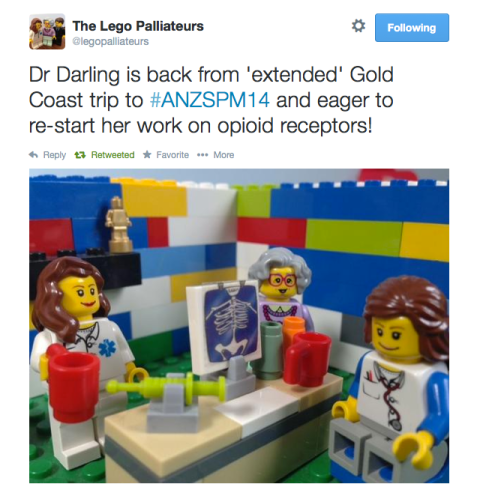
Hot on the heels of the @LegoAcademics come the @LegoPalliateurs. I think these Lego accounts are all the reason you need to try out Twitter!

legopall

Continue reading

Palace of Care

image

Hi everyone,

Join me in sharing stories from the lighter/brighter side of Palliative Care.

Cheers,

James

Homelessness in palliative care

Thanks to Michael Bramwell, from Melbourne City Mission, for the following slides:

Homelessness in palliative care

Sonia learns a new word and hopes to impress her colleagues

It’s always a great pleasure to learn a new word and I had such a pleasure this week with “analgesia dolorosa”. In fact, two new terms as it’s also known as analgesia algera.

A pain specialist colleague (thanks C) used the term in reference to a patient who had presented with chest wall numbness and such severe nipple pain on light touch that he has difficulty wearing shirts. He went on to be diagnosed with a metastatic malignancy infitrating his thoracic vertebrae.

So, analgesia dolorosa is different from hyperalgesia which is an increased pain sensation from a normally painful stimulus, and I guess a variation on allodynia which is pain from a normally non painful stimulus.


Drop it in to a ward round near you and amaze your colleagues!


Sonia

Elsewhere in the Palliverse – weekend reads

The recent death of comedian Joan Rivers has brought end-of-life issues to the forefront. Kübler-Ross collaborator David Kessler wrote a piece in the Huffington Post on “Melissa Rivers’ Courageous Decision” to take her mother “off life support”. He gives advice to families going through the same decision-making process. Joan Rivers’ funeral plans, which she wrote about in a 2012 book, have also been getting wide coverage in the mainstream media. (Huffington Post, USA Today, news.com.au)

Nicholas Talley, President of the Royal Australasian College of Physicians (home to the Australasian Chapter of Palliative Medicine and therefore all palliative medicine specialists and trainees in Australia and New Zealand) has called for Australian governments to invest in and support further clinical trials into the benefits and risks of medicinal cannabis. In his piece for The Age, he speaks of humanity, compassion, patient-centred care and evidence-based medicine. (The Age)

Continue reading

#ANZSPM14 Conference Transcript

Team Palliverse are working on a post about the excellent content presented at the Australian and New Zealand Society of Palliative Medicine 2014 Conference that wrapped up yesterday. In the meantime you may wish to catch up on tweets via the #ANZSPM14 transcript (via Symplur)