Unknown's avatar

About soniafullerton

Palliative physician, mum of three.

Social media – health care hashtags

Greetings dear readers,

You may have caught up with past posts such as Twitter 101 and Twitter 102.

But, you may ask, how do I know which hashtags will be interesting for me?

Wonder no more. Here is a list from Symplur of healthcare hashtags.

The ones I look at are #HPMglobal (hospice and palliative medicine global), #HPM (you can work that one out), #HCLDR (health care leaders), #HCSMANZ (health care and social media Australia and New Zealand). There are some patient-centred ones I dip into like #BCSM (breast cancer social media) and #LCSM (lung cancer social media).

Continue reading

ANNOUNCEMENT – palliative research scholarship in Victoria AND travel grant

Research Masters or PhD Scholarship
The PCRNV will be offering a Masters or PhD scholarship in 2015 for Victorian students that are able to conduct high quality research into palliative care leading to immediate patient benefit.
The scholarship holder will be supported at his/her full salary for the duration of a full-time PhD (three years) or Masters (two years) to undertake research in palliative care. The successful applicant: will be enrolled as Masters or PhD candidate at a Victorian University; will have the majority of the research funded by the PCRNV completed within Victoria and; whom the Primary supervisor and applicant/student are based at a Victorian University (co-investigators and/or collaborators may work interstate or internationally).
The scholarship scheme is the result of a partnership between the Victorian Cancer Agency (VCA) and the PCRNV, and is designed to build research capacity in Victoria.
Stipends for the scholarship will be in line with NHMRC rates and are as followed:

Continue reading

updated palliative blogs list from Christian Sinclair at Pallimed

The fabulous Pallimed have updated their list of palliative blogs. Featuring Palliverse!

Or at least, mentioning Palliverse.

Some great blogs here!

http://bit.ly/1EsTeWG

The Palliverse Team

10 days to go and more reasons to come to @SoMebythesea!

10 days to go and more reasons to come to @SoMebythesea!.

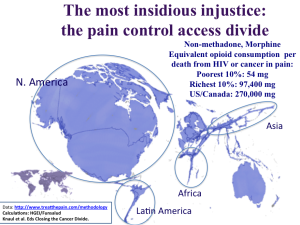
Atul Gawande’s Pain Control and Palliative Care

A thought provoking article by Torrey Ah-Tye about one of my personal heroes, Atul Gawande’s new book “Being Mortal, and what really matters in the end”. Have you read it? I need to get my hands on a copy…
sonia

Torrey Ah-Tye's avatarThe Vishuddha Journal ☼ 维苏达日记

pain_divide_cartogramThe ever affable author, doctor, and notable writer of “The Cost Conundrum,” article in the New Yorker back in 2009 (available here), instigating a movement posing serious questions and critiques of the U.S. healthcare system, has now endorsed Pain Control and Palliative Care.

Topically related to his new book, Being Mortal, and what really matters in the end, in honor of World Hospice and Palliative Care Day, which takes place tomorrow, on October 11, he released the following statement:

Dying and death confront every new doctor and nurse. The first times, some cry. Some shut down. Some hardly notice. When I saw my first deaths, I was too guarded to weep. But I had recurring nightmares in which I’d find my patients’ corpses in my house—even in my bed.
I felt as if I’d failed. But death, of course, is not a failure. Death is normal. Death…

View original post 539 more words

legal aspects of end of life care

This helpful MJA article by an Lindy Willmott et al, describes several relevant Supreme Court cases concerning end of life decisions.

It gives us some themes found in the various decisions made:

-Futile medical treatment is not in a patient’s best interests.

-Treatment that is overly burdensome is not in a patient’s best interests, even if the patient is unconscious or unaware of treatment burdens.

-Courts have generally not engaged expressly in quality-of-life assessments, but they remain relevant for determining best interests when considering the patient’s medical condition and prognosis.

-A patient’s wishes and values (gleaned when the patient was competent) are relevant to, but do not determine, his or her best interests. Family members’ views may also be relevant where they are reflecting a patient’s wishes, and perhaps also when reflecting their own wishes, but these views are not conclusive in determining a patient’s best interests.

-The interests of other people and organisations (including the wider health system) are generally not relevant when determining a patient’s best interests.

-Courts have generally deferred to medical practitioners’ opinions about treatment decisions, even when the patient’s family has strongly opposed them.

Have you had any sticky end of life issues recently and crossed paths with our legal brethren?

Sonia

The first conversation

He does not want to talk to me, that much is clear. He has had enough of doctors. He is a man of few words. His eyes do not meet mine. His coarse, calloused farmer’s hands play purposelessly with the starched white of the hospital bed sheet. The gentle hiss of his oxygen is barely heard over the hum of the city traffic below.

Out of his element.

“Tell me, what have the doctors told you about your medical condition?”

A useful question. I need to know how much he knows about his cancer. Not just what he knows, but what he doesn’t know and importantly, what he wants to know.

I have three cancers, he tells me. Lung cancer and brain cancer and bone cancer. The treatment isn’t working. There’s nothing more they can do for me.

A good start. I hit the last bit first. There is always something we can do for you, I say. It’s true, we can’t cure your cancer. But I want to talk to you about the pain you are getting, and the cough. Are there any other symptoms you’d like me to think about? I pick up a few new symptoms that have not been discussed before; low mood, low appetite, altered taste. He becomes more animated. We discuss treatment options and come up with a plan.

I am under some time pressure as he is to be discharged later today, back to the country, several hours drive away. I have fifteen other patients to see. I need to work fast while appearing to work slow. I elect not to correct him on there being three different cancers as I have other things I want to tackle first.

It’s a big ask for a man without high levels of health literacy and education who has just had shocking news. This is my challenge — to put information into terms that he can understand and remember. I pull out a piece of paper to summarize what we have talked out as I go.

Sometimes, often, my agenda is different to the patient’s; it’s good to be aware of this. My agenda today is to talk to my patient about dying and end of life care. He will probably not see another specialist in palliative care in the future.

“Are there any other questions you would like to ask me? Anything that’s worrying you that we have not talked about?”

No, he says. Yes, he means. He looks away. I wait. It’s harder than it sounds. I am better at talking and listening than silence. Silence is a tool, I remind myself. I count to ten very slowly.

I would rather not do this now, but I won’t see him again. Would you like to talk to me about dying?

“I saw my mum die,” he tells me. It was a bad death, with confusion, pain. We talk about his mother’s death. Often, care for the dying is not just about the person, it lives on in memories of those who watched, for decades.

We move on to the specifics of what is likely to happen to him in the next few weeks, the plans to manage his care. Oxygen. Don’t smoke with oxygen. Medications. Who to call if things go wrong. I reassure him that he should be comfortable, that plans are in place to look after him at home, we will speak to the district nurses and to his family doctor about what he might need. Options for care at home or at the local hospital. We agree he does not want to come back to the city again. He does not want to talk about the actual dying bit so I leave it. I give him the piece of paper with the summary of what we have talked about, and make the same old joke I always make about my bad handwriting. If you have any other questions or worries, please feel free to ask, I tell him.

“Thanks,” he tells me and his eyes meet mine again. “I really appreciate you talking with me.”

“It was a pleasure, “ I say, and mean it.

Sonia Fullerton is a palliative care physician in Australia and can be reached on Twitter @sonialf.
Tell me, which healthcare hashtags should I follow on twitter?

Too easy.

Symplur has come up with this fantastic list of healthcare hashtags.

The Healthcare Hashtag Project

You can search for areas of interest, eg. “palliative”
http://www.symplur.com/search/%23palliative
(Hey! I am 6th in worldwide palliative influencers!!)

I am off to check some of them out!

Sonia

twitter 102 – I know what a hashtag is, what’s next?

Greetings tweeps.
That’s not an insult by the way, a tweep is a person who uses twitter, think twitter/people.

So maybe by now you have had a look at twitter and know what a handle is, i.e. a person’s user name that starts with an @ symbol.
And you know we use hashtags like #palliative to “tag” topics of interest so other people can find them.
Hopefully you have registered and have a handle of your own.

What’s next? Time to dive into the fabulous world of tweetchats. A tweetchat is an event on twitter that can happen as a regular event, or as a one off or occasional event.

One of my favourties is #hpmglobal which is hospice and palliative medicine global. It’s hosted by Prof Jim Cleary (@jfclearywisc) who works at the University of Wisconsin Carbone Cancer Center as an oncologist and palliative medicine physician. He passionately promotes global access to opioids. https://twitter.com/jfclearywisc
Each week at a particular time, which at the moment is Monday 22:00 AEST, he hosts a multidisciplinary discussion which is attended by people interested in palliative care from all over the world, including clinicians in Africa, the Americas, Europe, and of course a strong showing from Australasia.

Your well-run tweetchat has a theme that is decided and promoted on Twitter ahead of time. Examples from the past have included discussions of opioid availability in developing countries, and end of life care policies in your country. It has an international emphasis. Another great chat, #hpm, is terrific but sadly at a bad time for ANZ tweeps, in work hours on a Thursday. See the link below.

The tweetchat hour may be structured like this:
The topic has been announced, often with a link to a blog written by the host of the tweetchat or by the co-host of that week’s chat.
1. restatement of the topic and relevant link
2. introductions
3. topics one, two and three (marked as T1 etc)
4. CT (closing thoughts)
5. Announcement of next week’s topic
6. Sometimes the data analysis of the tweetchat is tweeted

It’s really fun and you meet great people. You are welcome to just listen in and not say too much (“lurk”).

Once you have the hang of this, it’s time to start trying out other twitter related platforms like tweetchat, tweetdeck and hootsuite. These make it easier to follow several conversations at once, and tweet as different identities. So for example, sometimes I tweet as @sonialf and sometimes as @palliverse.

Other tweetchats I enjoy are #hcldr (health care leaders), #hcsmanz (health care social media Australia/New Zealand) and #hpmjc (hospice and palliative medicine journal club).

I hope to see you at 22:00 Monday night, i.e. tomorrow (Melb/Sydney time) for a combined #hpmjc and #hpmglobal. Let us know if you are there as a result of @palliverse!
Here is the tweet about it including the link…
#hpmglobal meets #hpmjc “How good r we at diagnosing dying?” Join @drol007 Mon Sept 29 12n GMT (10pSYD; 1pLON; 8aNYC) http://spcare.bmj.com/content/4/3/263.full.pdf

What is your favourite tweetchat? Let us know in the comments.

Cheers, sonia

Article by Christian Sinclair @ctsinclair about #hpm
http://www.pallimed.org/2014/07/hospice-and-palliative-medicine.html

Call for papers by Palliative Medicine for special edition

Palliative Medicine have put out a call for papers for a special edition focussing on integrated care for people with palliative care needs.

“This proposal for a special edition of Palliative Medicine aims to address the increasingly important topic of integrated care in the context of palliative and end-of-life care service delivery. Integrated care can be defined as ‘an approach that seeks to improve the quality of care for individual patients, service users and carers by ensuring that services are well coordinated around their needs’.”

The deadline is 30 March 2015.

Thanks to @jfclearywisc for posting on Twitter.

Further details from : http://pmj.sagepub.com/content/28/9/1078.full

Cheers, sonia