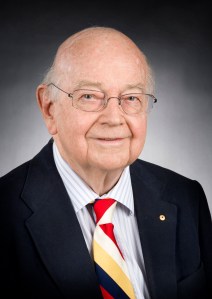
Senior Australian of the Year, Emeritus Professor Ian Maddocks AM, is a true palliative care pioneer. The first president of ANZSPM and the Australian Association for Hospice and Palliative Care (now Palliative Care Australia), Ian also held the first Chair of Palliative Care in the world. In early April, while in Geelong for the Third Annual Papua New Guinea Symposium, he generously agreed to Chi Li’s request for an interview, and then joined other local palliative care practitioners (including old acquaintances Trevor Banks and Rosalie Shaw) for further chats over dinner.
CL How did you become involved in palliative care? I read somewhere that it had something to do with an article you’d read [‘Death of a Daughter’] by Victor Zorza…
IM That was a particular trigger. He was a journalist and his daughter was just in her twenties, I think, when she was dying in the hospice out of Oxford. What impressed me was the way his daughter was so well looked after, which enabled her to assist her parents through a very sad and difficult time, because she felt okay about what was happening to herself.
I said to the people at Flinders Medical Centre in Adelaide, where I was working, that this was something we should do better. My picture at that stage was to have a small palliative care ward at the hospital. They said ‘well we’ve got no room for that.’ So a group of us established a working party, a group of people working together, advocating for better care.
We were able to get a small hospice set up at the hospital up the hill and gradually built it up. We got some funds to employ a researcher to do a very simple study on the palliative care needs of the people dying in southern Adelaide, and used that to lean on the government.
At the same time I was involved in IPPNW [the International Physicians for the Prevention of Nuclear War], travelling quite a lot, and because I was a part time consultant in Flinders and part time in general practice, if I was away I didn’t get paid. What I really wanted was a full time job where I could go away and still get paid. I was explaining this to some friends and they said ‘what about if we get a chair of palliative care?’
So I wrote a brief to the government saying that we needed a Chair of Palliative Care, and they said ‘yeah that sounds all right’. Then I wrote the job statement, then the advertisement, then my application for the Chair of Palliative Care. [Chuckles]
CL Before you became the Chair of Palliative Care, there were already hospices operating in South Australia…
IM The Mary Potter Hospice had been in existence for a long time, but it was perhaps not what you’d now regard as professional palliative care. It was the old fashioned Mary Potter care of the dying, worrying as much about their souls as about their bodies. They had some very good sisters working there. But they only had a visiting GP looking after the place and there wasn’t a great deal of expertise. But as part of this program, we were able to get access to a small ward in an old TB hospital. It wasn’t ideal but it was a start. We had a couple of part time doctors who looked after it until we got the opportunity to start up the Chair, which came with a purpose-built hospice. We were able to design it to suit how we thought a hospice should be.
CL Talking about the Mary Potter Hospice and the purpose-built hospice reminded me of conversations I’ve had with others about the difference between palliative medicine and palliative care. Having recently gone through basic physician training, sometimes I think I focus too much on the medicine and forget about the care side of things…
IM It’s a continuing tension and I don’t think there is a right answer. People do what they feel is appropriate in situations. If you’re going to do research and apply for funding, you have to be fairly hardnosed about it. You’ve got to have data and statistics and so on. On the other hand, the question of writing rigorous standards for palliative care or prescribing particular responses to palliative care situations is pushing it a bit hard. I think you will do well to recognise that a lot of it is intuitive. A lot of it has no right answer. You work through a situation with the patient, the family and the other doctors.
I say to the students that palliative medicine is simply good medicine, the keys to which are a full engagement with the patient, a confiding and trusting relationship, a willingness to listen, understand the patient’s needs, wishes, hopes and fears, then devise sensible strategies using the best available knowledge to satisfy those needs.
But a lot of it is just good management. You take stock of a situation and see what can be done in terms of the patient’s best interest. Where is the best place for them to be looked after? Who is going to care for them primarily? What are their physical, emotional, spiritual needs and how can we meet them? You make it up as you go. So having rigorous guidelines doesn’t seem to me to be particularly appropriate. It’s like saying that there must be a right dose for morphine, which we know is ridiculous. It used to be.
CL I’ve also been thinking about the difference between generalised versus specialised palliative care…
IM That’s another area of great interest. The theme for palliative care this year is that palliative care is everyone’s business. I’m reminded of the geriatricians who ring me up and say: ‘I’ve got this patient who’s dying. Would you look after them?’ I say: ‘why don’t you look after them?’
There is a bit of a tendency in the private hospital scene for me to get referrals from respiratory disease, cardiac disease, geriatricians, neurologists – for people that they should really look after themselves. They seem to think that palliative care has got a magic around it somehow. But in fact it’s just good medicine. It’s just doing the right thing.
If we made palliative care more everybody’s business, if the communities are more aware of it, more ready to accept the realities of terminal illness, to talk about it in advance, what they wanted and what they didn’t want, and if the GP’s were ready to pick up what they can do in terms of managing home care – then palliative care would remain a special consulting service for people with special needs. I don’t think it’s appropriate that palliative care should take over all dying.
CL When you decided to get into palliative care, did you seek any specific training? Or was it just learning from doing?
IM Yeah, I just picked it up. There were no courses available to me. My first few days in the hospice, I was on call, and the nurse said: ‘what do you reckon?’ We worked it out. And I read. And I spent some time in the UK fairly early on. I went to St Christopher’s, Eric Wilkes in Sheffield, Edinburgh, St Oswald’s in Newcastle, a hospice in York… just had a look around and saw what people were doing.
It must have been soon after I had the chair, because I remember the Dame [Cicely Saunders at St Christopher’s] looking down her nose at me thinking: ‘who’s this upstart from Australia who’s got a chair? Who is he? Never heard of him!’ [Chuckles] What impressed me the most about her was her persistence and vision. She knew as a young nurse that care for the dying was what she wanted to do and sustained that through further training in social work and medicine over decades. She was an important example and mentor for many.
CL It’s been twenty years since the first meeting of palliative medicine practitioners in Adelaide, which led to the formation of our society. Amongst other things, the delegates were enticed with the offer of ‘spartan college accommodation for two nights at $28 per night’. What do you remember about that first meeting?
IM A good spirit and excitement in forming a fellowship and a body to promote what we had come to believe in. I sent out a letter, I think, invited people who were interested to come to Adelaide. We had a meeting at Lincoln College, which was just across the road from where I lived. Most memorable was the disastrous dinner that Michael Ashby arranged at a local hotel – the chef walked out just after we had made our orders. A bad meal!
We managed to get about thirty-odd people from different parts. We had some talks, a mini-conference, where people gave presentations about things they were interested in. There was also a business meeting where we elected office bearers and set up the organisation.
It was important to know that you were practising as part of a special group. Linked with the opportunity to do distance study in palliative care, which we offered from Flinders, that enabled people to get up enough points to get foundation fellowship when we finally got the Chapter established with the college [the Royal Australasian College of Physicians]. So ANZSPM was a good forerunner of that, helping people through their conferences, keeping their spirits up, knowing that they were into something that was worthwhile.
CL Finally, although I’m sure you’re sick of this question: what does being the Senior Australian of the Year mean to you?
IM It’s made me busy, that’s all. I’ve been asked to do all sorts of stuff. There was an email today: could we do a tour of schools, talk about the importance of being Australian, with one of the other award winners… School one school two lunch school three, next day school four school five. So you just stand up… You can’t say no… [Chuckles]
If anything, it’s given me an opportunity to be heard a little more widely and often than I would otherwise have anticipated. The challenge is: what to say? I’m supposed to give a breakfast talk to parliamentarians in Canberra in palliative care week. [See: http://www.youtube.com/watch?v=ZGNZA_Fg5KQ] That’s serious, trying to tell them how to watch over… keep good policies up with palliative care. So there are some useful things to do.
Article first published in the Australian and New Zealand Society of Palliative Medicine Newsletter Volume 25 Issue 2 July 2013.

 palliverse.com