Team Palliverse is excited to be presenting at the upcoming Palliative Care Research Network Victoria (PCRNV) Forum on March 24th at 5pm AEDT (2pm AWST; 7pm NZDT). We will be talking about the use of social media in palliative care research and clinical practice. Join us in person, via webinar or on twitter!
Like @Elissa_Campbell, five weeks ago, rather than starting a new clinical rotation at the beginning of the medical year, I too embarked on a research fellowship. For the next twelve months, instead of trying to fit in training requirements and research projects around clinical duties, I have the luxury of being able to devote pretty much all of my time to thinking and learning about research, reading studies properly instead of quickly scanning through papers, and talking to other researchers and clinicians – who are almost always encouraging, interested and incredibly generous with their time and advice.
The Centre for Palliative Care is the academic arm of the palliative care service based at St Vincent’s Hospital, Melbourne. It is a collaborative centre of the University of Melbourne and has a goal and vision to enhance palliative care provision through enhancing research and education in the state of Victoria, Australia.
As such, the Centre has a significant research output with both clinician and academic researchers in the programs of:
Hospice New Zealand is once again presenting a lecture series on palliative care this year. The lectures are held on the first Thursday of every month at 7:30am NZDT/NZST and are available by teleconference at various sites across New Zealand. The first lecture on nausea and vomiting was delivered last week by Dr Michael Downing.
You can also listen to lectures from the previous series by simply registering here. Awesome!
Have you connected, communicated or collaborated with anyone via the database so far? We’d love to hear about it! Please send us an email at: Palliverse@gmail.com
Merry Christmas and Happy New Year from the Palliverse Team
The Bethlehem Griffiths Research Foundation provides funding support to scientists and health professionals undertaking research projects in the areas of palliative care and progressive neurological diseases.
Applications for 2016 project/equipment grants between $20,000 and $50,000 are due in June 2015. Details can be found here.
Applications for 2015 PhD scholarships are due on 6th February, 2015. Details can be found here.
The baby boomers are growing old and in the next 25 years the number of Australians who die each year will double. People want to die comfortably at home, supported by family and friends and effective services.
But more than half of Australians die in hospital and about a third die in residential care. Sometimes they have impersonal, lingering and lonely deaths; many feel disempowered.
Grattan Institute’s new report, Dying Well, released today, sets out how we can improve the quality of dying in Australia. With an investment of A$237 million, we can double the number of people who are supported to die at home – and the same amount could be released from institutional care spending to pay for it.
Institutionalised death
Over the past 100 years, home deaths have declined and hospital and residential care deaths have increased. Even over the past decade, the hospitalisation rate for those aged over 85 increased by 35% for women and 48% for men. Hospitals and residential care – nursing homes – are the least preferred places to die.
Around 70% of Australians want to die at home, yet only 14% do so. People die at home at twice this rate in New Zealand, the United States, Ireland and France, partly because of the differences in support systems.
Adapted from Broad et al 2013.
Deaths for younger people are now rare; about two-thirds of Australians die between the ages of 75 and 95. These days older people are more likely to know when they are going to die in the relatively near future. But we are not taking the opportunity to help people plan to die well.
When asked, most people have clear preferences for the care they want at the end of their life. But rarely do we have open, systematic conversations that lead to effective end-of-life care plans. Most people do not discuss the support they would like as they die.
Dying at home puts pressure on families and informal care, and this pressure is exacerbated in the absence of good support systems. With social change and increased population ageing, the carer ratio – the number of people who need a carer to the number of people who have one – is falling. Already, a significant proportion of dying people do not have a carer.
The result of these problems is that many experience a disconnected, confusing and distressing array of services, interventions and relationships with health professionals. They also end up dying in the very places they expressed a preference not to.
Towards better deaths
A good death gives people dignity, choice and support to address their physical, personal, psychological, social and spiritual needs. As we outline in Dying Well, this would happen more often with three reforms.
First, we need more public discussions about the limits of health care as death approaches, and what we want for end-of-life care. Public education campaigns are a well-established way of promoting change. A national public education campaign would focus on encouraging people to discuss their preferences and choices for end-of-life care with health professionals, including GPs.
Second, individuals need to plan better to ensure that our desires for the end of life are met. Too often we have not appointed someone we trust to make health care decisions when we are unable to, nor set out our wishes for treatment when there is little chance of recovery.
We need trigger points as we get older to remind us to have a conversation about what we want in terms of end-of-life care. Potential trigger points are:
hospital in-patients assessments that conclude the person is likely to die in the next 12 months.
Dying at home puts pressure on families, and this is exacerbated in the absence of good support systems. De Visu/Shutterstock
Third, services for those dying of chronic illness, such as cancer or heart disease need to shift their focus from institutional care and often unrealistic attempts at cures to supporting people’s preference to die at home and in home-like settings, in less pain.
The burden on carers can be reduced by providing more coordinated home care services for dying people including access to personal care and practical support, and symptom management for pain and nausea. Such services will become increasingly important as the number of informal carers declines as a result of more women working and smaller family size, among other changes.
Greater investment
If more people are to die at home, investment in community-based support is needed. Doubling the number of people who are supported to die at home will cost A$237 million a year. However, about the same amount could be released from institutional care spending to pay for it.
Contrary to widespread assumptions about the cost of end-of-life care, only about A$5bn a year – about 5% of the health budget – is spent on the last year of life. Admittedly this spending is only for about 1% of the population who die each year, so the cost per person is high. But less than A$100 million is spent on helping people to die at home. A change in focus will be cost neutral, and help more people to die well.
When death comes for each of us, we want to die comfortably, in surroundings we choose. We need the courage to promote mature discussions about a topic we may dislike but cannot avoid if we are to have better deaths in Australia.
The authors do not work for, consult to, own shares in or receive funding from any company or organisation that would benefit from this article. They also have no relevant affiliations.
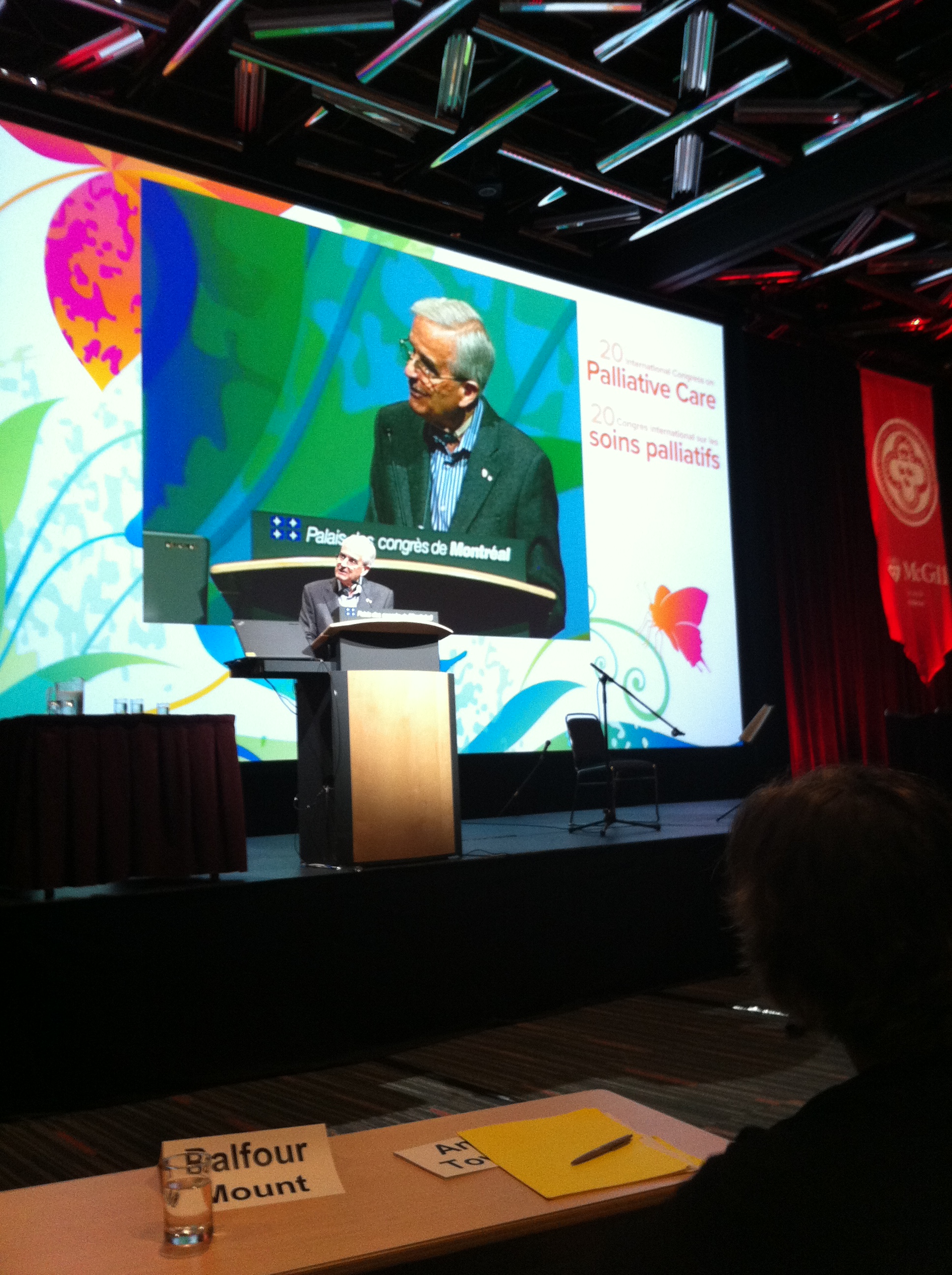
The 20th International Congress on Palliative Care was held in Montreal, Canada between 9-12 September 2014. Overall, it was a wonderful conference with:
Thought-provoking plenaries and masterful workshops
Knowledgeable speakers and engaged audiences
A wide range of parallel sessions covering diverse topics from basic pharmacology to service delivery and development to spirituality, psychology and ethics, catering for every member of the palliative care team
Wonderful moments of reflection
Opportunities to meet new friends and catch up with old colleagues
… all set in the beautiful city of Montreal, which had a decidedly European feel to it, with all the cobblestoned streets in Old Town, as well as the rapid-fire French in our ears. Continue reading →






 palliverse.com